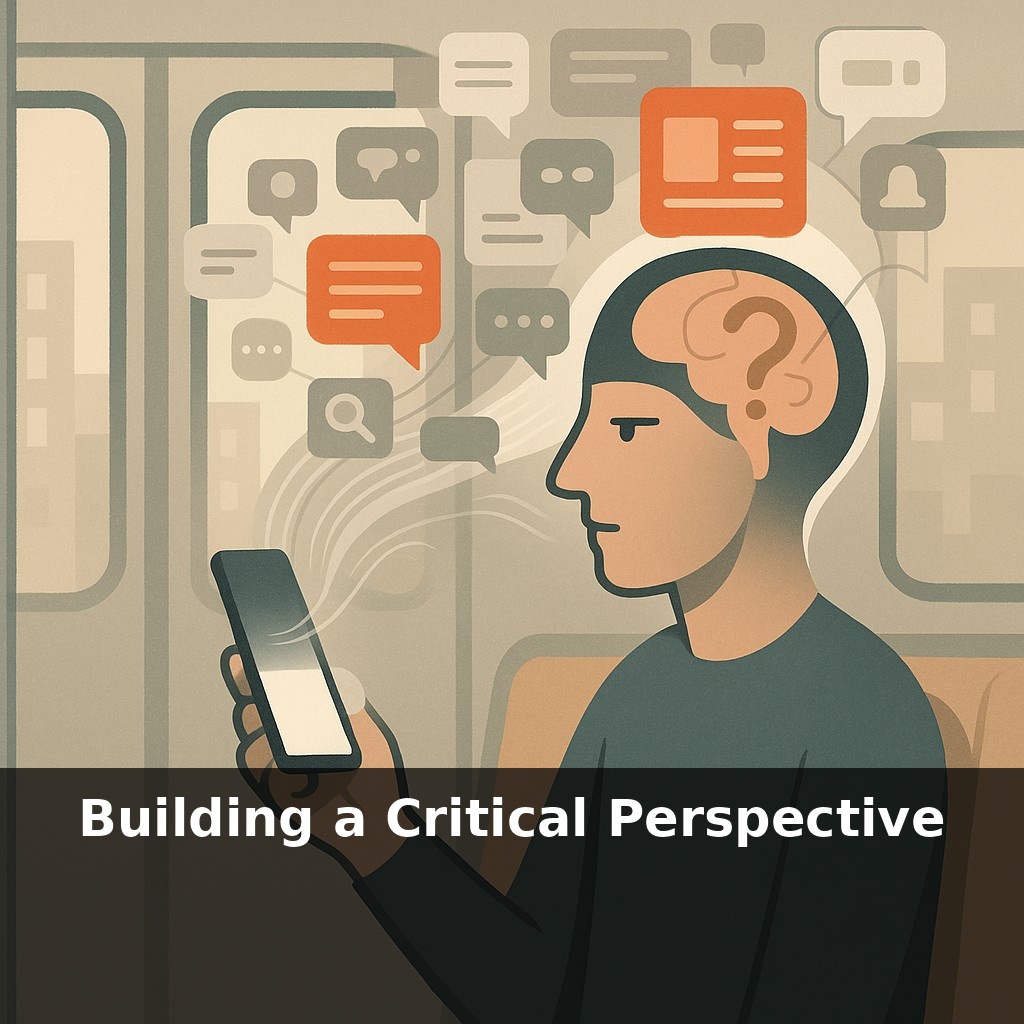
About half of what you scroll past each day isn’t news, it’s someone’s opinion dressed up *as* news. You’re on the train, half-listening, half-scrolling—and that one heated headline slips straight into your beliefs before you even tap it. How many of those slip through daily?
You spend over 7 hours a day swimming in digital media, but almost none of that time is spent asking, “Who benefits if I believe this?” That missing question is the core of a critical perspective. Headlines aren’t just information; they’re products competing for your attention, your outrage, and your loyalty. A 2020 Pew study found only 26% of Americans could reliably tell news from opinion in headlines—yet every headline still shapes what feels “normal” or “obvious” to us. Add algorithmic feeds that quietly reward whatever keeps you clicking, and you get a system where emotional, polarizing, and overconfident content rises fastest. Building a critical lens isn’t about becoming cynical; it’s about learning to see three layers at once: the source (who’s talking), the structure (how it’s framed), and your own mind (why it feels so persuasive right now).
In practice, that means shifting from passive scrolling to active analysis. Start by treating each post or clip as a claim that needs a quick stress test, not a truth by default. Ask: what concrete evidence is shown, and what’s merely asserted? A screenshot, a chart without a source, or a dramatic anecdote is weak support on its own. Look for named data (e.g., “Pew, 2020, n=10,300”), specific dates, and methodologies you could actually check. When those are missing, downgrade your confidence—especially if the content is short, viral, or shared by accounts posting more than 10–15 times a day.
A practical critical perspective has three working parts: source habits, content breakdown, and bias-aware reflection. Think of them as skills you can drill, not traits you either have or don’t.
Start with *source habits*. Make a short list of 5–10 “go-to” outlets you’ll actually check when something matters—ideally mixing at least 2 international outlets, 2–3 with different political leanings, and 1–2 topic specialists (for health, economics, tech, etc.). When a strong claim pops up, your first move isn’t “Do I agree?” but “Has any outlet on my list reported this?” If a claim only appears in low-credibility spaces, lower your confidence sharply. As a rule of thumb: if a story is supposedly huge but only visible on tiny accounts with under 10,000 followers, treat it as unconfirmed at best.
Next is *content breakdown*. Take the piece apart into at least four elements: 1) **Claim:** what is the most specific, checkable statement? (“X law will ban Y starting in 2027,” not “Freedom is under attack.”) 2) **Evidence:** count actual links, named experts, and original documents. A 1,500-word article with 0–1 verifiable sources is weak; 5–7 independent sources is stronger. 3) **Framing moves:** note 3 things: who gets quoted, what baseline comparison is used (last year, another country, a different group), and what numbers are missing. If you see “crime is exploding” without a time span, ask, “Compared to when?” 4) **Economic/technical context:** is this paywalled, sponsor-tagged, or boosted as an ad? Is it formatted for shares (short, provocative, image-first)? Each of these increases the odds that attention, not accuracy, is the main goal.
Finally, *bias-aware reflection*. Before sharing, rate your own reaction on a 1–5 intensity scale and name the emotion: anger, fear, pride, disgust, or delight. Then ask two questions: “If this supported the ‘other side,’ would I scrutinize it more?” and “What evidence would actually change my mind here?” If your answers are “yes, I’d be harsher” and “nothing,” you’re not analyzing—you’re defending a tribe.
Finland’s example shows this can be trained: they start media-literacy in kindergarten for under €9 per student each year. You can mirror that by turning these three steps into tiny, repeatable drills rather than once-in-a-while efforts.
Open your feed and pick one viral post about health, money, or politics. Now run it through a 3-step micro-drill.
**1) Source habits in action:** Say you see a claim that “70% of small businesses will close this year.” Spend 90 seconds checking 3 outlets from different countries or leanings. If none mention it, drop your confidence to “unlikely” until harder data appears. If 2–3 credible outlets cover it with similar numbers, upgrade it to “plausible but evolving.”
**2) Content breakdown with numbers:** Take a 60-second video: count concrete facts vs slogans. If you can’t list at least **3 specific, checkable claims** (“filed in 2022,” “survey of 2,000 people,” “law affects 12 states”), treat it as commentary, not reporting.
**3) Bias-aware reflection drill:** For one week, pick **2 posts per day** that hit you hardest. For each, write a single sentence: “If this story favored my least favorite group, would I still share it?” If the honest answer is usually “no,” you’ve found a bias pattern worth tracking.
In 2028, at least 30 countries are scheduled to run major elections while AI tools make it trivial to fabricate convincing speeches, photos, and “leaks” at scale. Expect platforms to add provenance panels, trust scores, and “how this reached you” overlays, but these will lag behind new manipulation tactics. Treat your drills as future-proofing: aim to verify 3 big claims per week from independent outlets. Over a year, that’s 150 practice reps—enough to noticeably sharpen your judgment.
Your goal isn’t perfection; it’s raising your “skepticism threshold” by a notch. Try this: for the next 10 major stories you encounter, consciously pass on sharing at least 3 that you *can’t* verify across 2 independent outlets. That alone cuts your risk of amplifying false or distorted claims by roughly 30%—a powerful personal filter in a noisy system.