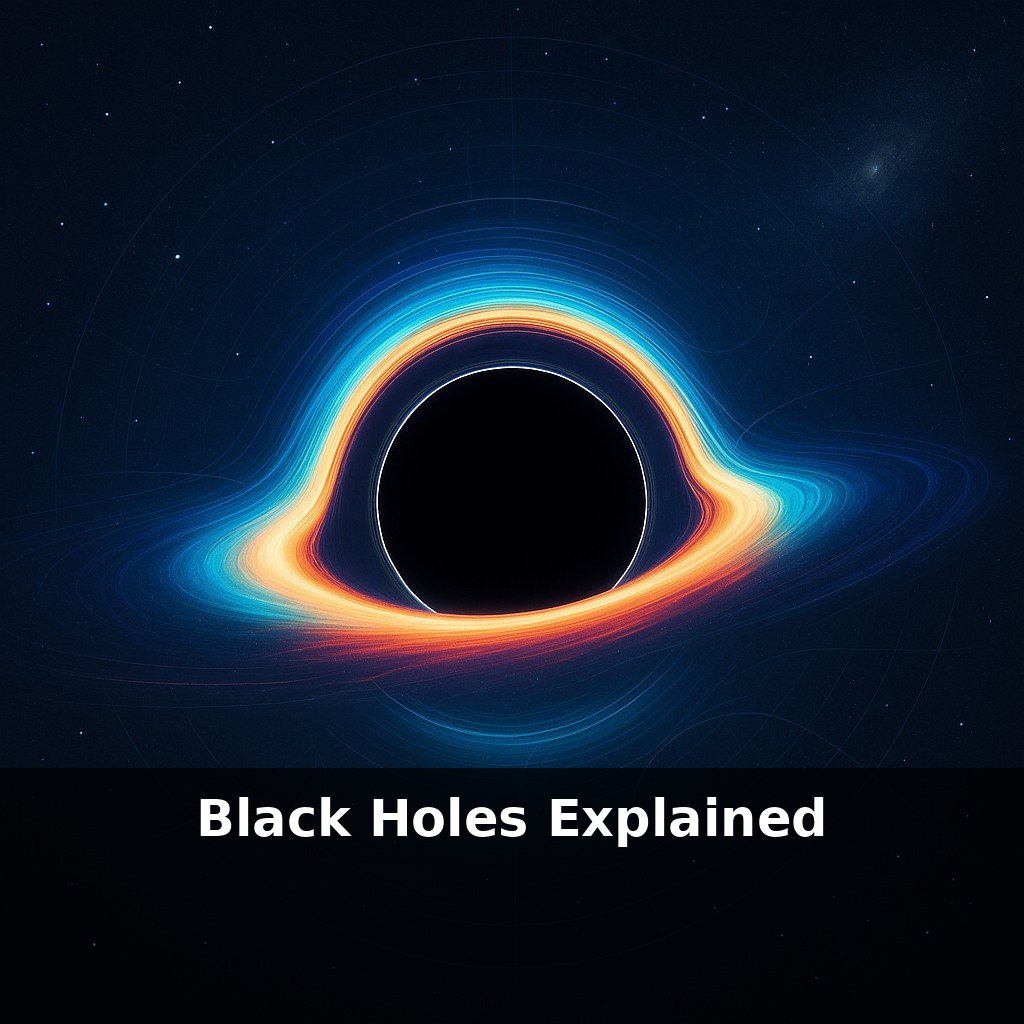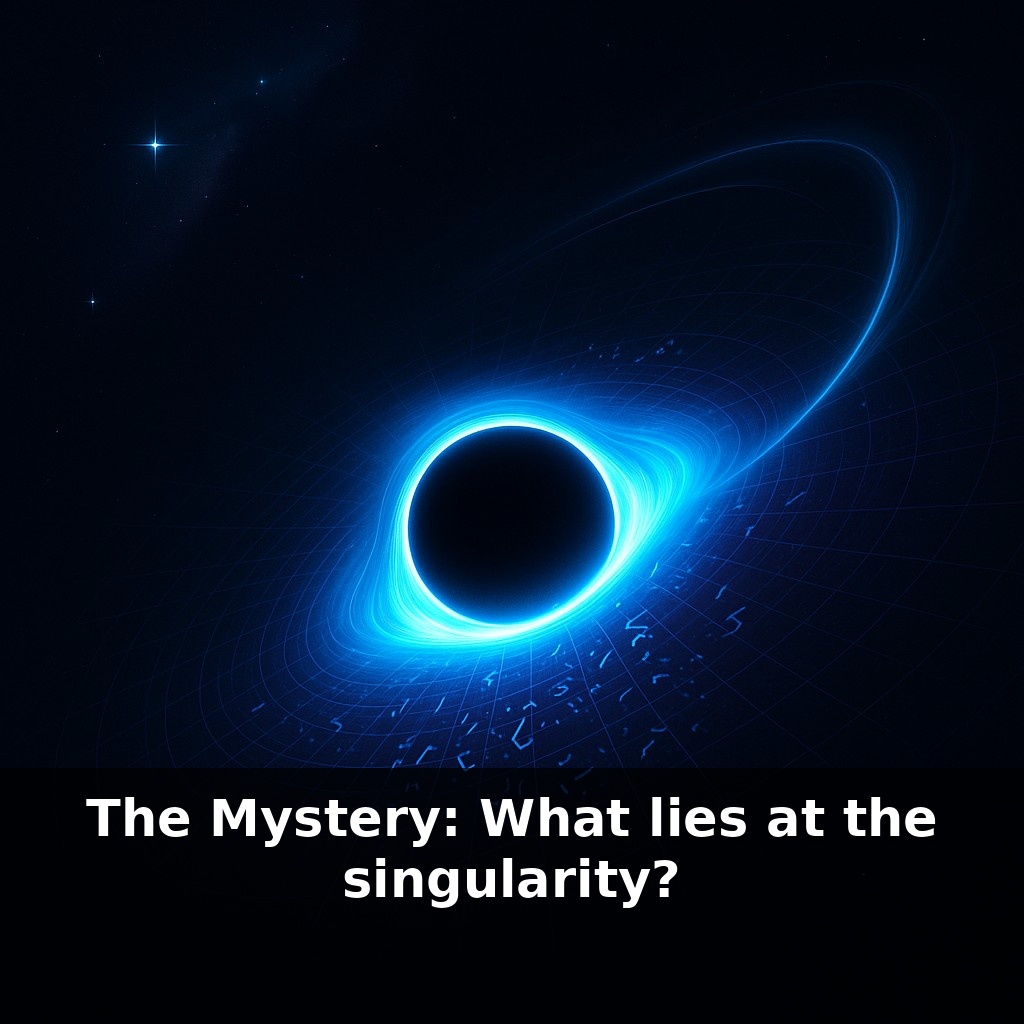
A place in the universe may exist where “infinite” stops being a math trick and becomes a physical address. A star collapses, gravity wins, and our best theories start arguing with each other. At the very center of a black hole, the laws of physics… simply disagree.
At the heart of this disagreement sits a single, loaded word: **singularity**. On paper, it’s where density and spacetime curvature blow up to infinity. In practice, it’s where our trust in the equations runs out. General Relativity draws a sharp point and labels it “here be dragons,” while Quantum Mechanics insists the universe never allows perfect points or infinities—only smallest-but-finite chunks of space, time, and energy.
That tension is why so many physicists suspect the “point” isn’t really a point at all. Instead, the collapsing matter might be squeezed into an ultra‑compressed, quantum‑gravitational phase of spacetime itself: a region where geometry fluctuates violently and familiar ideas like distance, direction, and even “before” and “after” start to lose their meaning. Our task is to guess that hidden interior from the only clues we’re allowed to see: the horizon’s edge and the ripples it sends into the cosmos.
The puzzle gets sharper once we attach numbers to it. Take the **Schwarzschild radius**: squeeze Earth into a sphere just 9 millimeters across and it would qualify. Cross that boundary and every possible path leads inward; not even light can chart a way back. Deeper in, densities race toward the **Planck scale**, where any smooth description of spacetime should fail. That’s the regime a full theory of **quantum gravity** must handle. To test our guesses, we watch from outside: LIGO catching black‑hole mergers, the Event Horizon Telescope sketching the shadow of M87* in exquisite detail.
Start with a black‑hole collapse in slow motion. As the stellar core shrinks, gravity amplifies every tiny wrinkle in spacetime. The classical calculation says: keep going and those wrinkles diverge to infinity at a precise point. But most physicists now treat that “infinity” as a red warning label on the math, not as a real physical state. The real question becomes: *what replaces it once quantum rules take over completely?*
One camp, **loop quantum gravity**, suggests that spacetime itself is woven from discrete loops. When matter collapses far enough, that weave refuses to compress beyond some critical density. Instead of a point, you get a ultra‑compact core whose quantum pressure counters further collapse. In some models, this core can eventually rebound, turning the interior into a kind of one‑way transition from collapse to expansion. From the outside, the object still behaves like a standard black hole for a very long time; inside, the story is more dramatic.
A related idea is the **Planck star**: a minuscule, extremely dense core buried deep behind the horizon. Over unimaginable timescales, quantum effects could let information and energy leak back out, perhaps via a final, explosive phase after the black hole has slowly evaporated. That would turn the “forever lost” character of infalling matter into “temporarily inaccessible,” potentially easing the information paradox without exposing any violations of known physics at observable scales.
String‑theory‑inspired pictures add more options. In the **fuzzball** proposal, especially studied for certain idealized black holes, there is no empty interior at all: the entire region is filled with tangled strings and branes. The horizon we calculate from classical equations becomes an effective surface hiding an intricate microstructure. Different microstates would look nearly identical from afar, but would encode the detailed information of whatever formed the hole.
Each of these scenarios must answer the same hard test: match the exquisitely clean signals from LIGO’s mergers and the sharp outline of shadows like M87*. Any viable replacement for the classical singularity has to impersonate a traditional black hole almost perfectly at the scales we can probe, while quietly rewriting the script in the unobservable depths.
Think of how doctors study the brain: they can’t peel it open in a living patient, so they infer structure from EEG traces, MRI scans, and how people behave. Black‑hole interiors get similar “remote diagnostics” from our best instruments. When LIGO caught GW150914, the precisely damped ringing after the merger behaved almost exactly like a smooth, featureless horizon settling down. Any sharp internal structure—say, a hard surface or layered core—would likely imprint tiny “echoes” in that gravitational ringtone. Teams have searched those data for delayed repetitions; so far, nothing conclusive.
On the imaging side, the Event Horizon Telescope doesn’t just deliver striking pictures; it constrains how wild the spacetime just outside can be. If quantum effects puffed up the interior too much, the silhouette size and brightness pattern around M87* would stray from predictions. Future arrays, adding space‑based radio dishes, may sharpen this test, letting us rule out whole families of exotic cores long before we know which specific replacement for the singularity is right.
A successful theory of what replaces the “point of no return” won’t stay confined to astrophysics. It could recast the early universe as a lab for extreme phases of spacetime, much like ice, water, and steam reveal hidden rules of H₂O. That, in turn, might hint at new cosmic ingredients now labeled “dark.” Closer to home, engineers watch closely: insights from quantum‑spacetime models could inspire unconventional architectures for quantum computers or ultra‑precise navigation systems.
So the “mystery point” becomes less a dead end and more a research frontier: a place where new particles, hidden symmetries, or even alternate cosmic histories might quietly reside. Like a composer hearing harmonies inside a single note, physicists mine each merger and shadow for subtle overtones that hint at the unseen structure beneath spacetime’s loudest chords.
To go deeper, here are 3 next steps: 1) Pull up the free online copy of Roger Penrose’s *The Road to Reality*, skim Chapter 17 on singularities, and jot down 3 questions you’d love to ask Penrose about how spacetime “breaks” at the singularity. 2) Open the interactive “Black Hole Simulator” at NASA’s Imagine the Universe (or the “Black Hole Flight Simulator” from Pearson) and play with mass/spin settings for 10 minutes to see how event horizons and photon spheres shift, then screenshot the weirdest configuration you find. 3) Queue up Sabine Hossenfelder’s YouTube video “What is a singularity?” and, as you watch, pause once to compare her explanation with the podcast’s description—note which theory of what happens at the singularity (information loss, bounce, or something else) you currently find most convincing.