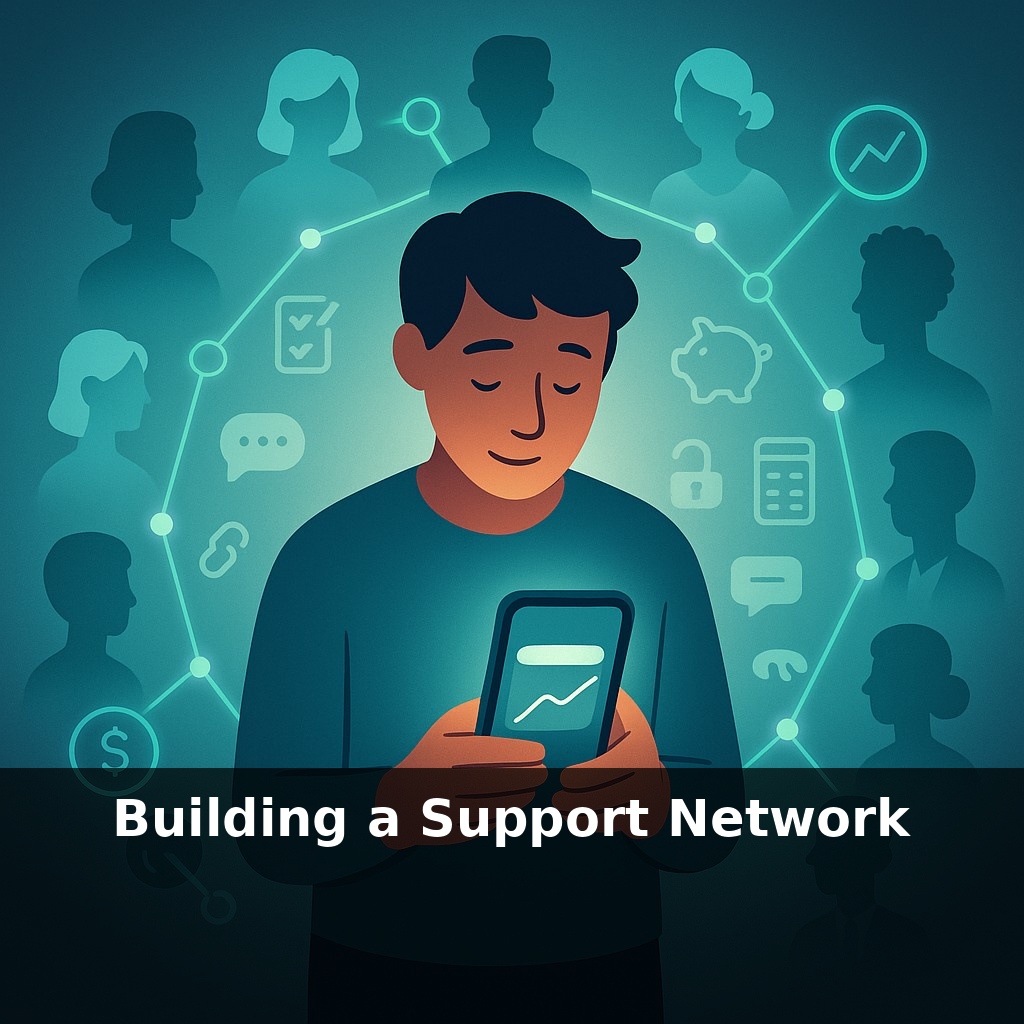
About half of people chasing money goals try to do it completely alone—yet those who plug into real support often crush debt in a fraction of the time. You’re checking your bank app, feeling stuck again. The problem isn’t your willpower. It’s who’s walking this road with you.
Four kinds of people quietly shape most money turnarounds. First, professionals: a CFP, accredited credit counselor, or tax pro who can spot mistakes that cost you thousands. In one AARP analysis, households working with a CFP had roughly 3–4× the median net worth of similar earners without one. Second, peers: people at your level sharing what actually works—r/personalfinance’s FAQ alone has racked up over 70 million views because millions are trading notes in real time. Third, mentors: someone a few steps ahead who’s already paid off the cards, cleaned up the credit report, negotiated the raise. Fourth, your “inner circle”: the 3–5 people whose money habits you see up close. Over the next few minutes, you’ll see how to intentionally build each layer so your goals stop depending on willpower and start running on structure.
Most people stop at “I should get help with money” and never turn that thought into a concrete plan. So let’s get specific. You don’t need a 10‑person team; you need the right few people, doing the right jobs. Think of this as assembling a “money board of directors.” One person might help you cut 18% interest debt, another might help you optimize a 401(k) match that could add $1,500–$3,000 a year, and another might push you to send $50 extra to debt every paycheck. Even two or three well‑chosen connections can shift your timeline to debt‑free by months or even years.
A practical support network starts with clarity: what, exactly, do you need help with in the next 12 months—crushing $8,000 of credit cards, building a $3,000 emergency fund, boosting income by $400/month? Different goals call for different people.
Start with one high‑leverage gap. If the main issue is chaotic debt, your first target might be a nonprofit credit counselor. Search your city + “NFCC certified credit counselor.” In a 45–60 minute session (often free), they’ll pull a soft‑pull credit report and map your current payments. If you’re sending $260/month at 24% interest, they might propose a debt‑management plan that consolidates to 8–10%, turning a 7‑year slog into a 3‑year plan with little change to your monthly out‑of‑pocket.
If income or long‑term planning is the bigger knot, look for fee‑only advisors at sites like NAPFA or XY Planning Network. Filter for “hourly” and “works with clients under $250k.” Before you ever book, email three candidates the same short note: your age, income, debts, primary goal, and budget for advice (say $300). Pay close attention to who replies with specific next steps versus vague sales language.
Next, add peer accountability. Instead of a loose “we should talk about money,” structure it. Invite 1–3 trusted people to a 30‑minute monthly “money lab.” Simple agenda: 1) 5 minutes: each person shares one win (e.g., “extra $75 to the card”). 2) 15 minutes: each shares a number‑based update: current debt, savings, or income target. 3) 10 minutes: each states one concrete commitment for the next 30 days.
Write those commitments down. If three of you each agree to send an extra $40/week to debt, that’s $480/month total redirected. Over 12 months, that’s $5,760 less hanging over the group—visible progress you can celebrate together.
For mentorship, avoid the vague “will you be my money mentor?” Instead, ask for a specific, time‑bound favor: “Could I buy you coffee and ask 5 questions about how you paid off your $20k in loans?” Come prepared with numbers: your balances, interest rates, and a draft plan. You’re far more likely to get useful, concrete guidance when they can see the actual puzzle you’re solving.
Finally, audit your inner circle’s impact. Track for one month: how often do conversations nudge you toward spending versus saving or earning? If three different friends regularly suggest $60 nights out when you’re trying to stay under $120/week discretionary, you’ve found hidden friction. Your goal isn’t to cut people off, but to deliberately add voices that normalize frugal wins and smart risks, like taking a $250 course that could boost your income by $2,000/year.
A simple way to stress‑test your network is to look at results, not vibes. Say Person A and Person B both earn $60,000. Person A talks about “being better with money” but their savings stays stuck around $500. Person B joins a weekly online payoff group, books a single $250 hour with a planner, and asks a cousin who’s good with negotiation to review their next raise request. Twelve months later, Person B has wiped out $3,200 of high‑interest debt, built a $1,500 buffer, and bumped income by $150/month from a small freelance gig the group encouraged.
You can copy this stacking effect in miniature. Pick one low‑stakes goal—like freeing up $100/month. Ask a colleague how they trimmed their phone or insurance bill. Post a specific question in a vetted forum about your plan. Then schedule a 20‑minute check‑in with a friend in 30 days to report the exact dollar change.
Your network’s quality shows up in numbers: fewer fees paid, lower interest, higher income, and steadier savings growth over 3–6 months.
Mentorship is about to get an upgrade. As AI tools learn your patterns, they could match you to “money twins” with similar incomes and goals, then surface playbooks from people who already hit your target—like scripts that helped 500 users negotiate raises averaging $3,200, or payoff plans that cut interest by $1,450 in a year. Your job: practice filtering. In a world of infinite advice, the real skill is choosing which 3–5 voices you’ll actually follow for the next 12 months.
Treat this like building a small “results team.” Over the next 90 days, track three numbers: total debt paid down, cash saved, and income added from new moves. If your network is working, each should tick up monthly—even by $25–50. If one stalls for two months, upgrade that seat: find a new pro, peer group, or mentor aimed directly at that stuck number.
To go deeper, here are 3 next steps: 1) Join an online community that matches the kind of support you want—try searching “(your field/interest) + Discord community” or join a focused group like the “Indie Worldwide” Slack (for founders) or “Women in Product” (for PMs) so you can start DM’ing 2–3 people to set up short intro calls this week. 2) Read the chapter on “Cultivating a Supportive Community” in *Together* by Vivek Murthy or the “Belonging” section of *The Art of Gathering* by Priya Parker, and pull one concrete idea (like hosting a tiny, themed “support circle” on Zoom) to test with 2–3 friends or colleagues in the next seven days. 3) Use a simple relationship-tracking tool like Clay, Monica, or a shared Notion page to create a “Support Network” list—add at least 10 people (peers, mentors, collaborators), tag them (e.g., “emotional support”, “career advice”), and schedule 3 check-ins using Calendly or Google Calendar before the end of today.