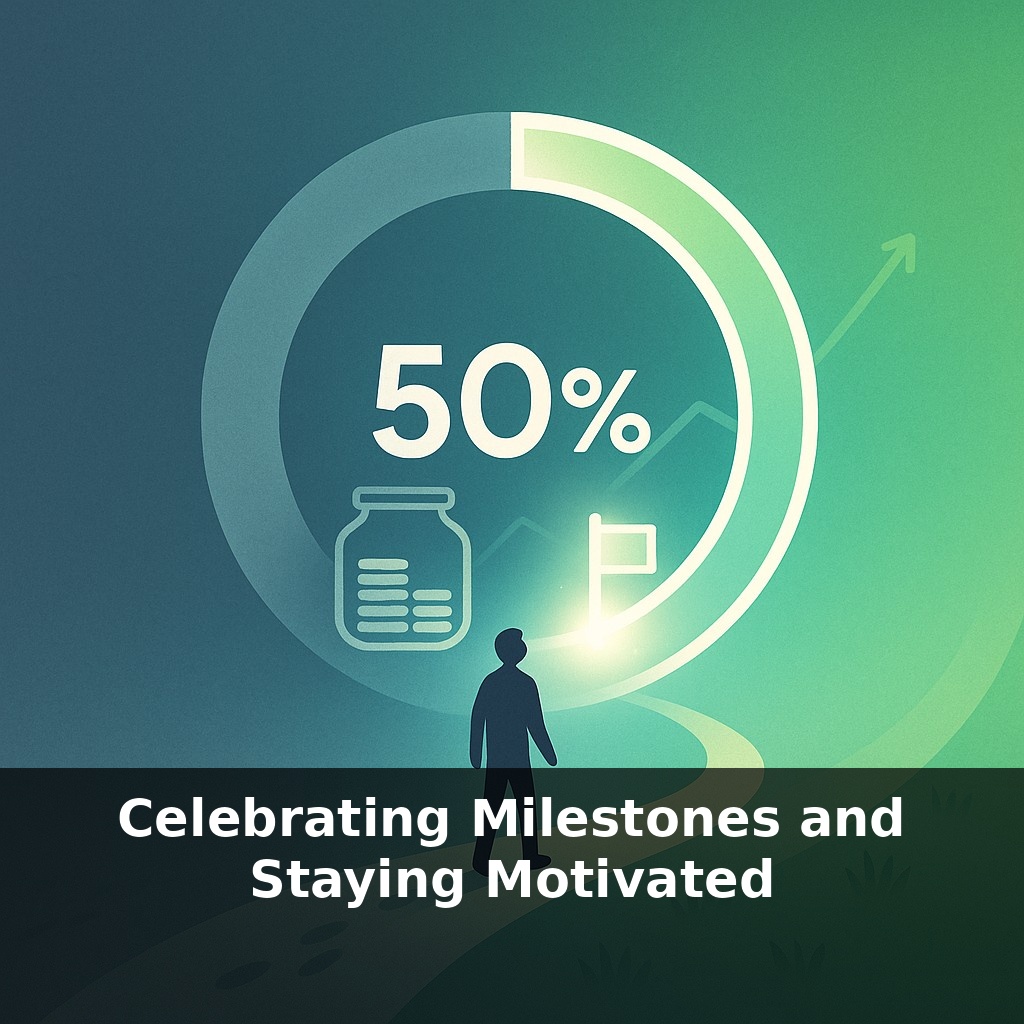
Halfway to a money goal is where most people quietly quit—right when their brain is actually most ready to lock in new habits. Tonight, we’re stepping into that messy middle: the moment you’re tired, tempted, and closer to the win than it feels.
Most people treat milestones like mile-markers on a highway sign: “Cool… 120 miles to go,” then straight back to white‑knuckling the wheel. But behavioral science suggests those “in‑between” points are where the real power is—if you pause and actually mark them. When you intentionally notice, track, and celebrate smaller wins, you’re not just being cheesy or “extra”; you’re rewiring your brain so that progress feels rewarding enough to repeat.
Think of it less like checking a box and more like planting flags along a hiking trail. Each flag doesn’t change the mountain, but it changes your experience of the climb: you can look back and *see* how far you’ve come, not just how far you still have to go. In a debt payoff journey, that shift—from vague endurance to visible milestones—is often the difference between falling off the plan and quietly becoming the person who actually finishes. Tonight, we’re going to design those flags on purpose.
So now we zoom in on *how* you mark those flags. Research on motivation shows it’s not just “noticing progress” that matters, but making it concrete, trackable, and a bit ritualized. Think less “vague pat on the back,” more “tiny ceremony.” That’s where visual tools, rituals, and community come in. A hand‑drawn progress bar on your fridge, a note in your calendar titled “$500 closer,” or a quick post in a debt‑free forum can all serve as proof that today counted. Instead of your journey living only in your banking app, you’re pulling it into the physical and social world, where it’s harder to ignore—and easier to keep going.
Here’s where the research gets surprisingly specific. When scientists study persistence on long projects, they don’t just ask, “Did people finish?” They watch *what happens right after* a bit of progress. Three patterns keep showing up:
First, **progress that’s visible** pulls you forward. That Journal of Consumer Research study on visual debt trackers didn’t work because people suddenly became more disciplined; it worked because every time they shaded in another line, their brain processed, “I’m the kind of person who follows through.” That identity shift is subtle, but powerful. It’s the difference between “I’m stuck with this balance” and “I’m actively shrinking this thing.”
Second, **progress that’s counted in small units** creates way more “psychological paydays.” Behavioral economists call this “granularity.” Instead of telling yourself “I paid $1,000 this month,” you break it into ten $100 steps, or even twenty $50 steps—each one a checkmark, a colored square, a tick on a chart. You haven’t paid more money; you’ve just given your brain more chances to notice, “I did it again.” That’s where the Qapital-style finding—that trackers plus celebrations can boost success rates—starts to make sense and feels less like magic.
Third, **progress that’s acknowledged socially** changes the stakes. That Stanford neuroeconomics finding—that a public shout‑out can light up your reward system similarly to a modest cash prize—explains why community challenges work so well. Posting “Just hit $2,000 paid!” in a group chat or forum doesn’t clear your balance any faster in dollars, but it does speed things up in motivation. Now quitting isn’t just a private decision; it feels like walking off a stage mid‑song.
A simple way to think about all this: your future, debt‑free self is sending you postcards from ahead on the trail. Each time you mark, count, and share a milestone, you’re basically mailing one back: “Message received. Still walking. See you soon.”
Think of how travelers tackle a long trail section: they don’t just check a map once at the start and slog in silence. They snap a photo at each overlook, circle a campsite in their guidebook, maybe press a leaf between the pages. Those tiny rituals don’t shorten the route; they make the story worth staying in.
You can treat your financial progress the same way. Some people keep a “progress shelf” at home: a candle they only light when they transfer extra to a card, a jar of pebbles where each stone stands for $50 knocked out, a postcard from a place they’ll visit once the balance is gone. Others build digital rituals: a specific playlist that only plays while they make payments, a recurring calendar alert titled with the next mini‑target, a private note on their phone where they jot one sentence after each win: “Future me will be glad I did this.”
The point isn’t the object or app; it’s choosing a small, repeatable way to say, “This step counted.”
Soon, these “little wins” won’t live only in your notebook or app. Your bank, employer, even your favorite brands may start reacting to your progress in real time—like streetlights turning on as you walk. Hit a key threshold and your HR portal might unlock a training stipend, or your banking dashboard could quietly lower a rate. As more systems sync, your future self isn’t just cheering you on; entire networks begin nudging you toward that next tiny step.
Your challenge this week: pick one tiny, repeatable ritual to mark progress—a victory song, a tally in your notes app, a quick voice memo to yourself—and *only* use it when you move a step closer to debt freedom. By next week you’ll have a trail of proof, like breadcrumbs in a forest, showing you’re already on your way out.