The Gig Economy: What It Means for Job Seekers
📝 Transcript
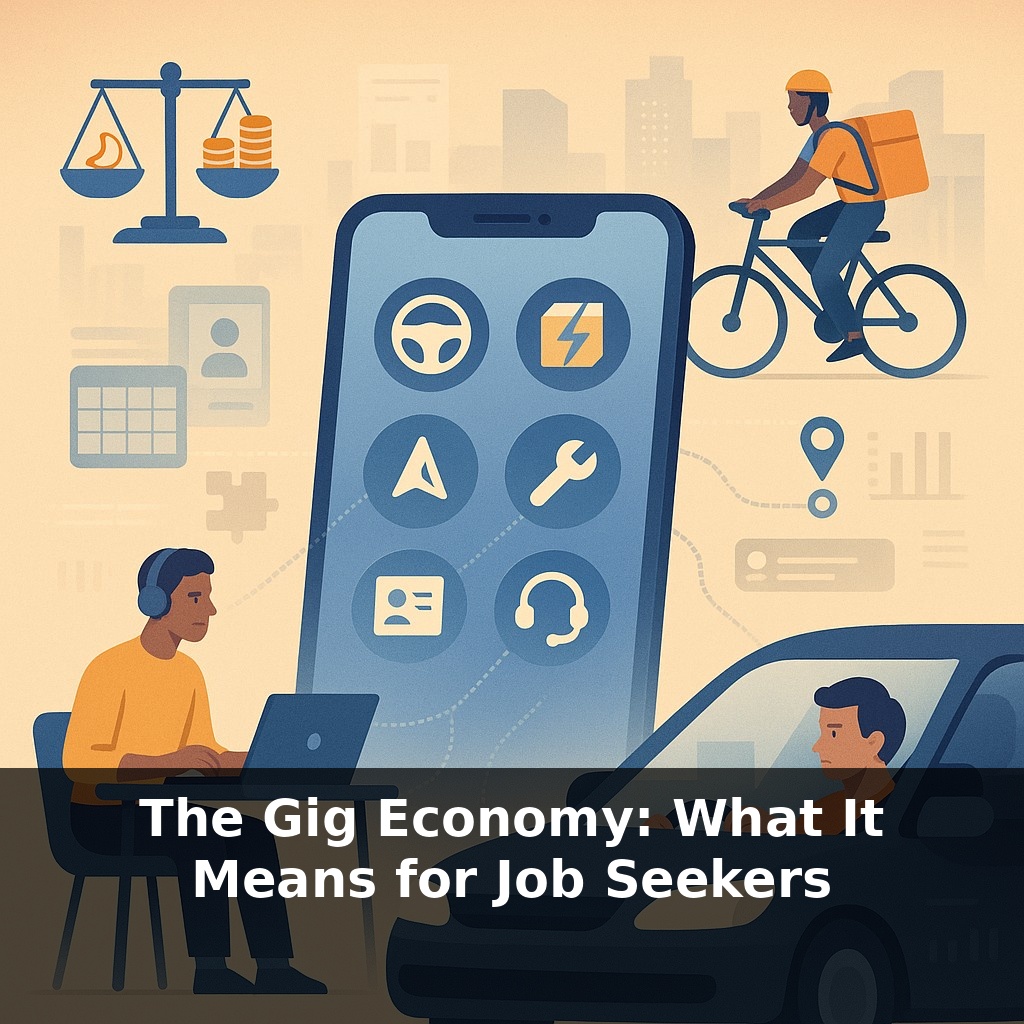
A few taps on your phone can now replace a full-time job. A designer juggles three clients before lunch. A driver turns an empty afternoon into paid rides. More freedom, yes—but also more risk. So here’s the real puzzle: in this new world, who is actually hiring whom?
That shift shows up clearly in the numbers. In 2022, an estimated 60 million Americans earned money this way, together generating about $1.35 trillion—roughly 6% of U.S. GDP. But the headline growth hides a quieter reality: the platforms that unlock this work also move many traditional “employer” responsibilities onto you. Health insurance, retirement savings, tax withholding, even the cost of your tools—these now sit on your side of the table. For a driver, that might mean gas, maintenance, and insurance eating into each fare. For a designer, it’s software subscriptions, hardware, and unpaid proposal time. At the same time, platforms like Fiverr and Upwork are enabling higher-value projects and global client bases. The result isn’t simply more “freedom” or more “precarity”—it’s a landscape where your choices about skills, positioning, and pricing matter more than your job title.
For job seekers, this shift doesn’t just change *where* you find work—it changes *how* you think about your career. Instead of climbing a single ladder, you’re assembling a portfolio: a few steady contracts, some short bursts of project work, maybe platform gigs that fill gaps. Earnings can spike one month and dip the next, so stability comes less from one employer and more from how you design your mix of work. That’s why skills like pricing, self-promotion, and basic accounting quietly become as important as your core craft, whether that’s driving, design, coding, or consulting.
For job seekers, the first big shift is how you define “a good opportunity.” In a traditional role, you mostly compare salary, title, and commute. In gig work, you’re weighing *total* value: not just what the project pays, but how it fits your skills, schedule, and longer-term positioning.
Think of three layers when you look at any gig:
1. **Surface payoff** – the headline number: $400 for a logo, $80 for a consulting call, $120 from a night of rides. This is what platforms highlight, but it’s the least complete measure.
2. **Hidden cost** – not only obvious expenses like fuel or software, but also context-switching, unpaid revisions, proposal writing, and the mental load of “always being available.” Two gigs with the same surface payoff can feel radically different once you factor this in.
3. **Future leverage** – does this work open doors? A well-scoped Upwork project with a reputable client, strong review potential, and public portfolio rights might be worth more than a slightly better-paying but invisible task for a one-off buyer.
This is where the gig economy quietly rewards an entrepreneurial mindset. You’re not just asking “Can I do this?” but “What does doing this *build*?” A string of similar, mid-paying projects in a single niche—say B2B email copy, Shopify store setup, or executive coaching—can snowball into expertise, repeat clients, and the ability to raise your rates. Random one-offs rarely do.
Platform metrics become your early “track record”: star ratings, response times, completion rates, and client feedback. They aren’t just vanity scores; they influence search ranking, eligibility for higher-value clients, and even automated badges. Understanding how each platform’s system works—and aligning your behavior with it—is almost like learning the “rules of a game” you’re choosing to play.
Then there’s time strategy. Many successful independents blend:
- **Anchor work**: a retainer client, recurring contract, or regular shift pattern that covers a reliable base. - **Upside work**: shorter, higher-margin projects where your skills are scarce. - **Buffer work**: gigs you can turn on quickly (like driving or microtasks) when other streams slow down.
The mix that works at one stage of your career may not fit the next, which is why treating your choices as experiments—not permanent labels—matters more than picking the “perfect” path on day one.
Think of skill-building in this space like hiking a branching trail system: each small turn nudges you toward a very different view a few miles later. Take two writers who both start with generic projects. One quietly leans into SaaS onboarding emails, accepts a few slightly underpriced but well-scoped jobs, and studies what the top profiles in that niche offer. Within a year, most of their inquiries are from B2B founders, and they can quote by project instead of by hour. The other says yes to everything—blog posts, product descriptions, podcast scripts. The calendar stays full, but patterns are harder to spot, and raising prices feels riskier.
You see similar forks with drivers. One simply chases surge pricing. Another tracks which neighborhoods, events, and hours bring not just more rides, but more *predictable* ones, then layers in delivery work during slow times. Same apps, same city, but the second driver is gradually exchanging randomness for a plan—without needing anyone’s permission to do it.
Your future career may look less like a ladder and more like a map that keeps redrawing itself. As AI starts routing projects to specific skills, your profile, reviews, and online footprint become the “signal” algorithms listen to. Regulation, too, is likely to redraw boundaries—some gigs turning into jobs, others staying fully independent. Treat each platform as a temporary stage: useful while it amplifies you, risky if you never build relationships and reputation that travel with you.
As platforms evolve, your edge comes from noticing where demand is quietly spiking—new tools, niches, or problems people complain about but don’t know how to solve. Treat each short project less like a one-off paycheck and more like a test balloon: which skills get snapped up fastest, which offers fall flat, and where you feel pulled to go deeper next.
To go deeper, here are 3 next steps: 1) Create a profile on Upwork or Fiverr today focused on one concrete skill you have (e.g., copywriting, social media scheduling, data entry), and use the free rate calculators at Glassdoor and PayScale to sanity-check your starting hourly rate. 2) Block 30 minutes to read the free sections of “The Gig Economy” by Diane Mulcahy on Amazon or Google Books, focusing on the chapters about building a portfolio of income streams, then list 2 specific gigs you could realistically add alongside (or instead of) your current job. 3) Open a free account with a basic accounting tool like Wave or Bonsai and connect it to a separate bank account, so every gig payment you earn going forward is automatically tracked for taxes and gives you a clear view of how viable gig work is for you over the next 3 months.
From this course
Decoding the Modern Job Market
7 episodesUnlock all episodes
Full access to 7 episodes and everything on OwlUp.
Subscribe — $1.99/monthLess than a coffee ☕ · Cancel anytime