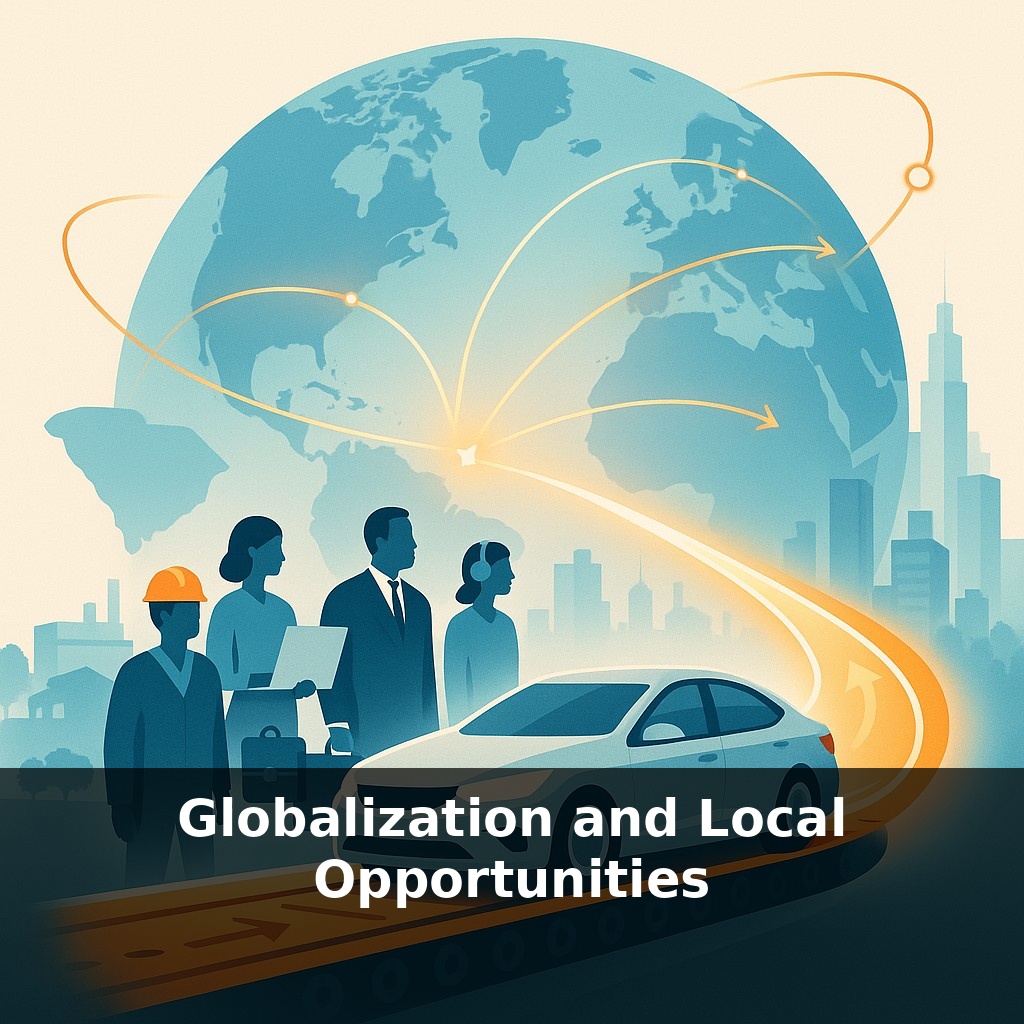
A car rolls off a factory line in South Carolina—and most of those vehicles won’t stay in the U.S. They’re heading overseas, built by local workers whose jobs depend on distant buyers they’ll never meet. Globalization isn’t far away anymore; it’s quietly shaping your next career move.
Those 8.1 million Americans employed by foreign firms aren’t outliers—they’re signals. A career can now be “local” in where you live, but “global” in who pays you, who you collaborate with, and where your work ultimately lands. The same goes for the 1.5 million Filipino freelancers earning online: their commute is a login screen, but their marketplace is the world.
This shift isn’t just for elite coders or executives. Welders in export plants, nurses on telehealth platforms, teachers tutoring overseas students, bookkeepers serving clients abroad—all of them are already plugged into these cross-border flows.
The real question for your career isn’t “Will globalization affect me?” but “Which part of the global map will I choose to connect my skills to—and how deliberately will I build that bridge from where I’m standing now?”
Some of the best “global” moves don’t look dramatic from the outside: a small factory adding a new export client, a local clinic adopting telehealth software, a neighborhood designer learning to invoice overseas. The big shift is that more of these chances now start as data, not airplanes—files sent abroad, code deployed to foreign users, customer calls routed across borders. That matters for you, because the skills that travel best are often specific: knowing a niche tool, a regulated process, or a language pair that’s rare in your town but prized somewhere else.
Here’s the twist most people miss: the biggest gains from globalization rarely go to the “best” generalists. They go to the people who become weirdly specific in ways that line up with international demand.
Not “I work in manufacturing,” but “I know how to calibrate sensors for electric-vehicle batteries to EU standards.” Not “I do admin work,” but “I specialize in onboarding U.S.-based clients to a particular CRM, and I know their tax-year rhythms.”
Three patterns show up again and again where local careers plug profitably into global flows:
First, *export‑anchored employers.* Think of BMW in Spartanburg as one example, but scale that idea down: a 40‑person furniture shop that ships custom pieces to hotels in three countries; a food producer that wins one overseas grocery contract. These firms often need people who can read foreign purchase orders, track shipment milestones, or adapt product specs to another country’s rules. The “global” edge isn’t flashy—maybe it’s just being the person who understands that client in Canada and keeps those invoices clean—but it’s suddenly critical.
Second, *digital services that cross borders by default.* When over half of global services exports are digital, a designer, therapist, translator, or support rep doesn’t need a passport stamp to have foreign customers. What matters is discoverability (being on the platforms or directories your overseas buyers actually use), reliability (clear turnaround times, time‑zone awareness), and credibility (reviews, certifications, portfolios that match the norms of that market, not just your hometown).
Third, *stacked specializations.* A single skill is generic; two or three, combined, can be globally rare. A nurse who also understands a specific electronic record system and speaks another language; a mechanic who knows both diesel engines and diagnostic software used by a Japanese brand; a teacher who pairs subject expertise with familiarity with one major tutoring platform. Each added layer narrows the field and increases your cross‑border value.
Your goal is not to chase “global” as an abstract ideal, but to notice where your local reality already brushes against the wider world—and then deliberately sharpen that edge until people far away have a concrete reason to seek you out.
A good way to spot your own “global edge” is to look sideways at people who already found theirs.
Think about a local chef who realizes weekend orders often come with notes in another language. Instead of ignoring them, they start curating a bilingual menu, learn how to meet dietary rules for those customers, and soon they’re catering virtual events for that diaspora community abroad. Same kitchen, different reach.
Or a bookkeeper at a small firm who keeps seeing clients ask about being paid from overseas. They quietly become the office expert in cross‑border invoicing tools and payment platforms. Within a year, they’re the go‑to person for every new international client—and the one the boss is least willing to lose.
Your “stack” might be unusual language pairs plus customer service, or CAD skills plus knowledge of foreign safety specs, or counseling plus familiarity with a specific country’s school calendar. The sweet spot is where a real problem in your town overlaps with people far away who will happily pay for a precise, reliable solution.
Global shifts will likely feel uneven: some streets buzzing with new roles, others quietly losing old ones. Watch how policy choices steer that tension. Cities that treat fiber‑optic lines like highways, or English classes like public transit, tend to attract work that hasn’t been invented yet. Think of a town turning a disused warehouse into a training hub where coders, welders, and climate tech startups bump into each other—those collisions often become tomorrow’s “local export.”
You don’t need a perfect roadmap to start; you need a small, testable bet. Treat the next year like a series of low‑risk “pilot projects”: volunteer on one export‑linked task, take one short online gig abroad, join one community where international clients hang out. Your challenge this week: pick just one such pilot and schedule the first concrete step.