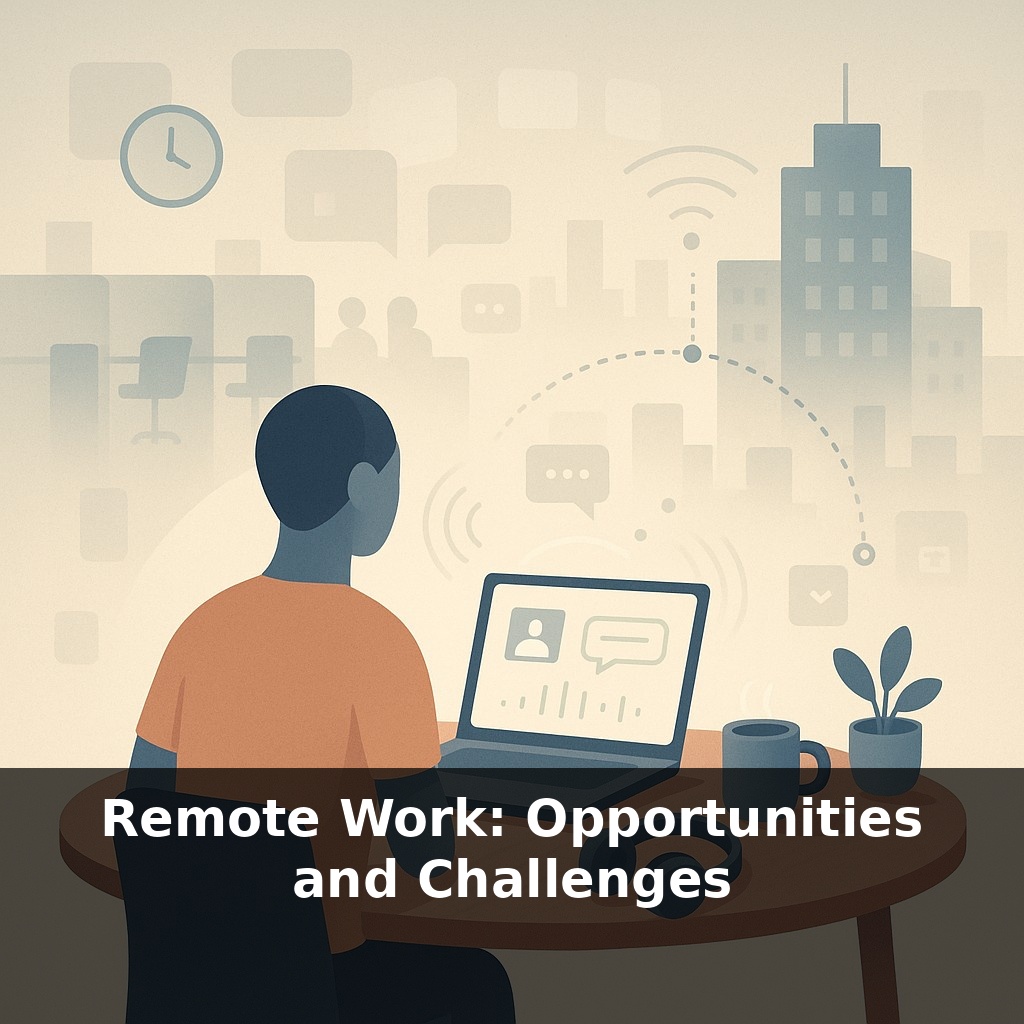
Right now, roughly a fifth of American workers no longer commute to an office—yet many companies are still designing careers as if they do. In this episode, we step into that tension: when work can happen anywhere, what actually counts as “showing up”?
In this new landscape, your “office” might be a kitchen table, a coworking desk, or a quiet corner of a library—but the expectations around impact, trust, and visibility haven’t disappeared; they’ve simply gone quiet and moved online. The research is clear: more people want remote options, and many are willing to trade salary for them, yet organizations are still arguing over whether this shift boosts performance or erodes culture. Some teams thrive with members scattered across time zones; others dissolve into missed messages and silent resentment. In practice, remote work isn’t one thing—it’s a spectrum of arrangements, norms, and tools that can either unlock deep focus or create 24/7 low-grade anxiety. Today, we’ll unpack what actually makes the difference: the structures, habits, and decisions that turn “working from anywhere” into a sustainable career advantage instead of a slow, invisible stall.
Here’s where the numbers sharpen the picture. Analysts expect tens of millions more people to be outside traditional offices within a few years, yet promotion criteria, performance reviews, and even casual recognition rituals still quietly favor those who are easiest to see and hear. Some companies redesign roles around outcomes and async collaboration; others default to endless video calls that drain focus and blur boundaries. For your career, the puzzle isn’t just “Can I do my job from here?” but “How do I stay visible, trusted, and protected when so much now runs through a screen?”
For your actual day-to-day, three levers matter more than any policy slide deck: what you produce, how you communicate, and how you protect your work and wellbeing.
Start with what you produce. Studies showing higher output for remote workers have a catch: they’re almost always looking at roles with clear, measurable deliverables. That’s your first quiet career move—make your work legible. Translate vague responsibilities into concrete artifacts: weekly summaries, dashboards, short Loom walkthroughs, before/after snapshots of a messy problem you clarified. When your manager’s mental picture of you is a feed of solved issues and shipped decisions, distance matters less.
Next comes how you communicate. In an office, you can patch over fuzzy expectations with hallway chats; online, ambiguity compounds. Strong remote performers over-index on clarity: they confirm priorities in writing, timestamp decisions, and ask explicitly, “What does good look like for this by Friday?” They also adjust to the “hidden” architecture of time zones and tools—choosing channels on purpose, not habit. Video for conflict or complexity, text for records, quick voice notes when nuance matters but time is tight.
Then there’s the social fabric. Isolation doesn’t just feel bad; it quietly narrows the flow of opportunities that reach you. The people who progress remotely tend to engineer surface area: they schedule short, agenda-light 1:1s, they participate thoughtfully in team threads, they share credit publicly and feedback privately. Think of it less as networking and more as maintaining weak ties that keep information—and your name—moving.
Underneath all this, security and boundaries become part of your professional skill set. Using strong authentication, updating devices, and treating unfamiliar links as suspect isn’t just “IT stuff”; it signals reliability with sensitive work. Likewise, defining when you’re online, how to reach you in a real emergency, and what you’ll decline guards you from becoming the always-on person whose output looks impressive but whose judgment erodes.
These levers don’t require a perfect company policy. They’re closer to craft: the small, deliberate moves that make your work stand out even when you’re just another square in the grid.
Think about the remote colleagues you quietly admire. One might be the “cartographer”: they keep a living document of what they’re tackling, what’s blocked, and what shipped. Another is the “radio host”: once a week they drop a short update in a shared channel—what they tried, what worked, what didn’t. Neither is louder than anyone else; they’re just easier to read from far away.
Concrete moves look small up close. A developer records a 3‑minute walkthrough of a tricky fix and links it in the ticket. A marketer adds a one‑line “decision + rationale” at the top of each campaign brief. A project manager ends meetings by posting three bullet decisions and owners in chat within 10 minutes.
These practices travel well across teams and time zones because they leave a trail. Over time, that trail becomes a quiet portfolio of how you think, not just what you do. When opportunities surface—a stretch project, a new lead role—the people deciding don’t have to guess how you operate under pressure; they’ve been watching your patterns unfold in the background.
Your future career won’t be about choosing “remote” or “office” once and for all; it’ll be more like adjusting sails to shifting winds. As companies rebalance costs, laws, and talent pools, the most resilient people will treat location as a variable they can renegotiate, not an identity. Expect more project-based roles, cross-border teaming, and contracts where the “where” is flexible but the “outcomes” are non‑negotiable—and documented in much finer detail than today.
You don’t need a perfect company to make this shift work in your favor, but you do need intent: pick a few practices, test them, keep what sticks. Over time, your patterns become a kind of signature—like a musician’s tone or a writer’s voice—that travels with you, making your value recognizable even to people who’ve only ever seen your name in a shared doc.
Before next week, ask yourself: 1) “If I mapped my current remote workday hour by hour, where are the 2–3 biggest time leaks (Slack pings, context-switching, unclear priorities), and what’s one concrete boundary I’m willing to set tomorrow—like scheduled ‘focus blocks’ or muting notifications during deep work?” 2) “Looking at my current tools (Zoom, project boards, chat channels), where does collaboration actually feel clunky—status updates, brainstorming, quick questions—and how could I redesign just one workflow this week (e.g., a weekly async update Loom video instead of another meeting) to make it smoother?” 3) “Thinking about the isolation the hosts mentioned, what’s one simple ritual I could start this week—like a 10‑minute virtual coffee with a teammate or a casual ‘wins and fails’ Friday message—that would make remote work feel more human for me and my coworkers?”