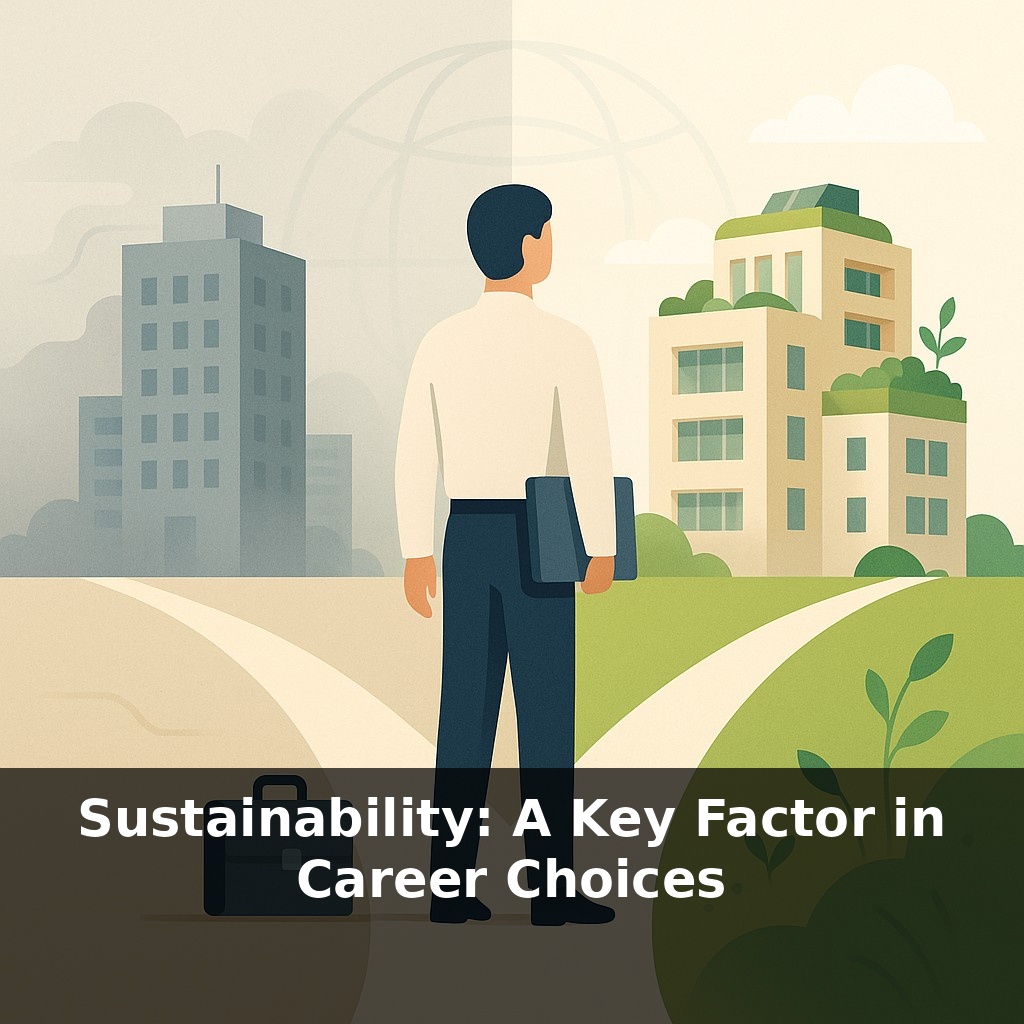
Nearly half of workers today say they’d take a pay cut to work for a greener company. Now, zoom into one office: two job offers on the table, similar roles, similar pay. One firm is proudly net-zero; the other dodges the topic. Which offer feels safer for your future—and why?
According to the ILO, the shift to a greener economy isn’t just an ethical upgrade; it could add a net 24 million jobs by 2030. That means sustainability isn’t a niche “do-gooder” track—it’s quietly becoming the backbone of growth across energy, finance, manufacturing, even marketing. Job posts that once mentioned “MS Excel” now slip in “carbon accounting” or “circular design” as if they’ve always belonged there. And companies that visibly commit—like Ørsted, which quadrupled its market value after going 90 % renewable—aren’t just polishing their image; they’re signaling long-term resilience. For workers, this changes the calculus: you’re not only weighing salary and title, but whether your skills, and your employer’s business model, will still make sense in a carbon-constrained world.
This shift reaches far beyond “green” titles. A supply-chain analyst now tracks emissions hotspots alongside delivery times. A product designer weighs durability and repairability with the same care as color and price. Even marketers are learning to separate credible climate claims from empty slogans. For job seekers, the question quietly evolves from “Is this a good company?” to “Is this company part of a future that’s actually going to exist?” Like a traveler choosing routes on a changing coastline, you’re scanning for employers whose plans won’t be underwater—literally or strategically—ten years from now.
Nearly 70 % of Gen Z and Millennials say an employer’s environmental track record sways their job choices—yet most of the fastest‑growing “green” roles don’t have the word “green” anywhere in the title. That’s where the real opportunity hides.
Think in layers instead of labels.
At the surface are the obvious roles: climate scientists, renewable energy engineers, ESG analysts. These get the headlines and the specialized degrees. But just beneath that is a much wider layer: ordinary jobs being quietly rewired with environmental responsibilities.
A project manager in construction now has to factor in low‑carbon materials and waste targets. A finance analyst in a bank helps screen lending portfolios against climate risk. An HR leader is tasked with embedding environmental goals into performance reviews. None of these people work at an NGO; all of them shape their employer’s footprint.
Then there’s the “invisible green” layer: roles where your leverage comes from asking different questions inside familiar work. The sales rep who pushes clients toward the lower‑impact product line. The operations lead who notices that a slightly different scheduling pattern slashes energy use. The product marketer who refuses to oversell eco‑claims and instead pushes for genuine improvements.
This is why employers are writing “familiarity with life‑cycle impacts” or “experience with environmental metrics” into job ads that used to be purely commercial. They’re not chasing virtue; they’re hedging against regulation, reputational risk, and shifting customer demand. A firm that can show credible progress wins cheaper capital, more loyal customers, and the kind of applicants Patagonia drowns in every hiring cycle.
For you, the strategic question shifts from “How do I land a sustainability job?” to “How do I make any job I want harder to do without my sustainability skills?” That’s the difference between pinning your hopes on a small set of green titles and tapping into the much larger current reshaping almost every role around them.
Consider three very different people. A software engineer joins a logistics startup and quietly redesigns the routing algorithm—not just for speed, but to cut empty miles. She never touches a solar panel, yet her code erases thousands of truck trips a year. A restaurant manager in a mid‑sized city renegotiates supplier contracts so that deliveries are consolidated and seasonal menus become the norm; food waste and fuel use both drop, and margins improve. A fashion merchandiser convinces her brand to pilot a repair‑and‑resell line; suddenly, customer lifetime value rises while inventory risk falls.
None of them carry “sustainability” in their titles, but each has made themselves harder to replace because they see the hidden environmental costs inside everyday decisions. Picking projects like these is less about moral purity and more about leverage: where does one small change in your role bend both impact and business results?
By the time today’s interns hit mid‑career, “knows their impact footprint” may sit beside “Excel proficient” as a default line on résumés. Roles will splinter: a product manager might specialize in low‑impact launches, a lawyer in climate‑risk clauses, a designer in materials passports. Think of cities evolving with bike lanes and green roofs: the basic map stays, but routes and skylines shift. Careers will, too, rewarding those who can read both financial and planetary bottom lines. Your future colleagues may include biodiversity data curators, retrofit strategists, and AI‑enabled resource planners shaping how factories, farms, and offices adapt in real time. Expect recruiters to scan portfolios not just for what you built, but for how you reduced hidden waste along the way.
Your challenge this week: Scan three job ads in your target field from different employers. For each, jot down any hints of environmental responsibility—however minor. Then, rewrite one bullet from your own CV to mirror that language using real actions you’ve taken (even small ones, like reducing printing, travel, or waste on a project). By Friday, you’ll have a sharper sense of which skills are quietly becoming “green by default” in your path, and one concrete upgrade to how you present yourself to match where demand is headed.
Careers are starting to look less like fixed ladders and more like river deltas, splitting into channels that reward people who can spot hidden waste and redesign routines. As hiring managers quietly favor those skills, your small experiments—on one project, in one team—become like trail markers, showing others that a lower‑impact way of working is not only possible, but practical.
Before next week, ask yourself: Where in my current role do I see a clear connection to environmental or social impact (for example, reducing waste, improving supply chains, or influencing company policies), and where is that connection missing? If I had to choose one sustainability issue I genuinely care about (like climate resilience, circular design, or ethical sourcing), how would that change the kinds of roles, industries, or companies I’m willing to consider? Looking at my LinkedIn, CV, or portfolio today, what’s one concrete project or experience I could add, reframe, or start this week that would make a sustainability-focused recruiter immediately see me as aligned with their mission?