The Attention Economy: Understanding the Game
📝 Transcript
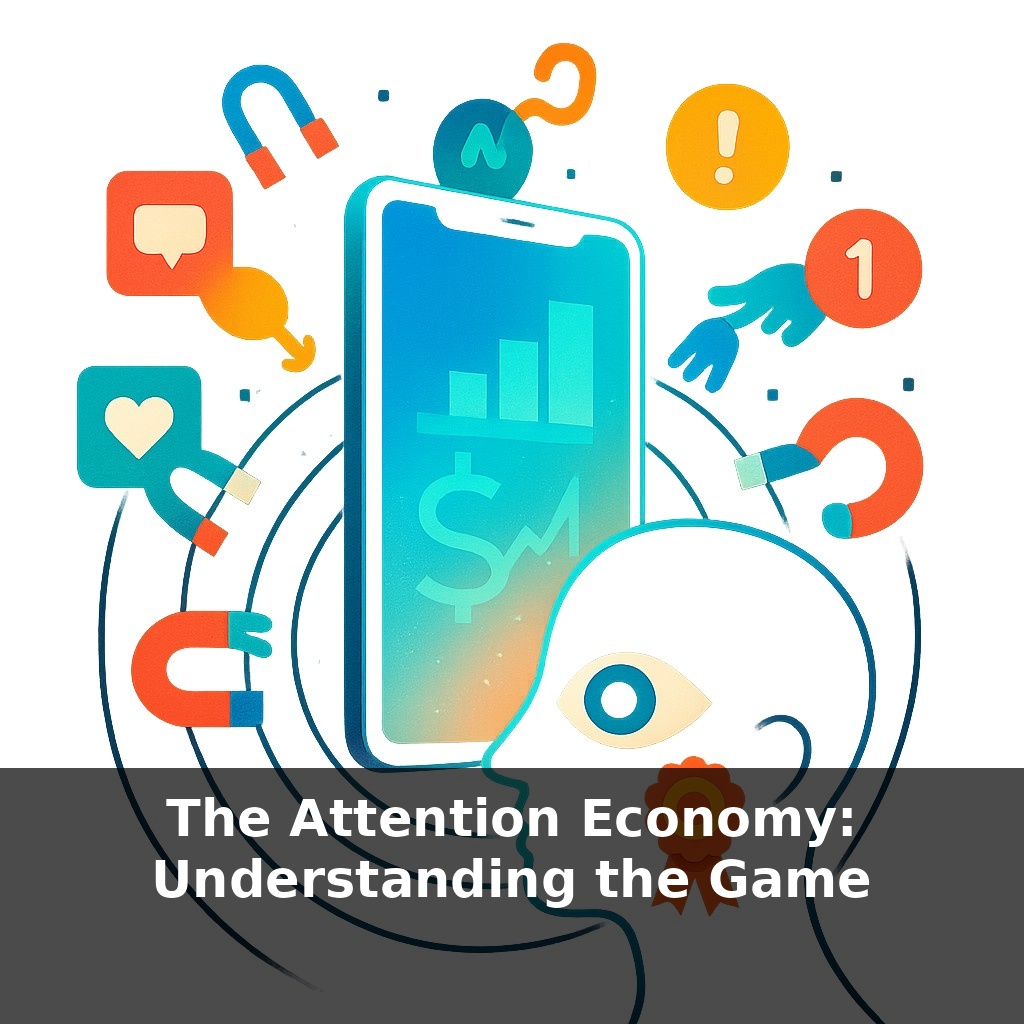
Right now, as you’re listening, a dozen apps on your phone are quietly competing for your next glance. Not your money—your attention. In this episode, we’ll step behind the screen and ask: who’s actually playing this game, and when did you become the prize?
If your attention is the prize, today we’re going to meet the players who profit when you stay glued to a screen—and the tools they use to keep you there. Last year, digital ads pulled in around $626 billion worldwide, more than TV and print combined. That kind of money doesn’t come from better cat videos; it comes from better control over your time. Platforms like Facebook, YouTube, and Netflix run massive, real‑time experiments on billions of people, constantly tuning colors, notifications, and recommendations to keep you scrolling or watching “just one more.” You’re not simply browsing; you’re being steered. And the more precisely they can predict what will hook you next, the more your attention can be sliced, packaged, and sold to the highest bidder.
Behind all those nudges and endless feeds sits a simple business rule: if a platform can keep you a little longer today, it can predict you a little better tomorrow. That prediction is gold. It’s how advertisers decide not just *what* you’ll see, but *when* you’ll be most vulnerable to seeing it—tired at night, bored at lunch, stressed between meetings. Think of it as a constantly updating weather report for your mood and habits, sold to whoever wants to catch you in just the right storm. The more data they gather, the sharper that forecast becomes—and the less random your “random” browsing really is.
Here’s the unsettling twist: most of the techniques that keep you locked in weren’t invented for tech at all. They were borrowed—from casinos, behavioral psychology labs, and decades of marketing research—and quietly woven into the apps you open before you’re even fully awake.
Take “variable rewards.” Instead of giving you the same result every time, platforms mix in just enough unpredictability to keep you checking. Refreshing a feed, pulling to reload email, opening a notifications tab—each is a tiny gamble. Most of the time you get something boring or irrelevant. But every so often, there’s a message from someone you care about, a shocking headline, or a video that hits your exact interest. Your brain learns: keep pulling the lever.
Then there’s social proof. Metrics like likes, views, and streaks don’t just show what happened; they tell you what *matters*. If a post has a million views, you’re nudged to assume it’s important—or at least worth your time. When you see that “typing…” bubble or a friend’s profile pop to the top of your chat list, you’re reminded: people are here, things are happening, don’t leave now.
Designers also lean hard on loss aversion—the fact that humans feel losses more intensely than gains. Snapstreaks, “only 2 seats left,” “this story disappears in 24 hours,” or “last chance to watch” badges are all versions of the same move: they frame closing the app as missing out on something you almost had. You’re not just choosing whether to stay; you’re defending against a tiny loss.
On top of that sits personalization. The more data these systems collect—how long you hover, what you skip, what you replay—the more they can tailor what you see to your specific triggers: your politics, insecurities, hobbies, fears. Over time, your feed starts to feel weirdly intimate, as if the platform “gets” you, when in reality it’s just very good at predicting what will keep you engaged a bit longer.
Put together, these tools create an environment where *doing nothing*—not tapping, not scrolling, not responding—feels uncomfortable. Silence in a chat, an empty inbox, a quiet home screen can seem like something’s wrong. The attention economy wins when your default state is to be slightly restless unless you’re feeding it.
Open your favorite video app, watch one cooking clip, and notice what follows: more recipes, kitchen gadgets, “10 hacks chefs don’t want you to know.” One tap quietly trains the system to treat you as “food‑obsessed for the next hour,” and the feed adjusts in real time. Do the same late at night with stress‑relief content, and suddenly you’re in a loop of sleep aids, productivity gurus, and calming playlists. The system isn’t just predicting what you like; it’s inferring *when* you’re tired, hungry, lonely, or anxious—and serving content that keeps that state going long enough to sell against it. Think of it like a shifting menu in a restaurant: what’s printed isn’t fixed, it updates based on what you’ve already ordered, how fast you’re eating, and how often you return. Over days and weeks, that invisible menu can reshape your habits, your opinions, and even your sense of what “normal” looks like online—without ever asking your permission.
The fight for your focus won’t stay on screens. As AR layers pop‑ups onto your glasses and AI spins endless “personalized” worlds, the quiet parts of life—waiting in line, staring out a window, daydreaming—become prime real estate. Those pauses are where reflection and original ideas tend to surface. Your future leverage may be less about quitting apps and more about defending these blank spaces, the way cities protect parks from being turned into parking lots.
So the real question isn’t “how bad is my screen time?” but “who set the rules of this game, and do they match what I care about?” You don’t need to quit tech to change the outcome; you need to notice the moments it quietly bends your plans. That awareness is your opening move—the shift from being the prize to becoming an active player.
To go deeper, here are 3 next steps: 1) Install Freedom or Cold Turkey Blocker and, for the next 7 days, set a recurring “deep work” block (90 minutes) where TikTok, Instagram, YouTube, and news sites are completely unavailable on all your devices. 2) Read the first two chapters of *Stolen Focus* by Johann Hari or *Stolen Attention* (whichever was mentioned in the episode) and use the Take Control Over Tech quiz at screenSanity.org (or a similar assessment tool discussed) to see exactly how the attention economy is shaping your behavior. 3) Swap 20 minutes of doom-scrolling tonight with a “high-agency feed” by subscribing to one long-form source recommended in the episode (e.g., an email newsletter like The Browser or a curated Substack) and unsubscribing from at least three lowest-value notification sources on your phone.
Unlock all episodes
Full access to 8 episodes and everything on OwlUp.
Subscribe — $1.99/monthLess than a coffee ☕ · Cancel anytime