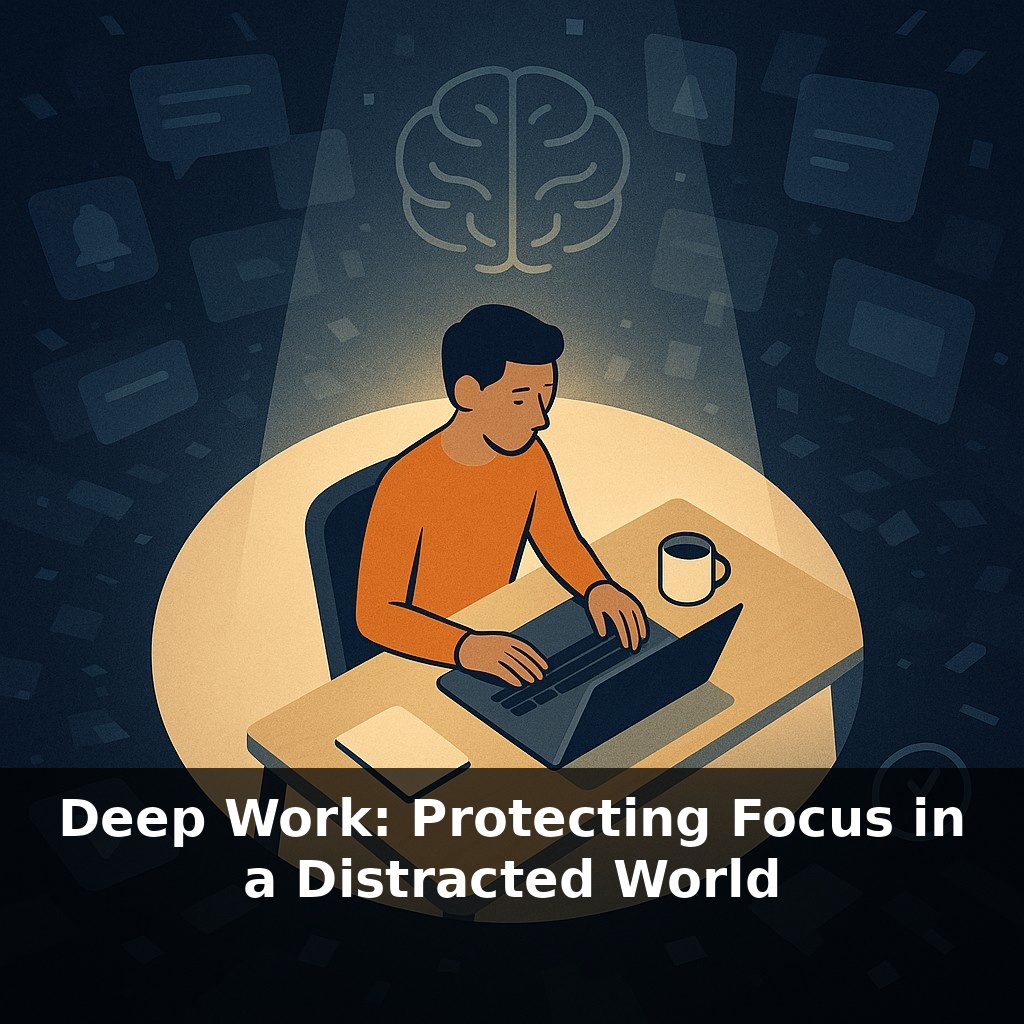
Right now, the average office worker switches screens in well under a minute. Yet the work that really matters—breakthrough ideas, elegant solutions, clear writing—almost never appears in those tiny slices. So how do we protect the long, quiet stretches our best thinking secretly demands?
Most people don’t lose their focus in a single dramatic moment; they leak it away in tiny, “harmless” fragments—quick inbox peeks, notification glances, micro-scrolls between tasks. The problem isn’t just the time these detours consume, but the invisible drag they leave behind. Researchers call it attention residue: part of your mind stays stuck to the last thing you touched. So even when you’ve technically “returned” to the hard problem in front of you, you’re bringing mental lint along for the ride. Over a day, that residue quietly lowers the ceiling on how sharp you can think, how fast you can learn, and how bold your ideas feel. Deep work is about more than working harder; it’s about building a protected mental environment where your brain can actually operate at full capacity instead of constantly climbing out of shallow distractions.
Most people assume focus is about willpower: if you just tried harder, you’d resist the pings, tabs, and tiny diversions. But the research points somewhere else entirely—toward systems and structure. Your brain’s limited capacity for control is more like a daily budget than an endless well; spend it on resisting temptations and you have less left for actual thinking. This is why people like Bill Gates literally leave their normal environment for “Think Weeks,” and why Cal Newport scripts his days into protected blocks. They’re not stronger than you; they’ve simply made distraction the inconvenient option.
When researchers track high performers over time, a pattern shows up: their best work clusters in surprisingly small portions of their schedule—usually a few tight, well-defended hours per day. The difference isn’t that they care more; it’s that they’ve redesigned how their time, tools, and teams interact so those hours stay intact.
One useful way to think about this is at three levels: calendar, environment, and protocols.
At the calendar level, it means treating demanding work like an immovable appointment, not something you “fit in” around messages and meetings. Bill Gates didn’t wait for a free week to appear; he carved out Think Weeks years in advance. Many researchers and writers do the same on a daily scale: non-negotiable 60–120 minute blocks where nothing else gets scheduled, even if that means pushing back on “quick syncs” or rescheduling standing calls. The key is deciding *in advance* which hours are protected, instead of negotiating with every new request in the moment.
At the environment level, the question becomes: what does your workspace reward? If your desk, browser, and phone are optimized for rapid response, they’ll keep pulling you toward shallow tasks. In contrast, people who consistently access deep states often engineer friction: a separate user account or device for intensive work, a different physical spot reserved for it, only the essential apps installed there. Small inconveniences—like having to log into a separate machine to see chat—quietly shift behavior without requiring constant self-control.
Protocols are the rules you and others agree to follow. Cal Newport, for instance, is explicit with colleagues and students about when he’s reachable and by what channels; within that clarity, long offline stretches become socially acceptable instead of rude. Teams that value deep work often adopt norms like shared “focus hours,” delayed email expectations, or using subject-line tags to signal urgency, so no one feels compelled to check constantly “just in case.”
What emerges from these layers isn’t rigidity, but rhythm: predictable stretches of depth, buffered by lighter periods for collaboration and logistics. Over time, your brain starts to trust that real space for hard problems is coming—and that trust makes it easier to drop fully in when the time arrives.
A practical example: a software engineer I worked with was constantly “available” on chat, proud of instant replies. His code reviews slipped, bugs increased, and he felt strangely exhausted. He ran an experiment: three 90-minute blocks per week with chat closed, phone in another room, and a simple rule for his team—if it’s urgent, call. Within two weeks, his defect rate dropped and he finished a long-stalled feature in a single morning. Nothing about his talent changed; only the conditions around it did.
Think of a surgeon preparing for a complex operation: doors closed, instruments laid out, team briefed, no one wandering in to “just check something.” The seriousness of the setup tells everyone this time is different. You can create a similar “sterile field” for your own work—maybe it’s a certain playlist, a cleared desk, or a specific café corner—but what matters is that your brain learns to associate those cues with an unbroken stretch where difficult tasks are finally safe to tackle.
As AI offloads more routine tasks, the real career risk won’t be automation—it’ll be trying to compete while permanently half-distracted. The premium shifts to people who can wrestle with fuzzy problems, connect odd dots, and learn new domains fast. Schools and companies may start treating protected concentration like sleep: a basic health metric. You might see “deep-work credits” on performance reviews, or offices redesigned like libraries, with noisy collaboration zones at the edges and silent cores at the center.
Your challenge this week: choose one recurring task that deserves more respect—design, strategy, reading, coding—and give it a standing 60–90 minute appointment every weekday. Before each session, clear your desk like a kitchen counter before cooking, silence everything, and note how far you get when you let depth become your default, not your exception.