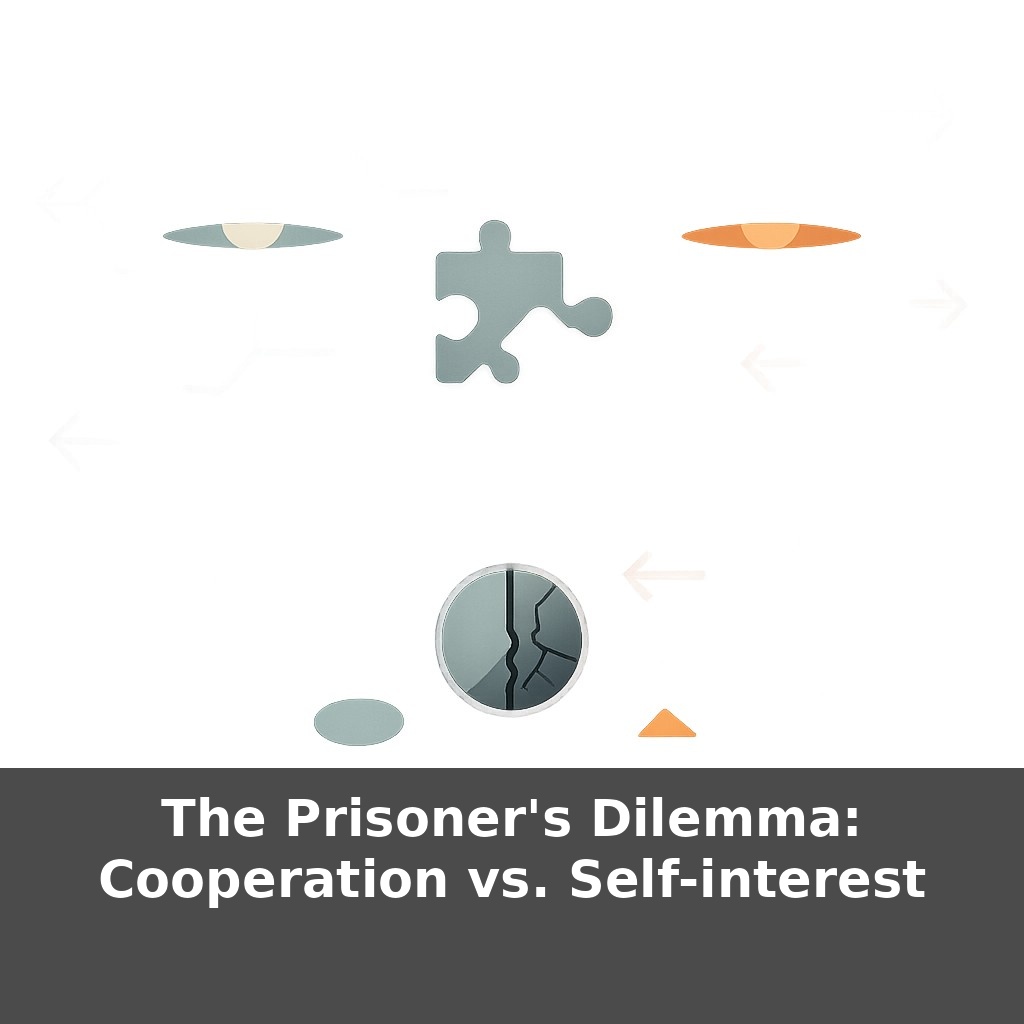
Two strangers sit in separate rooms, no phones, no internet, no way to signal each other—yet their choices could save or ruin them both. Here’s the twist: the “rational” move almost guarantees a worse outcome. So why do so many of us still follow it in real life?
In everyday life, the Prisoner’s Dilemma usually doesn’t show up as a police interrogation—it hides inside routines that feel completely ordinary. Two co-workers share credit on a project; each can subtly inflate their own role. Drivers approach a merge; each can ease off the gas or speed up. Online platforms decide how aggressively to harvest your data; each can restrain itself or race to the bottom. None of these people are villains. They’re just responding to incentives that quietly reward short-term self-interest. Yet when everyone leans into that logic at once, teams become toxic, traffic snarls, digital spaces grow predatory. The real puzzle isn’t just what any one person “should” do—it’s how groups, markets, and institutions can be shaped so that cooperation is no longer an act of heroism, but the obvious, self-sustaining choice.
Economists, biologists, and political theorists all treat this same puzzle as a kind of X‑ray machine for human systems. Run a version of it with money in a lab, with animals sharing food, or with nations trading tariffs, and you keep seeing similar fractures: trust is fragile, and incentives quietly tilt behavior. Sometimes people surprise the model—about 35–45% will “cooperate” even when it’s a first round with no future. Other times, patterns harden: countries lock into emissions races, firms undercut wages, apps chase your attention like rival teams running no-defense, all-offense plays.
In the classic set‑up, two people sit alone, make a choice, and live with it. Real life is rarely that clean. You face the same faces at work tomorrow, your country still trades with its rivals next year, platforms compete with each other for decades. Once you add repetition, the grim logic of “defect now, worry later” starts to bend.
That’s what Robert Axelrod tested in 1980. He invited experts to submit computer strategies for a repeated version of the game. No grand AIs emerged. The surprise winner was “Tit‑for‑Tat”: start by cooperating, then simply copy whatever the other side did last turn. It wasn’t sneaky, it wasn’t vengeful—it was clear, forgiving, and firm. Defect on it once and you’re punished once. Return to cooperation and it instantly lets you back in.
From that simple script came three big lessons. First, the future matters. Once today’s move shapes tomorrow’s treatment, it can be costly to grab a short‑term edge. Second, clarity matters. Because Tit‑for‑Tat was easy to read, others could adjust around it, stabilizing cooperation instead of spiraling into mutual suspicion. Third, memory matters. Even a very short history—just “what happened last time?”—is enough to reward reliability and penalize exploitation.
Outside the lab, those same elements show up in familiar places. High‑trust business partnerships don’t rely only on goodwill; they rely on the expectation that there will be another deal. Online marketplaces publish seller ratings so that past behavior changes future opportunity. Environmental treaties try—imperfectly—to make each round of talks influence the next by tracking promises and outcomes.
Reputation systems are like the structural steel inside a skyscraper: mostly invisible from the street, but they decide how high cooperation can rise before it buckles. Laws, norms, reviews, blacklists, even gossip all serve to carry records forward, raising the long‑run cost of “winning” this round at everyone else’s expense.
Yet there are limits. If players think the interaction will end soon, defection creeps back in at the edges. If power is lopsided, the strong may tolerate less restraint. And in global problems—such as a few countries producing over half of CO₂ emissions—the stakes are planetary while the temptations remain local.
In tech, content platforms often face a quiet version of this game. Each company can flood feeds with low‑quality clickbait to grab a few more minutes of your attention, or restrain itself and surface slower, more thoughtful material. One firm going aggressive barely moves the needle; a whole industry doing it turns the online world into noise. The payoff table pushes “more engagement now,” but the long arc punishes everyone as users burn out and ad rates fall.
Sports give another angle. Two cyclists in a breakaway can share the work at the front or let one rider do all the wind‑cutting. Freeloading saves your legs for the final sprint, yet if both riders try to hide, the main pack simply catches them and neither wins. Teams quietly experiment with different “strategies”: some agree before the race who will sacrifice, others rely on informal reputations built over seasons.
Urban planners face a slower, concrete‑and‑steel version when cities decide whether to invest in shared transit systems or keep doubling down on cars and private roads.
When Dilemmas scale, they redraw the map of power. Cities choosing data-sharing over digital hoarding can manage traffic, pandemics, even blackouts better—like turning many blinking routers into one resilient network. Climate pacts, open-source AI, and shared cyber‑defense all live or die on how we wire payoffs, not just on ideals. Your challenge this week: notice one system you’re part of that quietly rewards “defecting,” and sketch how a rule‑change could flip the rewards.
In the end, the puzzle isn’t how to be a saint in a world of schemers, but how to redesign the “game” so that even cautious, self‑interested players keep finding alignment. Think of it less like a test of moral purity and more like tuning a multiplayer strategy game: patch the rules, rebalance the rewards, then watch entirely new patterns of fairness emerge.
Before next week, ask yourself: When I’m in “Prisoner’s Dilemma” moments at work or in relationships (like sharing credit on a project or admitting a mistake), where do I tend to defect for short-term safety instead of cooperate for long-term trust? Looking at one current situation that feels risky to be open in, what concrete information or reassurance would I need—from the other person or from myself—to feel safe enough to choose cooperation? If I imagine we’ll repeat this interaction many times (like the iterated game in the episode), how would I act differently today to signal “I’m a reliable cooperator” without becoming a doormat?