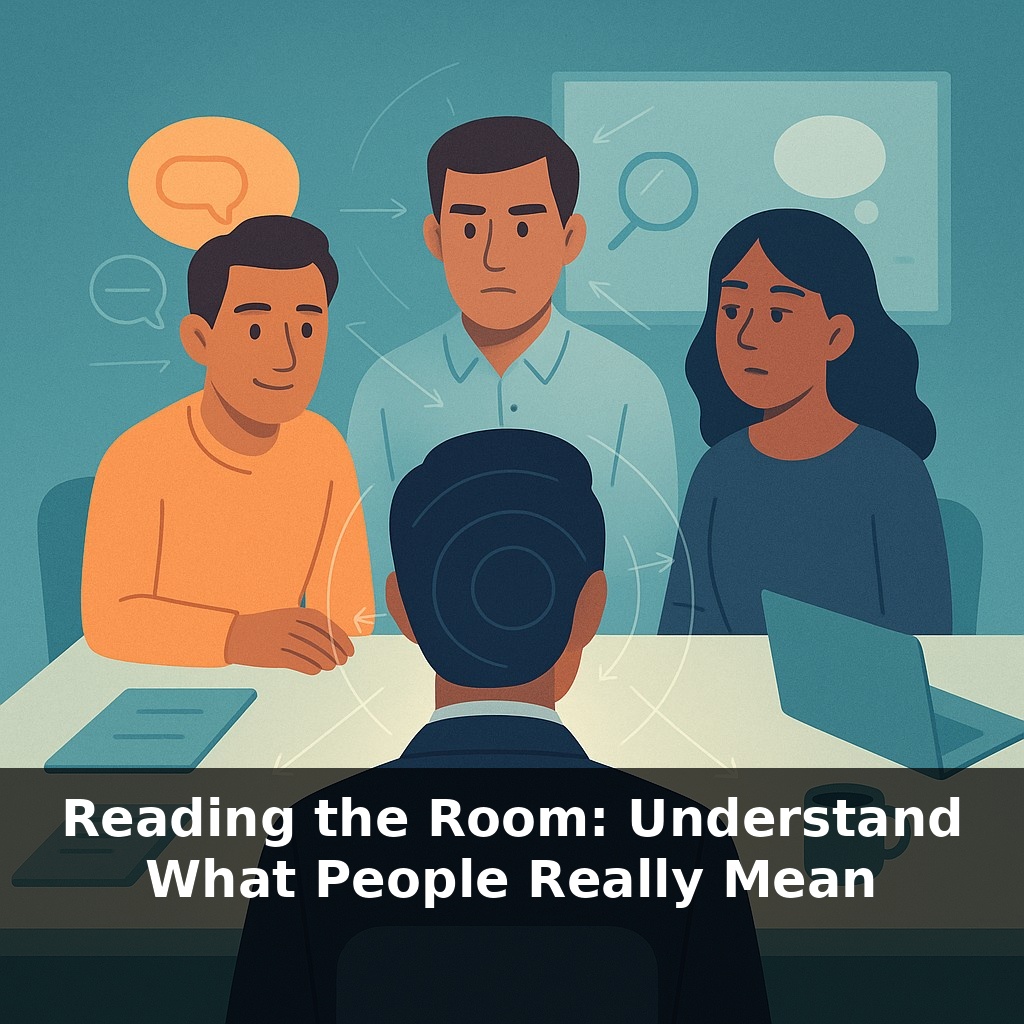
About half the time, we misread other people’s emotions—even when we’re staring right at their faces. Now, you’re in a meeting: your idea lands, one person stiffens, another smiles, someone glances away. Is this support, resistance, or boredom… and how sure are you, really?
Most people think “reading the room” is an instinct—you either have it or you don’t. Research says otherwise: it’s closer to a trainable technical skill than a mysterious talent. And like any skill, most of us are operating at “default settings.” We rush to label what we see (“She’s annoyed,” “He’s checked out”) instead of slowing down to notice patterns: posture plus tone plus timing plus context.
At work, those snap judgments are expensive. You might talk faster because you *assume* your manager is bored, when they’re actually processing. Or you water down a bold idea because one colleague’s raised eyebrow feels like rejection, when it’s really curiosity.
Here’s where it gets interesting: people don’t just send signals—they *adapt* to you. As you become more observant and less reactive, others subtly change how open, defensive, or engaged they are around you.
So instead of trying to “mind‑read,” the game is to slow your perception down. Think in layers: first, what’s literally happening—who talks after whom, who interrupts, who suddenly goes quiet when a topic appears. Then, how it sounds—voices getting tighter, warmer, flatter. Finally, how it fits the situation—Is there a deadline? A power shift? A recent reorg?
You’re not hunting for a perfect label; you’re running small, quiet hypotheses: “That joke fell flat—are people tired, stressed, or unconvinced?” Curiosity, not certainty, becomes your default setting.
Most people first look for *dramatic* signals—eye rolls, visible tension, big smiles. The more useful information is usually quieter and more distributed. Think in three dimensions: clusters, direction, and culture.
**1. Clusters: what’s lining up?**
One cue is almost never enough. Look for three or more signals pointing the same way:
- Body: Do several people lean back at the same moment a risk is mentioned? - Face: Do mouths tighten *and* eyes narrow right after a decision? - Voice: Do answers get shorter *and* flatter when a certain topic comes up? - Behavior: Do people suddenly “need to drop” after that topic, every time?
When multiple channels shift together, the odds go up that you’re close to what people actually feel. You still don’t *know*—but your guess is less random.
**2. Direction: where is the energy moving?**
Instead of asking, “What does this gesture mean?” ask, “Where is the room moving?”
Watch for:
- Who others orient toward when things get tense - Who people glance at before agreeing or disagreeing - Whose comments reliably raise or lower the overall energy - Who speaks more confidently when a particular leader leaves
These patterns reveal influence, alliances, and unspoken veto power. That’s often more critical than decoding any one person’s mood.
**3. Culture and norms: what’s “loud” here?**
The same cue can flip meanings across teams or countries:
- Direct eye contact may signal confidence, rudeness, or challenge. - Interrupting can be enthusiasm in one group, disrespect in another. - Silence might mean “I disagree,” “I’m thinking,” or “I’m deferring.”
So you calibrate. Notice how people behave when they’re clearly relaxed—coffee chats, team celebrations, side conversations. That’s your baseline. Deviations from that, not your personal standards, are the signals.
Over time, this turns into a quiet background process: you’re listening for patterns in posture, tone, and timing without staring or overanalyzing. You’re not trying to *catch* anyone; you’re trying to understand the conditions under which people speak up, shut down, or change their minds.
Think of a recent 1:1 where you left thinking, “That felt… off.” Instead of labeling it, replay the moment like a slow‑motion replay: not what they *said*, but what changed. Did their voice drop half an octave when compensation came up? Did their shoulders rise a few millimeters when you mentioned a deadline? Did they stop gesturing once a certain stakeholder’s name entered the conversation?
Shift your attention from *big* signals to pattern breaks. The “tell” is often the first thing that disappears: the extrovert who suddenly gives one‑word answers; the usually‑silent colleague who starts jumping in quickly; the energetic manager who keeps saying, “Anyway…” and ending threads early.
A practical move: in your next meeting, quietly pick one person and track only transitions—when they move from open to closed, fast to slow, relaxed to clipped. Then ask yourself: “What just happened in the conversation?” Over time, you’re less focused on decoding moods and more on noticing how specific topics, people, and decisions reliably shift the room.
Soon, your “read” of the room may compete with algorithms quietly scoring faces, voices, even typing rhythms—like having an over‑eager weather app predicting emotional storms. That can sharpen your awareness, but it can also nudge you to outsource judgment and ignore quieter colleagues whose signals don’t get “high scores.” The opportunity: treat these tools as wind‑vanes, not verdicts, and double‑down on the one edge machines still lack—your ability to ask, check, and repair in real time.
As you experiment, notice how your own presence changes the “flavor” of the room—like adding one spice that subtly shifts the whole dish. Instead of hunting for perfect accuracy, stay curious: check your hunches, invite corrections, and treat each interaction as data. Over time, your quiet attention becomes a signal of safety others can feel.
Before next week, ask yourself: 1) “In my last three conversations, when did someone’s tone, pause, or body language not quite match their words—and what might they have really been signaling that I missed in the moment?” 2) “The next time I’m in a meeting or social setting, which one person will I quietly ‘observe’ for five minutes—watching their micro-expressions, posture shifts, and eye contact—and what patterns do I notice about how they signal interest, discomfort, or disagreement?” 3) “When I feel myself getting defensive or eager to respond, what one curious follow-up question (like ‘Can you say more about that?’ or ‘What did you mean when you said…?’) can I choose to ask instead, to make sure I’m really reading the room before I react?”