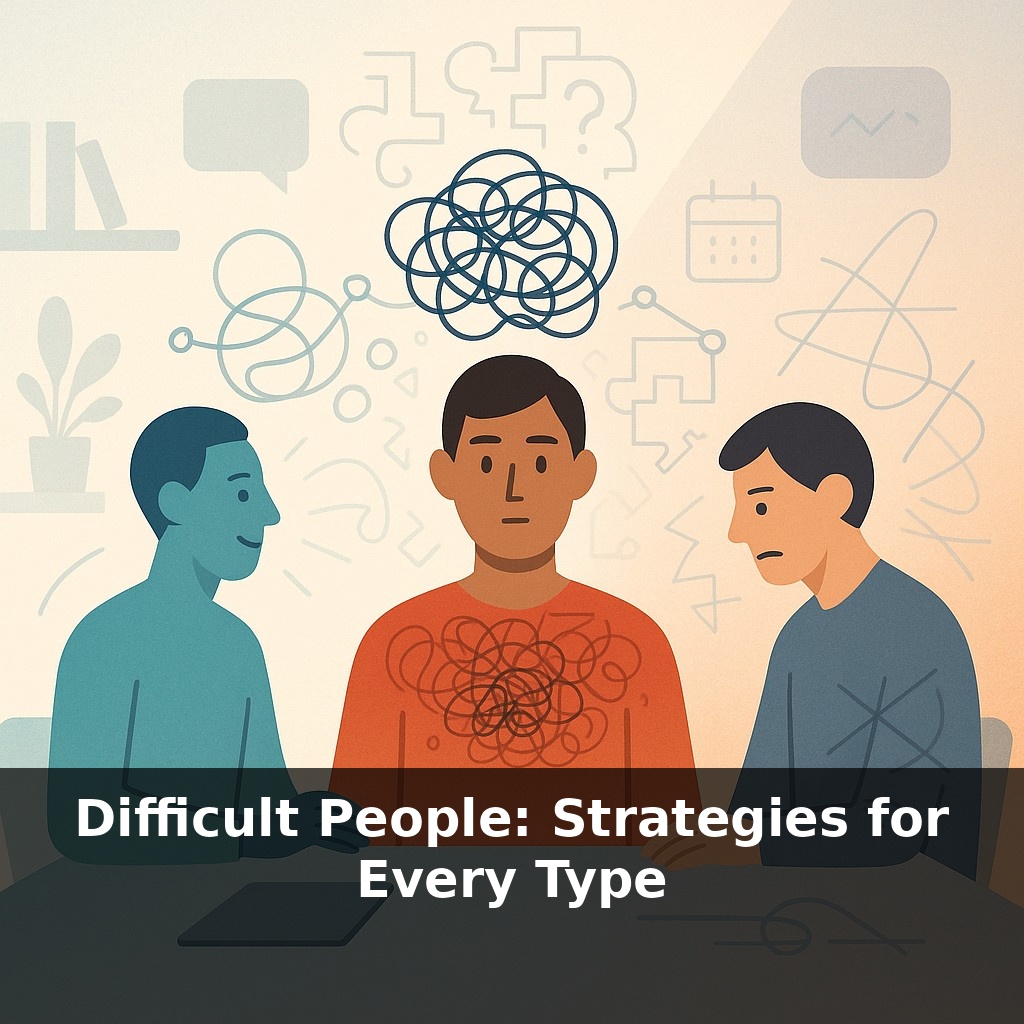
About half of workers say a single colleague makes their day harder. Now think of three people at your job: one inspires you, one drains you, and one…you still can’t quite figure out. Today we’re diving into that third person—and why decoding them might change your whole workweek.
85 % of employees are tangled in workplace conflict each year—and most of that friction comes from a surprisingly small set of repeat behaviors. Not “bad people,” but predictable patterns: the hovering boss, the endless critic in meetings, the teammate who smiles in public and sabotages in private. You don’t need to be a therapist to handle them; you need a playbook.
This episode is about building that playbook.
We’ll zoom in on the behavior, not the person, so your brain stays cool instead of hijacked. Then we’ll match patterns to strategies: what actually works with the Bully that backfires with the Chronic Complainer, and why your usual “be reasonable” approach often makes things worse.
Our goal isn’t to turn you into HR or a hostage negotiator. It’s to help you protect your time, focus, and sanity—without starting a war or becoming someone you don’t recognize.
Some difficult colleagues are loud about it; others drain you in quieter, confusing ways. One rewrites your work at 11 p.m., another agrees in meetings then stalls every decision, another somehow makes every project about them. On the surface, it feels like a messy mix of personalities. Underneath, there are recurring “tracks” playing: control, anxiety, status, fear of looking bad. When you learn to hear the track instead of just the noise, you gain options. You can decide: negotiate, set a limit, bring data, or simply step aside. Emotional intelligence here isn’t about being nicer; it’s about getting strategic.
Let’s get more specific and practical. When someone is “difficult,” your brain usually jumps to judgment: “She’s impossible,” “He’s toxic,” “They’re just lazy.” That reaction feels satisfying for about three seconds—and then you’re stuck. Label the person and you’re out of moves. Label the pattern and suddenly you have options.
Think of a few common patterns:
The Micromanager hovers because control lowers their anxiety. They’re scanning for risk. Arguing about “trust” rarely lands; showing them a simple dashboard, clear checkpoints, or a written plan often does. You’re not fixing their personality; you’re reducing the uncertainty that drives their behavior.
The Passive‑Aggressive colleague says “fine” but drags their feet. Direct confrontation (“You’re sabotaging this”) usually makes them retreat further. A better move is surfacing specifics: “Last week we agreed on X by Tuesday; it’s Thursday and I don’t have it. What’s in the way?” You’re anchoring the conversation to concrete commitments, not vibes.
The Narcissistic type needs to look important. Telling them to “be more humble” goes nowhere. But linking your proposal to their goals can: “If we do it this way, it’ll highlight your team’s role in the launch.” You’re not feeding their ego for fun; you’re aligning incentives so they’re less likely to derail you.
Here’s the deeper shift: instead of asking, “Why are they like this?” ask, “What is this behavior trying to accomplish—and how do I respond without rewarding the worst parts of it?”
That’s where structured tools help. Thomas‑Kilmann reminds you there isn’t one “right” style; sometimes you need to compete (with a Bully), sometimes collaborate (with a Micromanager), sometimes calmly stand your ground. Non‑Violent Communication gives you a script when your emotions are hot: observation, feeling, need, request—without the loaded commentary that triggers defensiveness.
And high‑EQ teams don’t magically have fewer tricky personalities; they just notice patterns faster and react less. They treat flare‑ups like a system problem to debug, not personal drama to replay. Over time, that turns sporadic heroics (“I survived that meeting”) into a repeatable, calmer way of dealing with almost anyone.
A practical way to use this is to “tag” situations in real time. You’re in a status meeting and someone keeps derailing the agenda with side issues. Instead of silently fuming, you name the pattern in your head: “This is a dominance move, not a genuine concern.” That tiny reframe shifts your options: you can park their point (“Let’s note that for later”) and return to the goal without turning it into a showdown.
Think of your responses like adjusting seasoning in cooking. With a controlling peer who rewrites your slides, you add more “structure”: shared document, explicit owners, deadlines visible to everyone. With a colleague who goes quiet then vents to others, you add more “visibility”: short 1:1 check‑ins, explicit invitations to disagree early, written summaries of decisions so revisionism is harder.
The aim isn’t to win every interaction; it’s to make fewer of them spiral. Over time, these small pattern‑based tweaks compound into a calmer, more predictable workday for you—even if no one else changes.
Conflict skills will soon be as measurable as sales numbers. AI tools already scan meetings for tension spikes, like a weather radar tracking storms before they hit. That means your patterns—whether you de‑escalate or inflame—will be more visible. As teams spread across time zones and cultures, the “right” response to a terse email won’t be obvious; you’ll need curiosity and cultural fluency to avoid misreading signals and turning simple friction into lasting distrust.
As you experiment with these approaches, notice which tensions soften and which still flare up. That feedback is your map. Over time, you’re not aiming for a conflict‑free office, but for one where friction runs more like a well‑managed train system: delays are expected, signals are clearer, and fewer small glitches turn into full‑blown derailments.
Try this experiment: For the next 24 hours, pick ONE difficult person type from the episode (e.g., the "steamroller," the "passive–aggressive," or the "chronic complainer") and deliberately test the matching strategy the hosts suggested with them. For a steamroller, calmly interrupt once, name what’s happening (“You’re talking over me”), and then restate your point in a single clear sentence; for a chronic complainer, listen for two minutes, then ask, “What have you already tried?” and “What’s one thing you’re willing to do next?” After the interaction, quickly rate (1–10) how tense you felt before vs. after and whether the dynamic shifted, then repeat the same approach with that person one more time this week to see if the pattern starts to change.