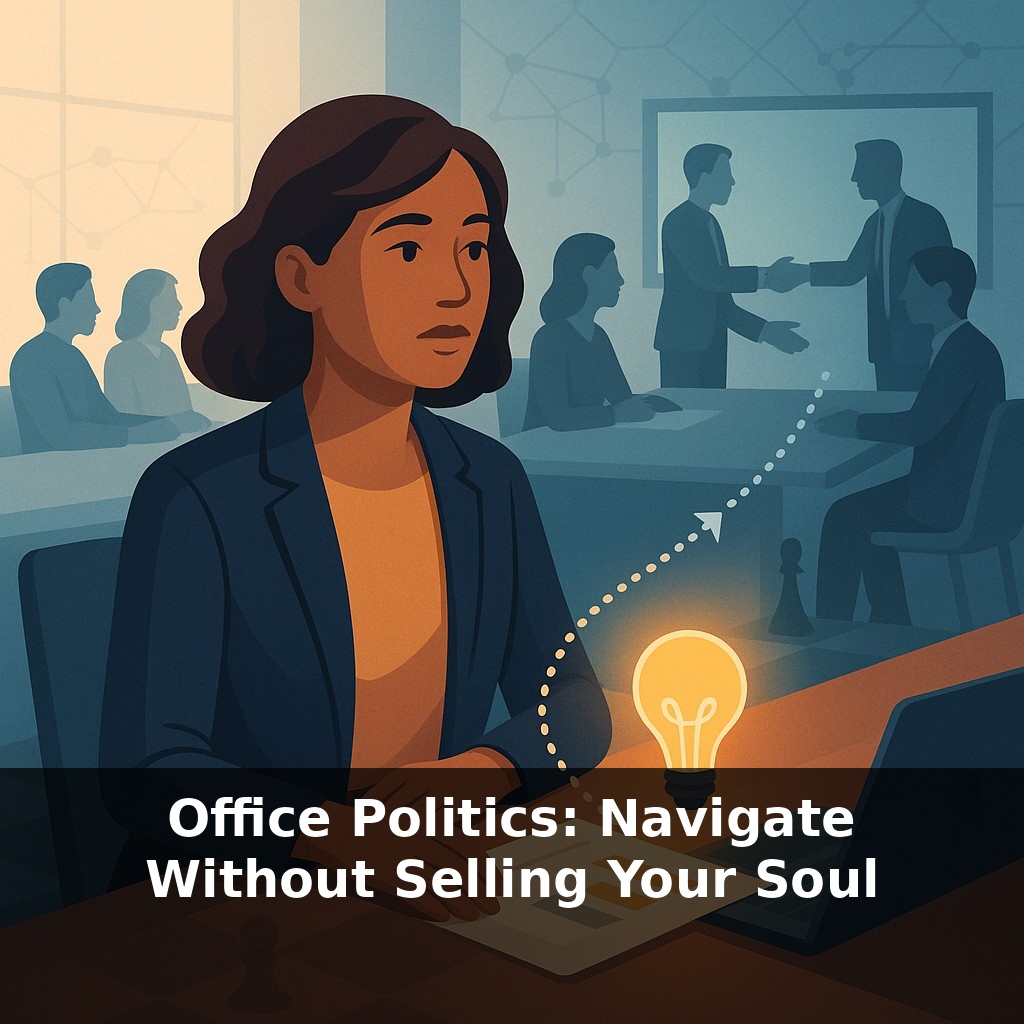
Office politics silently sculpt careers, influencing not just meetings but who receives crucial opportunities and accolades. Katherine, a diligent analyst, watches others take credit for her ideas. This invisible game decides who steps forward or stays in the background.
That gap doesn’t just show up in meetings; it decides who gets the stretch project, the mentor’s quiet endorsement, or the “we thought of you for this role” email. Research shows that people who intentionally cultivate trust and visibility aren’t being fake—they’re managing the social side of work as deliberately as they manage deadlines. Yet many of us treat relationships like background apps: always running, rarely optimized. We hope “good work speaks for itself,” even as we watch others’ work get amplified. The uncomfortable truth: opting out of politics is still a political choice—it just means you’re letting other people write the rules. In this episode, we’ll explore how to participate consciously: building alliances without flattery, using influence without manipulation, and protecting your energy in cultures where the volume is always turned up.
So where do you start if you don’t want to become “that political person”? Research on ethical influence suggests the first move isn’t toward others at all—it’s toward clarity about your own goals and non‑negotiables. Many careers get quietly derailed not by villains in the hallway, but by fuzzy priorities: saying yes to every “quick favor,” accepting roles that don’t fit your strengths, or aligning with whoever seems powerful this quarter. In this episode, we’ll map three levers—values, visibility, and value creation—and show how to pull them in ways that feel authentic, not performative.
Values are your first lever, but they only matter if they show up in real decisions. Start by translating vague ideals (“integrity,” “respect”) into observable behaviors. For example: “I don’t bad‑mouth people who aren’t in the room,” or “I raise concerns in 1:1s before I escalate.” Once you have 3–5 of these, use them as a filter: which meetings you attend, which leaders you support, which shortcuts you refuse. Politics becomes less about “what will make me look good?” and more about “what keeps me consistent?”
The second lever is visibility—not popularity, but clarity about what you’re actually contributing. Many high performers get stuck because their work is impressive but invisible at the right altitude. Think in three layers: peers, cross‑functional partners, and decision‑makers. Each group needs a different story. Peers need to know how to collaborate with you. Partners need to know how your work reduces their risk or effort. Decision‑makers need to see how you move the needle on metrics they track. If your updates only describe tasks (“we shipped feature X”), you’re doing technical reporting, not political positioning. Add impact language: who benefited, what changed, what trade‑offs you managed.
The third lever is value creation through relationships, not just through deliverables. Research on network breadth isn’t just about how many people you know—it’s about the diversity of perspectives you can tap. A useful test: in a normal week, do you only talk deeply with people who share your boss and function? If so, your influence radius is probably capped. Look for “boundary spanners”: colleagues who sit at intersections—ops and sales, product and customer support, HQ and the field. These people often know where decisions *actually* get made, which helps you navigate without gossip or guessing.
Handled well, this is less like playing a game and more like running a careful experiment: you make a small, strategic move, observe the ripple effects, then adjust. You’re not trying to win every interaction—you’re trying to steadily align who you are, what you do, and who knows about it.
Think about three people in your organization. First, the “quiet linchpin”: rarely in the spotlight, but everyone goes to them when a launch is wobbling. They rarely complain about politics, but they do three subtle things: they loop in downstream teams early, they copy the right leaders on key decisions, and they give credit loudly. Their reputation is: “If they’re on it, we’re safe.”
Second, the “drive‑by hero”: swoops into meetings with big opinions, volunteers for visible work, then disappears when the follow‑through gets messy. Senior leaders may notice them, but peers quietly route around them. Influence without reliability is a short‑lived currency.
Third, the “connector”: they remember that legal is slammed this quarter, that finance closes books next week, that the regional office is piloting a workaround. They adjust requests, timing, and language accordingly. Like a good chef learning how each ingredient behaves under heat, they don’t overpower the dish; they balance it so everyone can contribute.
AI won’t erase the undercurrent of who gets heard; it will shine a harsh light on it. Communication maps, calendar analytics, even sentiment dashboards will reveal who’s orbiting power and who’s isolated. Think of it like turning on the kitchen lights: patterns of who actually “feeds” decisions become obvious, along with the crumbs of exclusion. Your future edge: being someone who can read these patterns, ask fair questions about them, and still choose transparent, human‑first ways of working.
You don’t need to become a different person to move smarter at work. Start by noticing where your choices subtly endorse the status quo and where they quietly bend it. Like a careful gardener, prune one unhelpful habit (venting in the wrong rooms) and plant one new one (asking, “Who else should be in this loop?”). Over time, those tiny cuts and seeds reshape the whole garden.
To go deeper, here are 3 next steps:
1) Grab **“The 48 Laws of Power” by Robert Greene** and read just Laws 1, 3, and 6 tonight, then map them to real dynamics in your office (who holds informal power, who controls information, who gets visibility) using a simple 3-column table in Notion or Google Sheets. 2) Watch **Harvard Business Review’s YouTube playlist on “Office Politics & Power at Work”** and pick one tactic (like building cross-functional allies) to practice this week by scheduling a 20-minute virtual coffee with someone in another department using Calendly. 3) Install the **Reclaim.ai or Motion** calendar tool and for the next 5 workdays, block a 15-minute “Stakeholder Check-In” slot to send one value-adding update to a key stakeholder (e.g., a metrics screenshot, a brief Loom video walkthrough, or a quick Slack summary) that quietly showcases your impact without self-promotion overload.