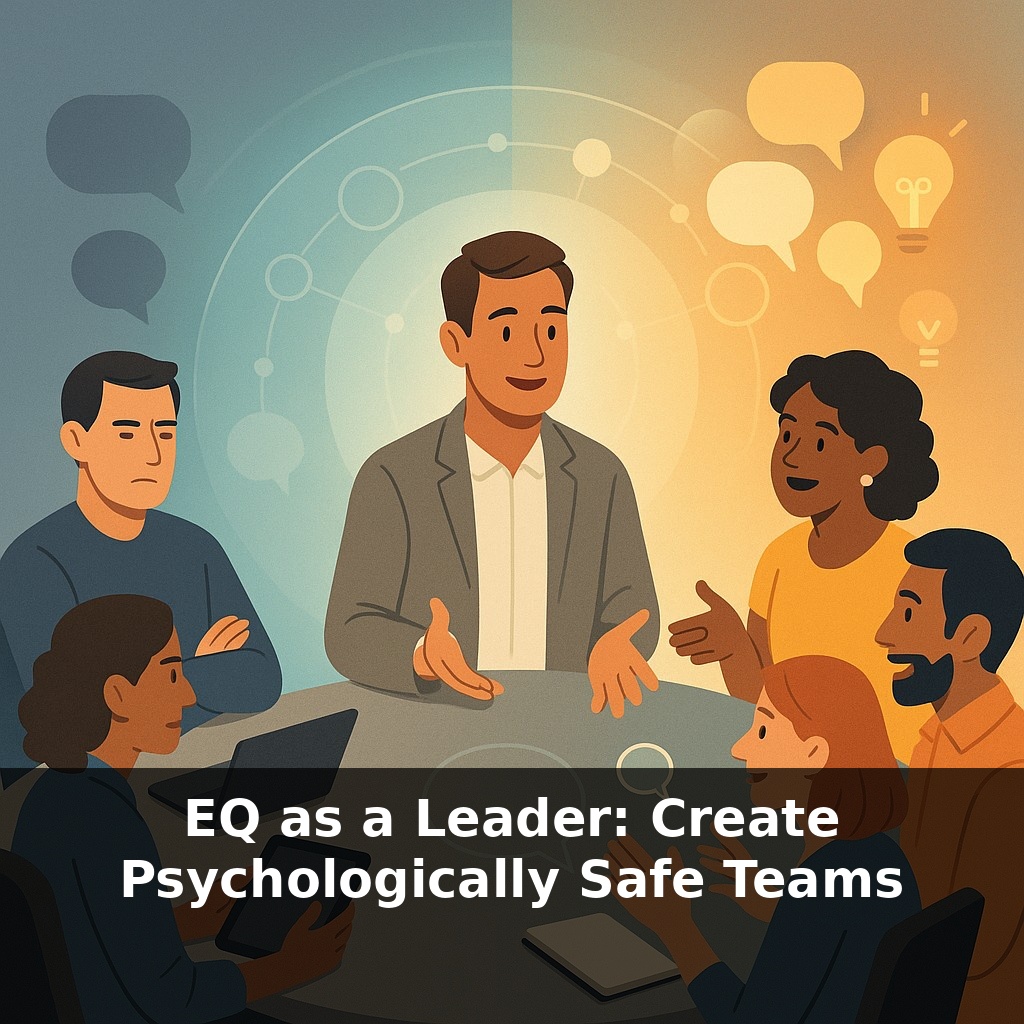
While many leaders cling to 'toughness' as a tool for success, the true innovation cost lies in the silent suppression of ideas. Sarah, a marketing genius, leans back during meetings, withholding insights that could drive major breakthroughs. Silence here isn’t golden—it’s costly.
Thirty‑one percent. That’s how much more often psychologically safe teams hit performance targets in Google’s internal research. Not because they’re nicer—because they surface problems sooner, argue better, and recover faster when things go wrong. And the leaders at the center of those teams aren’t the loudest or the toughest. They’re the ones using emotional intelligence deliberately: reading the room, naming the tension, and staying curious when others get defensive.
This isn’t soft science. Gallup links high‑EQ leaders to 20 % lower turnover. A global EQ study ties a single‑point EQ jump to a 10 % engagement boost. In healthcare, Amy Edmondson found teams that reported 40 % more errors actually had better patient outcomes—because people told the truth.
In this episode, you’ll translate EQ into concrete leadership habits your team can feel in every meeting.
Leaders often say, “My door is always open,” but their micro‑reactions close it in seconds. A raised eyebrow, a rushed “we’ve tried that,” or a sigh when someone flags a risk can shut down contribution for weeks. Neuroscience backs this up: Paul Zak’s lab found trust‑boosting behaviors can raise oxytocin levels by up to 50 %, shifting people from threat to learning mode. The lever you control isn’t grand speeches; it’s dozens of small, observable behaviors per day—especially under pressure—that signal whether speaking up is rewarded or quietly punished. This episode focuses on those specific behaviors.
Start with what people can see and feel from you in the moment. High‑EQ leadership isn’t a personality trait; it’s a set of repeatable behaviors under stress. Here are four that reliably shift a room from guarded to engaged.
1. How you open the conversation Most leaders jump straight to content: “Here’s the issue.” High‑EQ leaders start by lowering the social risk. For example: - “I may be missing something here, so I’d like your pushback.” - “This is half‑baked—help me stress‑test it.” That 10‑second framing tells people you expect critique, not compliance. Use numbers to keep it honest: “I’ve spent about 70 % of my time on this idea; that means there’s at least 30 % I haven’t seen. What are we blind to?”
2. How you respond to friction Conflict is the stress test of psychological safety. Instead of defending, narrate your internal state and choose curiosity: - “I notice I’m getting a bit defensive—I’m going to pause and understand your view.” - “On a scale of 1–10, how strongly do you feel about this approach? What makes it an 8?” Quantifying intensity helps you discern when a disagreement is minor preference (3–4) or mission‑critical (8–9), and it signals you care about their assessment, not just their agreement.
3. How you handle bad news The first three seconds after someone shares a problem matter disproportionately. Swap “Why did this happen?” (often heard as blame) for: - “Thank you for surfacing this early. What do you think are the top 1–2 drivers?” - “If we could only fix 20 % of this issue this week, which part would you start with?” You’re training the team that bringing issues forward earns respect and structured problem‑solving, not interrogation.
4. How you close the loop Psychological safety erodes when input disappears into a black box. Close with specific follow‑through: - “You raised 5 risks. We’ll tackle 2 this sprint: A and C. We’re parking the other 3 until Q3—here’s why.” Concrete numbers show you listened, prioritized, and decided, instead of nodding and reverting to your own plan.
In medicine, the best surgical teams use brief, scripted checklists to force these behaviors—short prompts that turn hierarchy into collaboration without slowing the work. You can do the same with a few well‑chosen sentences, used consistently, until your team starts using them with each other.
At a software company rolling out a risky product change, one director started every design review with, “We’re here to break this idea, not each other,” then explicitly invited the most junior engineer to speak first. Within 3 months, the team had logged 27 “pre‑launch saves” in Jira—issues caught before release—compared with 9 in the previous quarter. No extra headcount. Just different behavior in the room.
A manufacturing plant manager used colored index cards in daily huddles: green for “all good,” yellow for “small concern,” red for “significant risk.” People could raise a card without interrupting. Over 6 weeks, red/yellow cards appeared in 19 of 30 meetings, leading to 7 process tweaks and a 15 % drop in minor defects.
If you’re unsure where to start, pick one recurring meeting and change just the first 2 minutes and last 2 minutes for 4 weeks. Open by normalizing dissent; close by summarizing what input changed your mind and what you’ll decide later, with dates.
As AI takes over predictable tasks, your edge will come from how well you run the “human system.” By 2030, McKinsey estimates up to 30 % of work hours could be automated in advanced economies; the rest will depend heavily on collaboration under uncertainty. High‑stakes hybrid launches, cross‑border squads and VR “war rooms” will magnify every EQ skill you’ve practiced. Your challenge this week: in one recurring meeting, ask, “What feels risky to say here?”—then act on one answer.
Treat this as a skill sprint, not a mindset shift. For the next 30 days, log 1 interaction per day where you either invited dissent, named your own defensiveness, or thanked someone for raising a risk. After 30 entries, count: in how many did the other person open up more (aim for 20+)? That number is your new baseline—improve it by 5 next month.
Here’s your challenge this week: In your next team meeting, start with a 5‑minute “failure share” where you go first and describe a recent mistake you made, what you felt in the moment, and what you learned from it—no sugarcoating. Then, ask each person to share one moment from the past month when they felt hesitant to speak up, and respond to each share with one validating phrase (e.g., “That makes sense,” “Thank you for saying that out loud”). Before the meeting ends, ask the team to vote (verbally or via chat) on one specific behavior they want you to practice that would make them feel safer to disagree with you this week, and commit to trying it in your next three interactions.