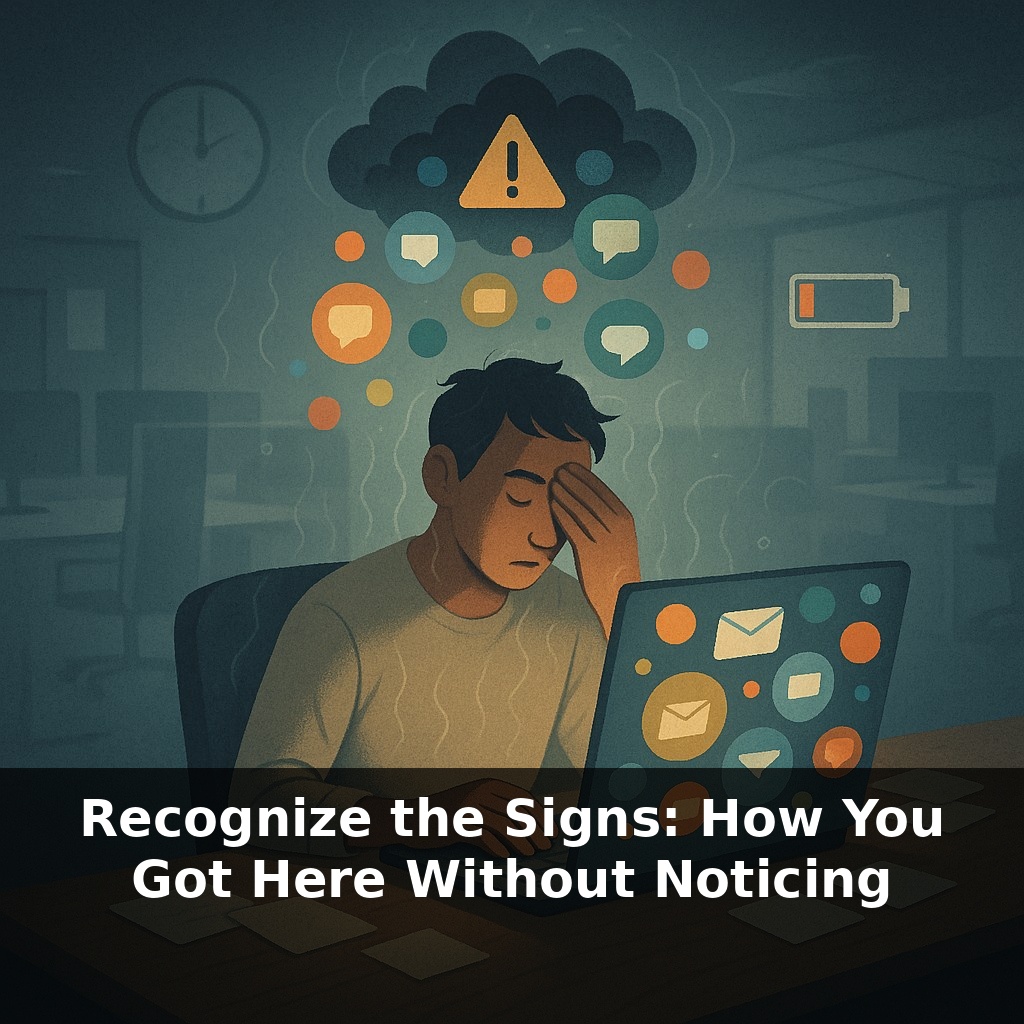
Recognize the Signs: How You Got Here Without Noticing
📝 Transcript
The average office worker checks email or chat about every six minutes—yet most will swear they’re “just a bit busy.” You start the week energized, end it snapping at small things, and still call it normal. The paradox is: burnout rarely feels like burnout while it’s happening.
You don’t wake up one morning and “have” burnout the way you wake up with the flu. You slide into it in tiny, almost invisible steps that feel like reasonable responses to a demanding life. You start going to bed a bit later “just to clear today’s tasks,” skipping one workout “because this week is exceptional,” working through lunch “until things calm down.” Weeks pass, but the exception quietly becomes the rule. Your nervous system keeps adapting, like turning up the volume on a podcast in a noisy café—you hear fine, but the background noise never really stops. The tricky part is that many of the early signs masquerade as being committed, ambitious, or a “team player.” You tell yourself you’re just in a push phase, just until that project ends, just until your manager hires help. But the finish line keeps moving, and your body is keeping score even when your calendar looks like it’s winning.
So how do people actually cross the line from “busy but fine” to “something’s off” without noticing? It often starts with small trades you make with yourself. You swap a real lunch for scrolling between meetings. You answer Slack in bed because “it’ll only take a second.” You start measuring days less by how you feel and more by how much you got through. Over time, your inner dashboard—hunger, tension, mood, focus—gets ignored the way we ignore app notifications we’ve seen too often. You’re still functioning, maybe even praised for it, but you’re flying with instruments you’ve quietly stopped checking.
One of the most slippery parts of this slide is that the warning signs don’t arrive labeled as “warning signs.” They usually show up wearing disguises that sound flattering or reasonable.
Sleep is a good example. You might not say, “My rest is collapsing.” You say, “I do my best thinking at night,” while your bedtime drifts 15–30 minutes later each week. You still *can* get up, so it feels fine. But research shows that even losing about an hour and a half of sleep a night for a week can quietly dull your thinking as much as being just over the legal driving limit for alcohol. You’re technically “functional,” but you’re running at a kind of invisible cognitive handicap: more typos, re-reading the same line, needing coffee to feel like yourself.
Something similar happens with focus. Checking Slack and email every few minutes doesn’t just nibble at your time; it trains your brain to expect interruption. The more fragmented your attention, the more effort it takes to do the same task. That extra mental effort often feels like, “Work has gotten more demanding,” rather than, “My attention is being constantly taxed.” You finish the day weirdly exhausted from work that isn’t objectively harder.
Emotionally, the shift is just as incremental. You might notice you’re more irritated by small requests, or oddly blank about projects you used to care about. Instead of naming that flatness, you frame it as “being realistic,” “less naïve,” or “just tired this week.” Cynicism can sound sophisticated in your own head: you call it “seeing how things really work,” even as you stop bringing ideas because “nothing changes anyway.”
Socially, you may start opting out: skipping the quick coffee with a colleague, turning camera off more often, defaulting to “I’m slammed” when friends ask to meet. It doesn’t feel like isolation; it feels like efficiency. Yet your world narrows to screens and obligations.
Organizations can unintentionally reward every one of these shifts. Answering late-night messages earns praise. Plowing through illness gets you labeled “reliable.” Never saying no looks like commitment. From the outside, you appear dedicated. Inside, you’re slowly trading flexibility, curiosity, and joy for bare-minimum functioning.
Burnout is like a phone battery that’s never allowed to charge above 5% because background apps—notifications, worries, mental to‑dos—are constantly running. At first you just plug in more often. Over time, the battery itself degrades, not just the charge level. By the time performance obviously drops, the wear has been building for months or years.
This is why burnout so often surprises people: the patterns were there, but each micro-step felt logical, temporary, and even admirable in the moment.
You might notice this creep not in crises, but in tiny, ordinary moments. You re-read the same email three times, not because it’s complex, but because your mind keeps tabbing over to the next thing you “should” be doing. You tell yourself you’ll step outside after this call, then another invite appears and the break quietly disappears. A week later, you can’t quite say when you last saw daylight during work hours.
Micro‑errors often show up first: replying in the wrong Slack thread, forgetting to attach the file, double‑booking a meeting. Each one feels like clumsiness, so you compensate by triple‑checking everything—adding more invisible workload to a day that already feels packed.
Relationships shift too. You stop volunteering thoughts in meetings because “it’s easier if someone else decides.” At home, simple questions—“What do you want for dinner?”—start to feel oddly heavy. Decision fatigue blurs preference into “I don’t mind,” even when you do.
Your body offers quiet hints: jaw tight during “quick” check‑ins, shoulders curving in as you open your laptop, stomach clenching at calendar alerts. None of these moments scream “crisis.” That’s exactly why they’re so easy to miss.
Soon, spotting overload may not rely on “how you feel” at all. Workplaces are already testing dashboards that blend meeting load, response times, and even wearable data into a kind of “pressure index.” Helpful—like a weather report—until it starts driving decisions about promotions or layoffs. The frontier question isn’t just “Can we detect strain earlier?” but “Who owns that knowledge—and who gets to act on it first: you, or your employer?”
Noticing these small shifts isn’t about blaming yourself; it’s about reclaiming authorship. Instead of waiting for a dramatic crash, you can treat each subtle signal like a notification from an app you actually control: “Update available.” The experiment is to respond sooner, with tiny course‑corrections, before the system quietly rewrites your whole operating code.
To go deeper, here are 3 next steps: (1) Re‑listen to the section where they talk about “micro-compromises” and then use the free Values Assessment from the VIA Institute on Character (viacharacter.org) to see exactly which values you’ve quietly sidelined over the past year. (2) Print the “frog in boiling water” metaphor checklist from the episode show notes (or, if they didn’t provide one, grab the free “Life Satisfaction Wheel” from positivepsychology.com) and score your current job, relationships, health, and finances to spot where you’ve been slowly tolerating red flags. (3) Grab a copy of *The Slight Edge* by Jeff Olson or *Atomic Habits* by James Clear and set a 7‑day rule from the episode—every night this week, use the Habit Tracker template from jamesclear.com to record one way you either honored or ignored a warning sign in your day.
From this course
From Burnout to Sustainable High Performance
8 episodesUnlock all episodes
Full access to 8 episodes and everything on OwlUp.
Subscribe — $1.99/monthLess than a coffee ☕ · Cancel anytime