You woke up today with more energy than a billionaire has dollars—and leaked most of it before lunch. A tiny sleep deficit, a buzzing phone, three “quick” emails, and suddenly you’re exhausted. Here’s the twist: your calendar didn’t do that. Your invisible energy habits did.
Most people try to “fix” exhaustion by rearranging their calendar: fewer meetings, a different to‑do app, maybe a new morning routine. Helpful, but incomplete. What actually determines how drained or alive you feel at 4 p.m. isn’t just what you’re doing—it’s the *energy price* each activity quietly charges you.
Two people can walk out of the same one‑hour meeting: one is fired up with ideas, the other wants to lie under their desk. Same hour, wildly different energy math.
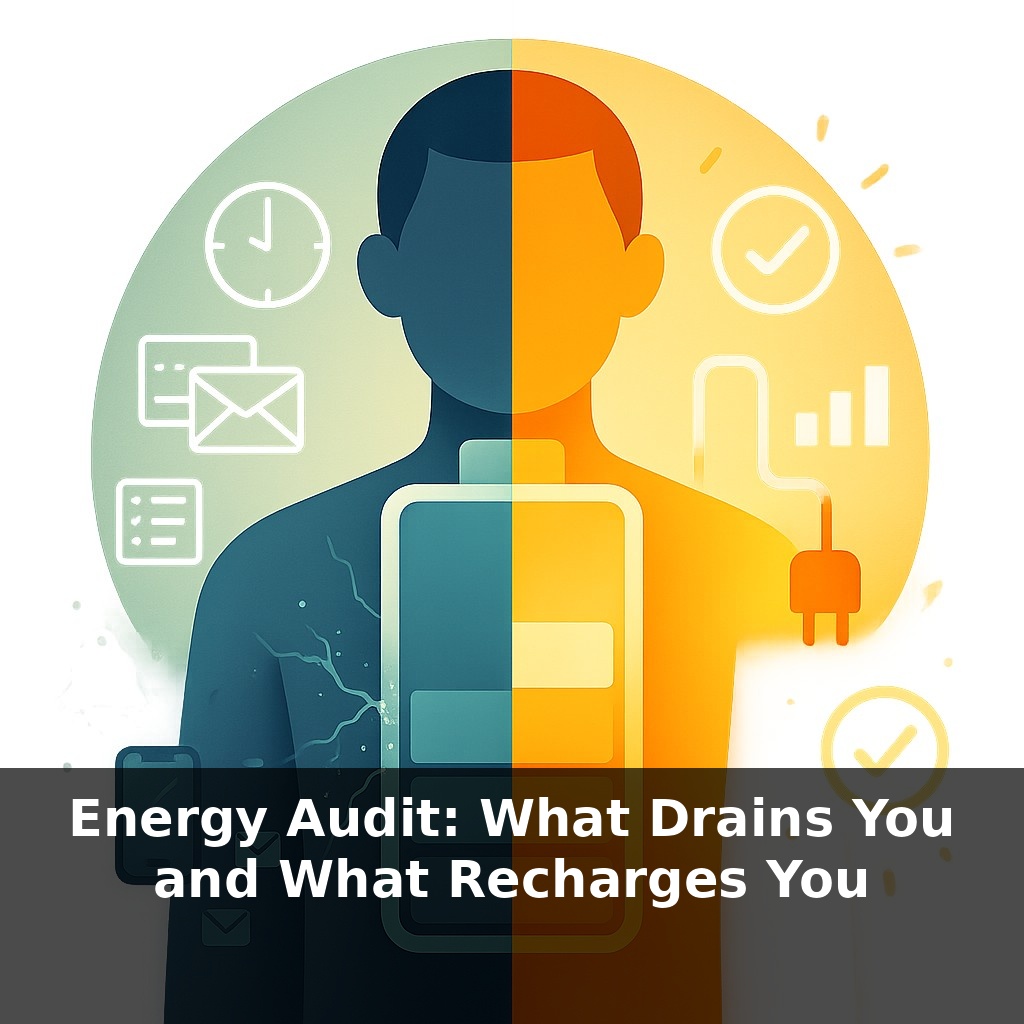
This is where an energy audit comes in. Instead of guessing what’s burning you out, you start observing it like a researcher: which conversations, tools, commutes, foods, and tiny in‑between moments are slowly taxing you—and which ones, unexpectedly, top you up again, like finding bonus credits you didn’t know you had.
Most of us only notice energy when it’s in crisis mode—eyes burning at 10 p.m., or staring blankly at a screen at 2 p.m. The rest of the day is a blur of “I’m fine.” But underneath “fine” is very specific data: your heart racing after certain Slack pings, the calm you feel when you walk outside, the way a focused 90‑minute block leaves you clearer than three scattered hours. This episode is about turning that fuzzy sense of “I’m tired” into traceable patterns you can actually work with, like switching on a detailed dashboard instead of relying on a warning light.
Here’s where this gets interesting: not all “tired” is the same, and not all “rest” fixes the kind you have.
Researchers now talk about *four* main energy streams: physical, emotional, mental, and spiritual (or meaning-based). Each has its own drains, its own chargers, and its own “currency exchange rate” with the others.
Physical is the most obvious: movement, food quality, light exposure, HRV, sleep. That Stanford data on sleep and productivity is really just one tiny window into how fragile this layer is. Drop it too low and everything else—mood, focus, sense of purpose—starts operating on emergency power.
Emotional energy is about your inner climate: safety, friction, tension, appreciation. A 30‑minute status meeting with a psychologically safe team might *restore* you, while a 10‑minute interaction with a contemptuous manager can wipe you out for hours. Same time block, opposite impact on this specific stream.
Mental energy is your capacity for directed, high-quality thinking. That UC Irvine finding—that knowledge workers switch tasks every 2.8 minutes—shows how expensive fragmentation is here. Every ping, tab-switch, or “let me just check that” forces your brain to pay a re-entry fee to get back into deep focus.
Spiritual or meaning energy is the sense that what you’re doing matters to something larger than your to‑do list. Microsoft Japan’s four‑day workweek didn’t just give people another day off; it signaled trust and respect, which often boosts this meaning layer. People weren’t only less tired; they felt more aligned.
The trap is that we usually try to fix every dip with a single lever—coffee, a nap, a workout, a quote on Instagram—and then wonder why it only half‑works. The real move is to notice *which* stream is low.
Think of a day when you were physically fine but mentally shredded from decisions, or when your brain was sharp but emotionally flat from constant conflict. The activities were the same; the *location* of the drain was different. The more precise you get about the “where,” the more surgical you can be about the “what now.”
A practical way to see this in action is to zoom into a single, ordinary day and tag moments by *type* of drain or charge. Say you start with a quiet 30‑minute walk: your breathing slows, shoulders drop, a small idea pops into your head about a tricky project. That’s one act feeding physical recovery, mental clarity, and even a hint of meaning in one shot.
Contrast that with a “quick” check of your inbox before bed. You read a vague message from your manager: “We need to talk tomorrow.” No real time cost, but now your mind spins through worst‑case scenarios. You sleep, but it’s shallow; you wake up on edge. The original trigger was emotional, but it quietly taxes your mental and physical reserves overnight.
Or think about tackling a complex brief in one uninterrupted block versus chopping it into six pieces between chats and notifications. Same total minutes, very different mental toll—and very different sense of progress, which ripples into motivation and purpose the rest of the week.
As workloads intensify and AI handles more routine tasks, the “cost” of wasting mental and meaning-based energy gets steeper. The real opportunity isn’t to power through, but to design work that fits your natural rhythms: batching deep work, front‑loading complex thinking when you’re sharpest, and reserving low‑stakes admin for your dips. Treat your calendar like a chef treats a menu—pairing demanding “courses” with deliberate recovery so you don’t blow your capacity by midday.
Treat this week like a quiet beta test, not a makeover. Note one tiny tweak—leaving your desk for 5 minutes, saying no once, protecting a focus block—and watch how the rest of your day “recompiles.” Over time, these micro-updates stack, like releasing new versions of your operating system: fewer crashes, smoother performance, same hardware—better you.
Try this experiment: Tomorrow, set a timer for every 2 hours and label your energy in that moment as “plugged in,” “battery saver,” or “drained,” and next to it, write exactly what you just did in the last 30 minutes (meeting, scrolling, deep work, talking to a friend, etc.). At the end of the day, circle the three activities that showed up most often next to “plugged in” and schedule a 10–15 minute block of one of those recharging activities into the same time slot for the next three days. At the same time, take one activity that kept showing up next to “drained” (like back-to-back Zoom calls or doom-scrolling) and reduce it by half for those same three days, replacing the gap with your chosen recharger. After three days, notice: do you feel even slightly less fried at the end of the day, and which swap made the biggest difference?