You’re working late… again. The to‑do list is longer, your focus is worse, and yet you keep telling yourself, “I just need to push harder.” Here’s the twist: research shows that past a certain point, adding more hours can quietly start subtracting from your results.
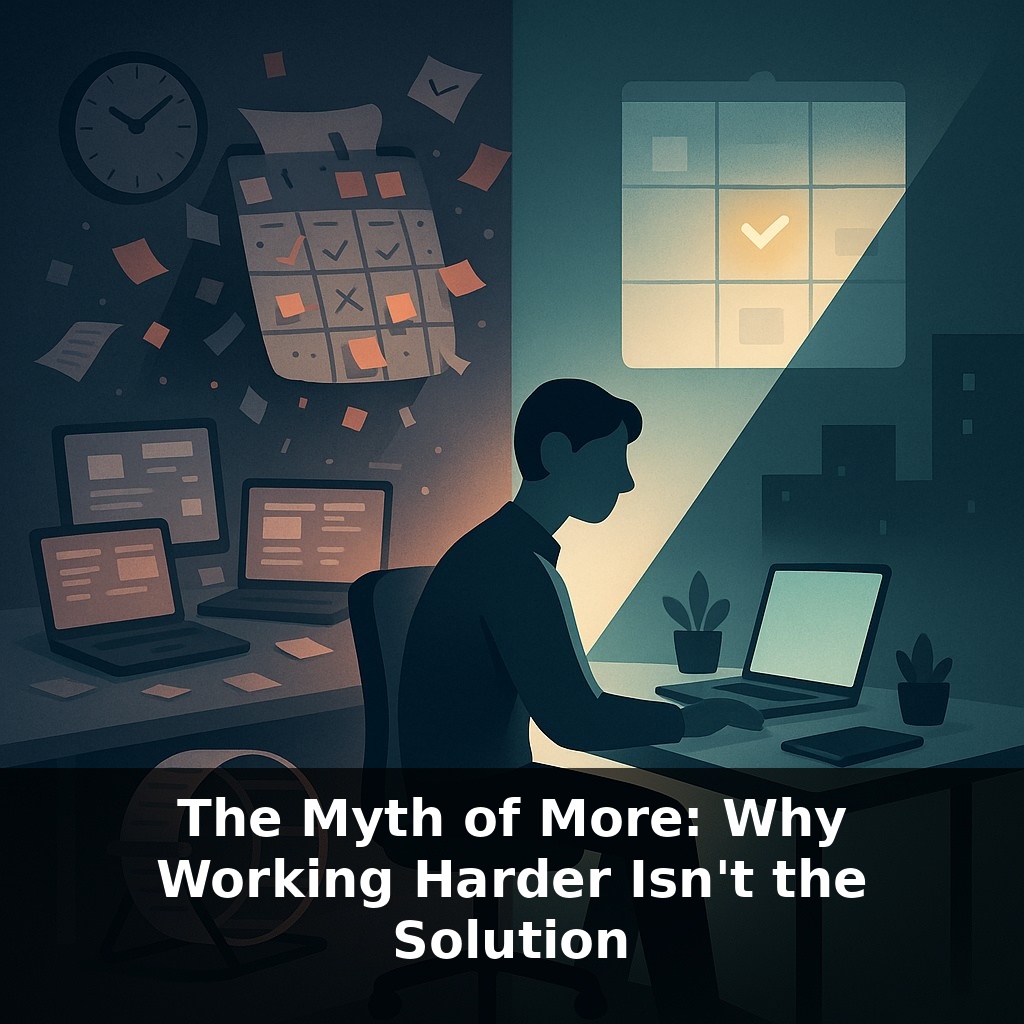
A strange thing happens when “I’ll just do a bit more” becomes your default move: your entire day quietly reorganizes around urgency instead of impact. You start treating your calendar like a suitcase—if there’s empty space, you feel compelled to stuff something else in. Meetings that should be 20 minutes swell to 45. Emails you could ignore become mini-essays. Minor tasks sneak onto center stage, while the work that actually moves your career forward keeps getting pushed to “when I finally have time.”
This is the myth of more in action: the belief that adding effort automatically adds value. But notice what’s missing from that equation: intention. The most sustainable high performers aren’t the ones who tolerate the most pressure; they’re the ones who are ruthlessly selective about what deserves their full effort in the first place. In this episode, we’ll zoom in on how “more” quietly hijacks your choices—and what to do instead.
The trouble is, “more” doesn’t just fill your calendar; it rewires your default settings. Your brain starts tagging any empty slot as “wasted,” so you auto-accept meetings, say yes to “quick favors,” and keep Slack open like a nervous system. You stop asking, “Should this exist at all?” and only ask, “Where can I squeeze this in?” Over time, that pulls you into a reactive stance—constantly responding, rarely directing. It’s like running every app on your laptop at once: nothing crashes dramatically, but everything slows, updates take forever, and the work that truly matters never gets the full processing power it needs.
Think about what “more” actually looks like in a typical day. It rarely shows up as a dramatic decision like, “I’ll work 80 hours this week.” It sneaks in as micro‑choices that feel harmless in the moment:
You see a notification and “quickly” check it between tasks. Someone pings, “Got a minute?” and you say yes before you’ve even read the full message. A meeting invite appears with ten people on it and you click Accept because declining feels political. None of these choices seem like a big deal, but each one slices your attention into thinner strips.
Here’s where the research gets uncomfortable: your brain doesn’t just track how much you work, it tracks how fragmented your work is. Constant context‑switching costs you time, but it also fools you into feeling strangely productive. You’re touching a lot of things, so it must mean you’re moving a lot of things forward—right? Yet when you zoom out at the end of the week, the needle on what truly matters hasn’t moved nearly as far as your exhaustion suggests it should.
At an organizational level, the myth of more shows up as cultures that glorify responsiveness: fast replies, always‑on chat, back‑to‑back video calls. Leaders say they value deep thinking, but reward instant answers. Systems get built for visibility instead of effectiveness: more status updates, more dashboards, more check‑ins. People learn that the safest career move isn’t to do the most meaningful work; it’s to be the most visibly busy.
Notice who benefits from this setup. It rarely produces better strategy, cleaner code, or more thoughtful design. What it does produce is an endless stream of activity that’s easy to measure and hard to question. If everyone is at capacity, no one has to confront whether the work itself is well chosen.
This is where “working smarter” stops being a motivational poster and becomes something sharper: a willingness to disrupt the default. To question whether you’re solving the right problems instead of just solving visible ones. To design your workday so that important decisions and creative work aren’t squeezed into the margins, but given protected, high‑quality time—while the noise gets automated, delegated, batched, or simply dropped.
You don’t have to overhaul your entire job to start. You do have to get honest about one thing: which parts of your workload exist because they’re genuinely valuable, and which exist because no one has paused long enough to say, “Why are we still doing this?”
Think of your workload like a complicated piece of software you inherited instead of wrote yourself. Over the years, features were bolted on in a hurry: a weekly standup here, a status deck there, another approval step “just in case.” Nobody ever goes back to refactor; they just keep adding patches. At some point, the system isn’t slow because the processor is weak—it’s slow because the codebase is bloated and tangled. Your day works the same way. A recurring meeting that no one questions. A report three different teams compile separately. A Slack channel that generates more anxiety than insight. In companies that redesigned this “code,” the gains were startling: teams that killed one standing meeting freed up hours for strategy; leaders who set “office hours” replaced random pings with focused time. The takeaway isn’t to squeeze your calendar tighter; it’s to identify which parts of the system need a rewrite, not more CPU.
Tomorrow’s “more” may be measured less in hours and more in insight per quiet block. As AI takes over routine churn, the real leverage will come from protecting the human work machines can’t do: connecting dots, sensing nuance, earning trust. Calendars could start to look more like city grids than parking lots—clear lanes for deep work, side streets for collaboration. Teams that design around energy instead of ego will ship fewer things, but each one will matter more. Those clinging to volume will feel increasingly outdated.
Treat this week like a live beta test. Notice where you still equate value with volume: the extra slide you add, the late email you answer, the “quick” favor you accept. Then, once a day, trade one of those reflexive yeses for a cleaner boundary. You’re not trying to do less; you’re trying to ship better “features” with the energy you already have.
Try this experiment: Tomorrow, keep your normal workday hours but deliberately cap yourself at **three** meaningful tasks: one “deep work” task, one maintenance/admin task, and one relationship/communication task. Before you start, list those three clearly on a sticky note and put it in front of your keyboard. Any time a new request, email, or “quick thing” pops up, don’t do it—park it on a separate “Parking Lot” list and return to your three core tasks only. At the end of the day, compare how you feel (energy, sense of progress, stress level) with a typical “do everything” day and notice whether doing *less* actually moved the needle more.