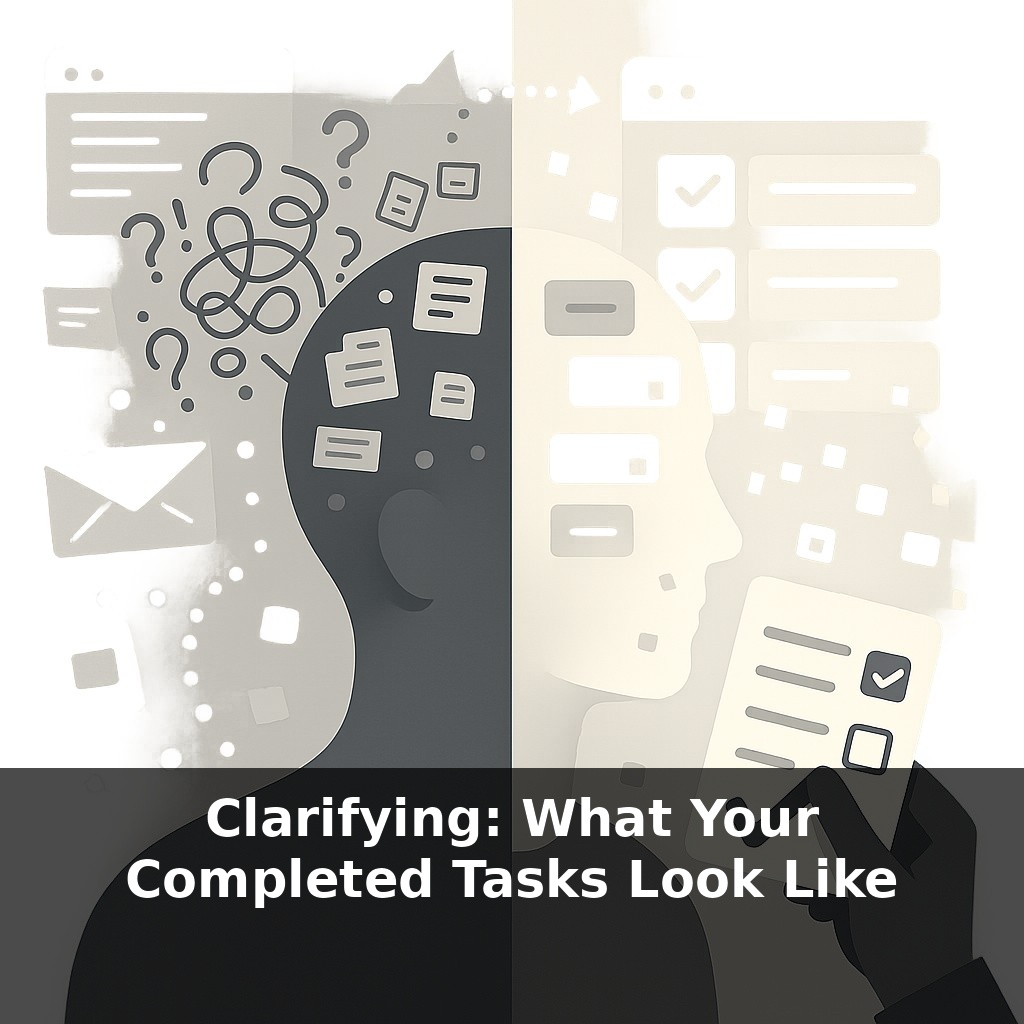
You clear your inbox, but your brain still feels crowded. Here’s the paradox: it’s not the number of tasks stressing you out, it’s the ones you can’t picture finished. In this episode, we’ll explore why your work only relaxes you once you can *see* what “done” actually looks like.
Most people treat their inbox, notes app, and meeting minutes like a crowded attic: everything gets tossed in, nothing gets properly labeled. The Clarify step in GTD is where you stop “stacking stuff” and start deciding what each thing actually *is*. Instead of vaguely thinking, “I should deal with this,” you specify, “This is a client question that needs a draft reply,” or “This is an idea for next quarter, not this week.” The power move is that you’re not doing the work yet—you’re defining it so precisely that future-you can do it with almost no thinking. You’re separating raw material from real commitments, distinguishing ideas from obligations, and turning fuzzy intentions into concrete, finishable pieces of work that your system can actually track and complete.
Clarifying is less about being organized and more about being *honest* with your work. That calendar invite, the Slack ping, the half-legible note from yesterday’s meeting—each one is quietly asking, “What, exactly, do you expect from me?” In GTD, you answer by deciding the *finish line*: is this something to move, decide, draft, or simply park for later? Until you define that finish line, your brain treats everything as equally urgent. Once you do, you can sort items like you’d sort luggage at an airport: this bag boards now, this one connects later, this one never should’ve been checked in.
Clarifying starts with a deceptively simple fork in the road: every input becomes either “actionable” or “not actionable.” That sounds binary, but in practice it creates several clear destinations, each with a different definition of “finished.”
If it’s *not* actionable—no movement needed right now—you only have three options: - Trash: Done means “I’ve decided this will never matter.” - Someday/Maybe: Done means “I’m parking this where I’ll see it when I *choose* to consider new projects.” - Reference: Done means “It’s stored where I can find it, and I don’t owe it anything else.”
Notice what’s missing: “Leave it in the inbox and feel vaguely guilty about it.” The moment you declare one of those three, the loop closes—for now. Your brain stops nagging, because there’s a clear, parked outcome.
If it *is* actionable, you ask two further questions: 1. What’s the very next visible, physical action? 2. Will that action take less than 2 minutes?
If it’s under 2 minutes, the Clarify decision is: do it now. “Done” is literal completion. If it’s longer, you choose one of two paths: - Delegate: Done means “It’s in someone else’s court, and I’ve set a reminder to check back if needed.” - Defer: Done means “It’s on a list or calendar I trust, phrased so clearly future-me can just execute.”
Concretely, “Marketing strategy” becomes: - Project: “Define Q3 marketing strategy for product X.” - Next action: “Email Sarah three time slots to review draft strategy.”
The project goes on a Projects list; the next action lands on your Next Actions list (or a context-specific list like “Calls” or “Computer”). Now “finished” isn’t an abstract hope—it’s a stack of named outcomes, each with its own visible next step.
This is where Clarify differs sharply from merely “capturing.” Capture pulls everything in; Clarify decides where each thing *lives* and what, if anything, you owe it. At scale—120 emails a day, recurring meetings, Slack threads—that distinction becomes career-critical: instead of drowning in inputs, you’re running a steady, almost mechanical decision process that turns chaos into the smallest possible set of concrete moves you can actually finish.
Your calendar reminder says: “Quarterly report.” That’s not something you can actually *do*—it’s a headline, not a step. Clarifying turns it into something concrete like: “Pull revenue numbers from Salesforce for Q1–Q3” and “Draft slide outline for exec review.” Now you’ve got two completions you can literally check off, instead of one vague obligation that lingers.
Same with a Slack DM: “Can we talk about pricing?” Instead of letting it sit, you define: “Reply to Jenna with 3 possible meeting times and ask her to send current proposal.” Once that’s written on your list, the original message no longer owns your attention.
Think of Clarify as financial auditing for your attention: you’re categorizing every “transaction” as spend now, schedule later, or archive. Each clarified item becomes a small, verifiable unit of work you can start and finish in one context, in one sitting—no guessing, no re-deciding, no hidden steps waiting to ambush you mid-task.
In a few years, “inbox zero” may not mean you processed everything yourself—it’ll mean you trained your tools well. As AI starts drafting replies, proposing deadlines, and tagging projects, your role shifts from worker to editor-in-chief. Clarified outcomes become the “style guide” your systems learn from. The more consistently you name results and next actions, the more your tools can pre-sort the noise, like a smart DJ lining up tracks that actually fit your playlist instead of blasting random songs.
As your lists get sharper, you may notice side effects: faster meetings, leaner emails, fewer “just circling back” pings. Clear outcomes nudge collaborators to respond in kind, like labeling leftovers so everyone actually eats them. Over time, your calendar becomes less a graveyard of obligations and more a map of moves you chose on purpose.
Try this experiment: Pick one task on your list that feels vague (like “work on project” or “plan trip”) and, before you touch it, rewrite it as a crystal-clear “done picture” you could photograph or show someone else (e.g., “presentation slides with 10 finished slides saved in Google Drive,” “flight + hotel booked and confirmation emails in inbox”). Then, set a 20-minute timer and only work on moving that task toward that specific “photo-worthy” finish line. When the timer ends, compare how far you got versus how you usually feel after “working on” that kind of task—notice if your brain felt more focused, less resistant, or clearer about when to stop.