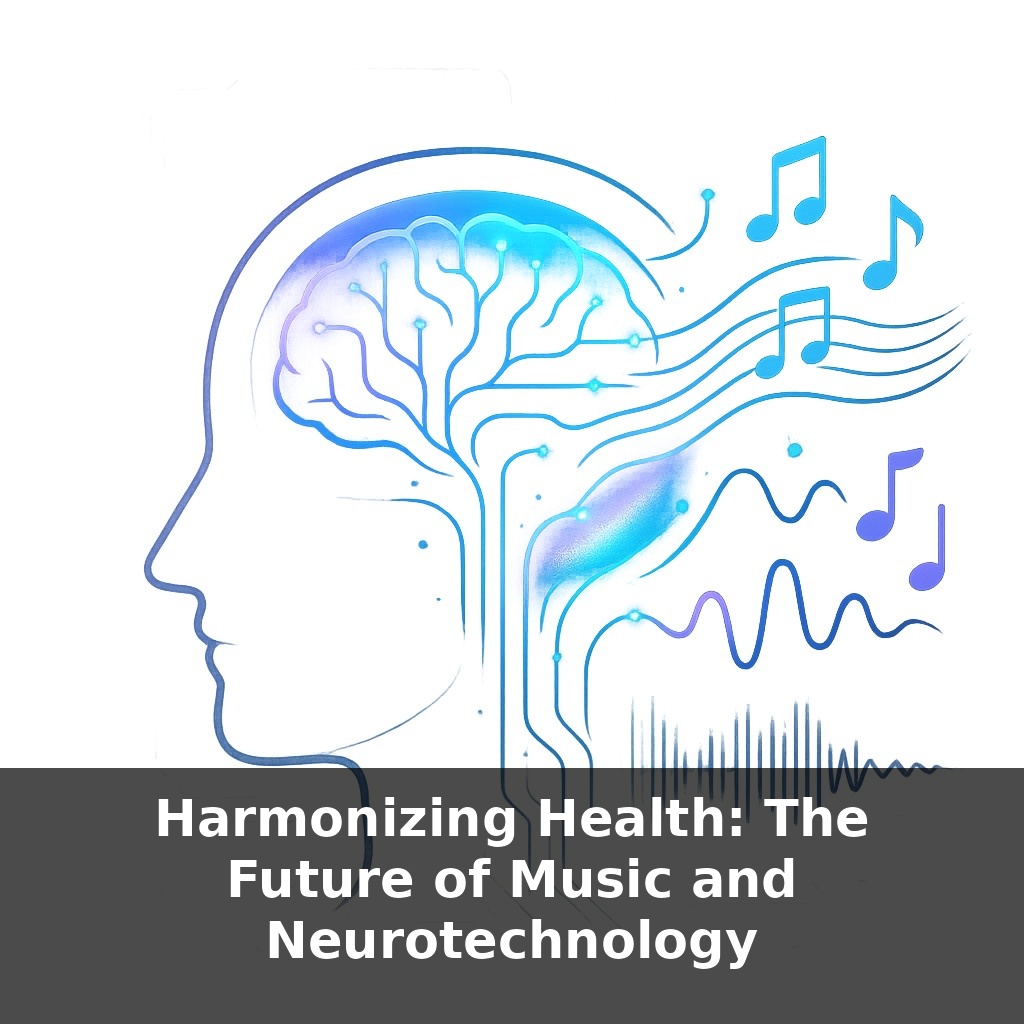
Right now, somewhere, a person who can’t move their hands is performing music—using only their brain signals. In this episode, we’ll step into that lab, follow those invisible electrical whispers, and ask: what happens when your mind, not your fingers, plays the song?
You already know the mind can stand in for the hands. Now widen the frame: the same systems that let a paralyzed musician trigger notes can also *listen back* to your brain and reshape the music you hear in real time.
On average, adults are already bathing their brains in about 30 hours of music every week. Neurotech is quietly turning that background soundtrack into a responsive system—more like a smart thermostat than a static playlist, nudging mood, attention and even movement toward specific targets.
Start-ups are feeding EEG and fMRI data into algorithms to generate “functional music” that claims to dial up focus or downshift anxiety. In clinics, early trials hint that neuro‑adaptive rhythms might help stroke survivors relearn precise motions a bit faster. And in the background, big tech is betting on neural audio hardware that could make today’s headphones feel oddly passive.
Now researchers are testing what happens when that responsive soundtrack doesn’t just *follow* your state, but quietly coaches it. In one MIT pilot, stroke patients moved a recovering limb to rhythms that shifted with their EEG, and shaved seconds off motor tasks. Commercial apps chase something similar for focus, using patterns that subtly tug brain rhythms toward stable, task-ready states. It’s less about a “magic song” and more about tiny, continuous course-corrections—like a navigation system gently re-routing you whenever your attention or mood starts to drift off target.
Call this the moment music stops being “content” and starts behaving like a collaborator.
Until now, most tools we’ve talked about simply *respond* to you. The new frontier is systems that negotiate with your nervous system—subtle, continuous back‑and‑forth between what your brain is doing and what the sound does next.
One strand focuses on emotional regulation. Labs are pairing real‑time neural readouts with generative music engines that can reshape harmony, tempo and texture on the fly. Your arousal level spikes? The system smooths out jagged rhythms and bright timbres. You start to sink toward drowsy rumination? It quietly injects a bit more rhythmic definition and melodic contour. Early anxiety studies suggest this can bring down physiological markers—heart rate, skin conductance—more reliably than fixed playlists.
Another strand is communication. For people who can’t easily move or speak, researchers are mapping distinct neural patterns to musical structures: scale degrees, chords, even short motifs. Instead of selecting letters on a screen, users select *sounds*—building phrases, expressing preference, improvising with a partner. It’s still slow and error‑prone, but the goal isn’t virtuosity; it’s agency and play.
On the consumer side, companies are inching toward lightweight “neuro‑profiles.” Rather than decoding your thoughts, they’re trying to learn signatures like “sustainably focused,” “pleasantly relaxed,” or “mentally overloaded” and link them to specific acoustic recipes. Over weeks, the system could learn that you concentrate best with narrow stereo width and minimal lyrics, or that certain intervals consistently nudge you toward worry. The promise is a kind of nervous‑system budgeting tool that allocates your limited cognitive resources wisely—reserving demanding soundscapes for when they help, stripping them away when they don’t.
That raises an uncomfortable question: if sound can steer your internal state this precisely, who gets to hold the steering wheel—and how will you know when someone else is riding along?
Picture your workday as a series of “levels” in a game. At level one, you’re answering emails; by level five, you’re deep in complex planning. A neuro‑adaptive playlist could, in principle, unlock new “sound power‑ups” only when your brain shows you’re ready—denser textures when you’re cruising, cleaner minimal sound when your circuits are nearing overload. At home, a sleep system might learn that your mind lets go fastest when low, steady tones appear *after* you’ve already started drifting, not before—so it waits for that subtle neural cue before unfolding its slow harmonic ladder.
In rehab, a future drum‑pad for Parkinson’s could slightly shift timing or pitch to reward moments when your movement becomes smoother, turning tiny improvements into instantly audible “wins.” And for creativity, a composing tool might detect when your ideas are looping and introduce gently clashing harmonies, nudging you toward a new melodic path you wouldn’t have chosen on your own.
Neuro‑adaptive sound could become as ordinary as adjustable lighting: a standard part of offices, transit systems and public spaces. Instead of one background loop for everyone in a café, your headphones might locally “tune” the room mix to your needs, while the person beside you hears a different world. Schools could equalize sound‑related advantages, giving easily distracted kids quiet, stabilizing textures and others gentle challenge—like personalized acoustic seating charts for attention.
As these tools mature, think less “high-tech playlist” and more nervous‑system literacy class. You might learn which sonic patterns act like caffeine for your mind and which feel like a weighted blanket for your thoughts. The frontier isn’t just decoding brains; it’s teaching listeners to co‑author their inner climate, note by adaptive note.
Here’s your challenge this week: Pick one specific goal (better sleep, less anxiety, or deeper focus) and create a 7‑day “neuro-music protocol” using the episode’s ideas—e.g., 20 minutes of 40 Hz binaural beats for focus, slow 60–80 BPM ambient tracks for sleep, or nature‑infused soundscapes for calming your nervous system. Use the same playlist at the same time each day, and pair it with one consistent cue (like dimming lights, sitting in the same chair, or putting on the same headphones). Each day, briefly rate your mood, focus, or sleep quality on a 1–10 scale right after the session so you can see if the combination of tempo, frequency, and context is actually shifting your brain state. At the end of 7 days, keep the most effective track/time combo and commit to it as your personal “neural soundtrack” for the next month.