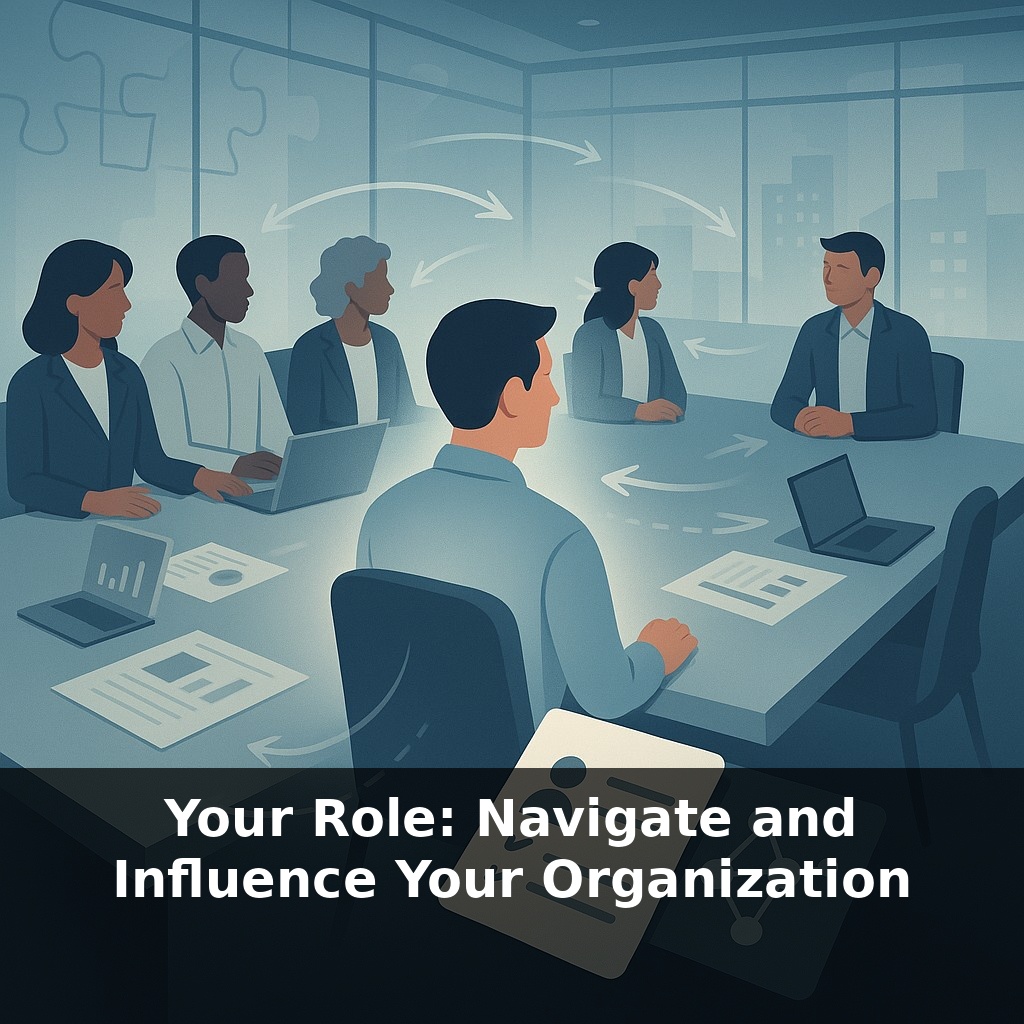
“Most corporate change efforts fail—not because the ideas are bad, but because the people with the best ideas can’t get anyone to move. You’re in a meeting: your proposal is stronger, but a quieter suggestion wins. Why did the room follow them, not you? That’s today’s puzzle.”
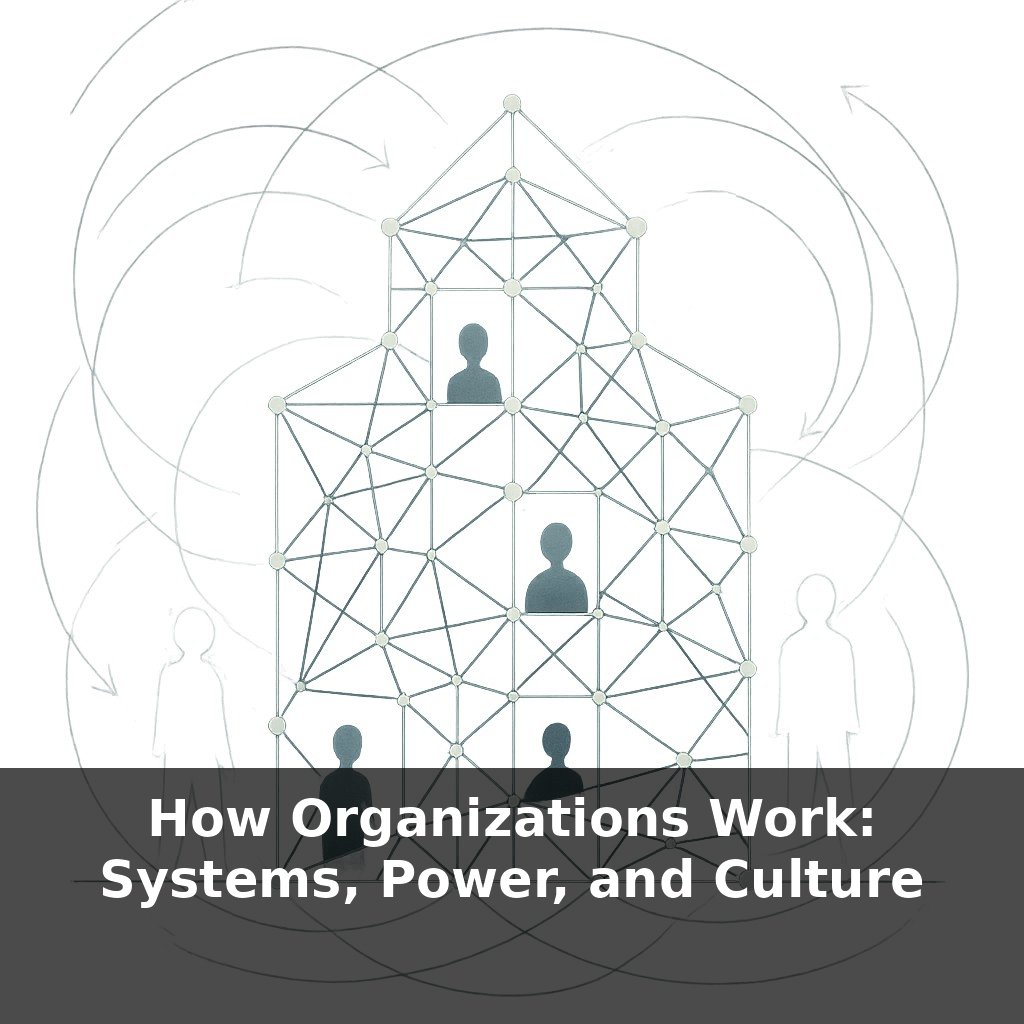
A strange thing happens in most organizations: your formal job description rarely matches the work that actually gets rewarded. On paper, your role is tasks, metrics, deliverables. In practice, your real “job” is to understand how decisions are made, who shapes them, and how to plug your work into those hidden circuits of influence.
That gap—between official structure and lived reality—is where careers quietly accelerate or stall.
You’ve probably seen it: two colleagues deliver similar results, but only one gets tapped for the next big project. It’s not random, and it’s not just “politics” in the eye-roll sense. It’s a system you can learn.
In this episode, we’ll unpack three levers you can actually pull: how you build social capital, how you read and work with your culture, and how you make your value visible without shouting.
So how do you actually navigate this system without becoming “that political person” everyone distrusts? The key is to shift your focus from isolated moves—one networking coffee, one big presentation—to the patterns shaping your daily work. Whose requests always jump the queue? Which projects quietly unlock new opportunities? Where do decisions really get made: standing in hallways, inside Slack channels, or during budget reviews? Think of your week like a data set: every meeting invite, side chat, and follow-up is a signal about power flows, risk tolerance, and who is seen as indispensable.
Start with the lever that feels least awkward: value visibility. Not self-promotion as in “talk louder about yourself,” but designing your work so others can *see* how it helps them win.
Instead of “I did X,” try: “Here’s the risk this removes for us,” or “This cuts two steps for your team.” You’re translating your contribution into the currency decision‑makers already care about: risk, revenue, cost, speed, reputation. The same piece of work can look like “nice to have” or “critical path” depending on that framing.
A practical move: before you start a project, ask your manager, “If this goes really well, whose life gets easier? Who will care most about the outcome?” Those people are your audience. Shape updates, dashboards, and quick pings around *their* metrics, not your task list. You’re not angling for applause; you’re making it effortless for busy people to connect your work to their priorities.
Now, influence rarely comes from heroic solo acts. It compounds through social capital—but not just with “important” people. The testers who quietly block bad releases, the assistant who controls calendars, the analyst everyone trusts with messy data: they’re leverage points. Help them succeed in small, concrete ways, and you build a web of weak ties that often matters more than one “big sponsor.”
Map this informally: who can say “no,” who can say “yes,” and who can strongly *recommend* yes or no? Your aim isn’t to charm everyone; it’s to avoid surprising them. Share early drafts with a few of these people. Ask, “What would make this easier to say yes to?” They’ll surface constraints and landmines that never appear on org charts.
Culture is the backdrop. In some places, public debate is rewarded; in others, the real work happens in pre‑meetings. Watch how dissent shows up: is it handled in the room, or in one‑on‑ones afterward? Adjust your approach accordingly. The same idea, routed through the wrong channel, can die for purely cultural reasons.
Your challenge this week: pick one upcoming decision that matters to you. Before the meeting, talk to three people who will be affected *in different ways*—a beneficiary, a gatekeeper, and a skeptic. Ask each one version of: “What would make this option clearly better from your point of view?” Then, in the meeting, frame your contribution using their words and criteria, not yours. Afterward, note who supports, who resists, and which language landed. You’re not just “speaking up” once—you’re running a small experiment in how influence actually works where you are.
Think about three different colleagues: the quiet engineer everyone trusts when things break, the upbeat project manager who somehow gets cross‑team favors, and the skeptical finance partner who always asks, “What’s the downside?” They’re each using the same three levers differently.
The engineer’s desk looks like a helpdesk queue. She earns influence by responding fast to tricky problems and looping back with, “Here’s what this avoids next time.” People start copying her on decisions because she reduces uncertainty.
The project manager runs on micro‑touchpoints: a Slack reaction here, a 2‑minute hallway check‑in there. Over time, she becomes the person who “always knows what’s going on,” so leaders pull her into early conversations.
The finance partner shapes outcomes by surfacing trade‑offs before others see them. When he says, “If we structure it this way, you can still hit your launch date *and* stay within budget,” his framing becomes the default.
Your mix doesn’t have to match theirs, but notice: none of them wait for big stages. They use ordinary moments as influence reps.
Influence literacy will matter more as orgs wire decisions through data and AI. You won’t win by hoarding info, but by curating signals from dashboards, customer feedback, even Slack threads, and translating them into options leaders can act on. Network analysis tools will expose who actually shapes outcomes, a bit like financial statements revealing where money really flows. That transparency raises the bar: your reputation will hinge on how responsibly you use influence, not just whether you have it.
Influence isn’t a fixed trait; it’s more like a skill tree in a game—each interaction earns quiet experience points. Over time, those points unlock access: earlier information, better projects, more say in trade‑offs. Keep asking, “What did today teach me about how this place really runs?” That curiosity keeps you upgrading, not just complying.
Try this experiment: For the next five workdays, treat yourself as a “role anthropologist” and pick ONE cross-functional interaction each day (e.g., with product, ops, finance, etc.) where you’ll deliberately ask, “What does success look like in your role this quarter—and how does my work help or hurt that?” Immediately after the conversation, update a simple one-page “org map” that lists each person, their top success metric, and what they need most from your role. On day five, look at that map and choose one concrete tweak to your own priorities (e.g., change how you report status, what you surface in meetings, or what you stop doing) that better aligns your role with those success metrics. Then, tell at least one of those partners what you’re changing and ask them in a week if it actually made their job easier.