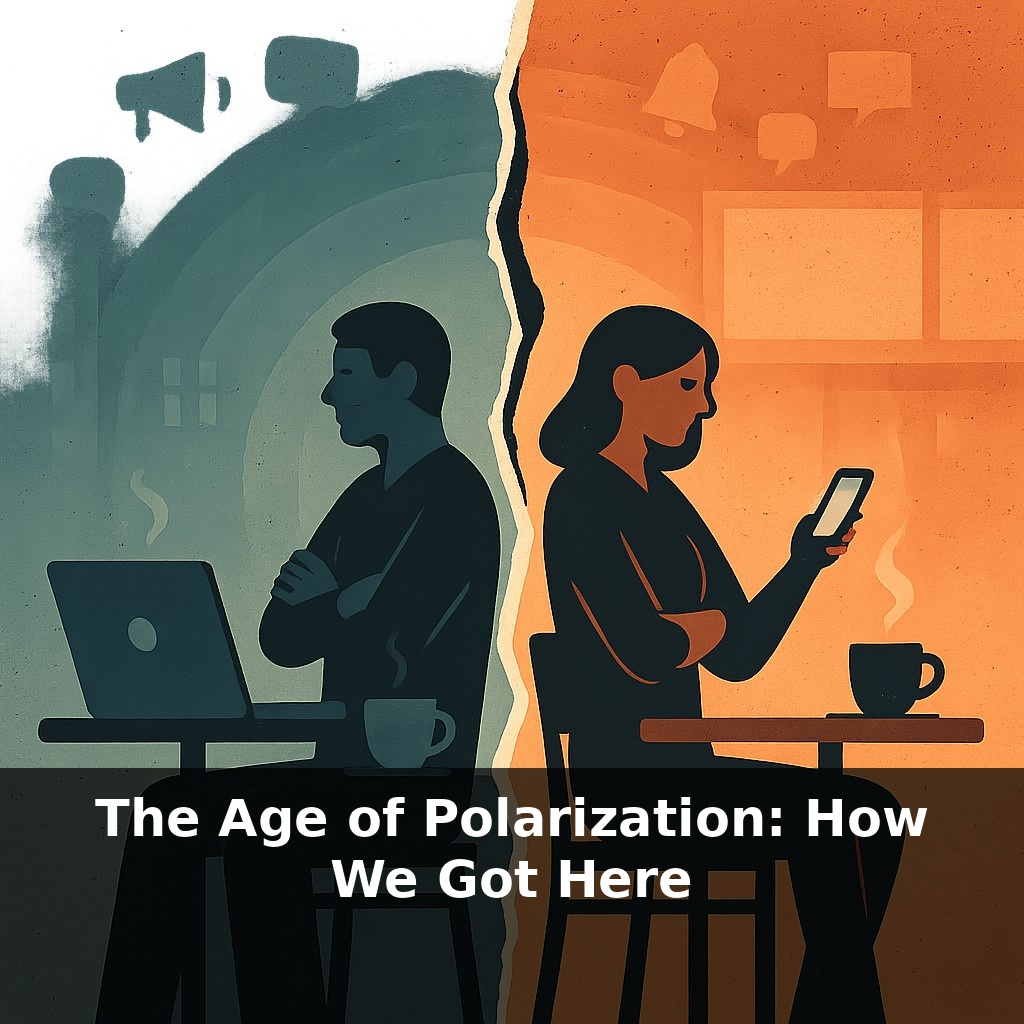
Two strangers bump shoulders in a café and, within seconds, silently sort each other into enemy camps—over a sticker on a laptop, a headline on a phone, a snatch of news on TV. Here’s the twist: this reflex isn’t ancient. It’s a surprisingly recent feature of modern life.
In the span of a few decades, mild disagreement has hardened into something closer to team loyalty in a championship game: victory feels existential, compromise like betrayal. The data backs up the mood. In the mid‑1990s, only a small slice of Americans reliably lined up on one ideological side; today, that group has more than doubled. Similar patterns appear from Europe to India to Latin America. This isn’t just louder arguing—it’s a shift in how identity, status, and morality get welded to politics. Economic gaps widened, parties reshuffled who they spoke for, media splintered into rival echo chambers, and social platforms learned to reward outrage and moral certainty. Layer by layer, these forces turned routine policy debates into clashes between incompatible worldviews. To understand how we got here, we need to trace how those layers formed—and why they locked together so tightly.
Across the same decades that tempers rose, something quieter was changing in the background: how we work, where we live, and who we trust. College degrees became stronger gateways to stable jobs, and whole professions began leaning clearly left or right. Cities pulled away from rural areas not just in income, but in lifestyle and expectations about the future. News went from a few shared broadcasts to endless, personalized streams. Like code refactoring in a giant software system, each small tweak in economics, culture, and technology rewrote how groups aligned—until the old coalitions no longer fit.
In the early 1980s, many party systems still looked scrambled by today’s standards. In the U.S., “conservative Democrat” and “liberal Republican” were common phrases, and in Europe you could find working‑class conservatives and affluent social democrats sitting under the same party tents. That looseness mattered: if your coworkers, neighbors, and in‑laws were scattered across parties, politics had a hard time becoming a full‑blown moral tribe.
Over the next few decades, that scatter tightened. Parties everywhere began to “sort” themselves by culture as much as by economics. In the U.S., civil‑rights realignment had already nudged white Southern conservatives toward the GOP; later, fights over abortion, guns, immigration, and gender roles pulled culturally conservative voters further right and socially liberal professionals further left. In India, the rise of Hindu nationalism linked religious identity to party identity. In parts of Europe, anti‑immigration parties tied national identity to a specific side of the spectrum. The labels shifted country by country, but the logic was similar: who you were started to say more and more about where you “belonged” politically.
At the same time, inequality climbed. When the top of the income ladder pulls away, politics becomes a battlefield over whose vision of fairness will rule: tax cuts or redistribution, open markets or social protection. The Edelman Trust Barometer’s global “trust gap” between higher‑ and lower‑income groups tracks closely with measures of polarization, suggesting that when people feel locked out economically, they’re more likely to see the other side not just as mistaken, but as rigging the game.
Inside legislatures, that hardening shows up in voting records. In the U.S. Congress, cross‑party votes on big bills have nearly vanished since the early 1980s. Lawmakers who might once have cut deals now fear primary challengers, activist backlashes, and partisan media attacks. The more each side treats compromise as surrender, the more they confirm voters’ suspicions that the stakes are existential.
Layered on top of these structural shifts came a powerful new amplifier: networked media that learned which messages travel fastest. Researchers at the Oxford Internet Institute find that tweets laced with moral‑emotional language spread significantly more than neutral policy talk. That doesn’t create division from nothing, but it does reward voices that frame every disagreement as a test of virtue and loyalty, and it punishes those that sound uncertain, conciliatory, or boring.
Over time, these patterns help fuse economic grievance, cultural identity, and partisan label into something thicker: a “mega‑identity.” Party becomes a shortcut for guessing someone’s values, friends, news sources, even sense of dignity. When that happens, backing down on an issue can feel less like revising an opinion and more like losing face—so people dig in, even when they privately harbor doubts.
Your challenge this week: when you encounter a heated political claim online, pause and ask two questions before reacting: “What identity is being signaled here?” and “What fear or status concern might be underneath this?” You’re not trying to psychoanalyze strangers; you’re training yourself to see the layers—economic, cultural, emotional—that turned a simple policy point into a litmus test. By the end of the week, notice whether your own urge to instantly agree, share, or condemn gets weaker once you can spot those layers in real time.
Think about how these trends show up in ordinary routines. A nurse on a night shift scrolls through her feed during a break. The posts that rise to the top aren’t the careful policy threads she bookmarked, but a friend’s furious video about a new hospital rule and a viral clip mocking “people like her.” She doesn’t need to know the makers’ intentions; the emotional temperature does the sorting.
Or take a sports bar on election night, TVs split between returns and a game. Two fans in the same jersey discover they voted for opposite parties. Instead of shrugging it off, the conversation freezes; both suddenly feel they’ve misread who’s “on their side.” That jolt—“I thought we were the same, maybe we’re not”—is the psychological fuel polarization burns.
Social media can act like a recommendation engine for conflict: if you linger on one tense exchange, you’re quietly nudged toward more like it, until arguments seem to be the only language politics speaks.
Polarization’s next phase may feel less like open conflict and more like a slow rewiring of everyday life: who we hire, date, or trust with our kids. As AI tools learn to read our habits, campaigns and advertisers can tune messages like a thermostat, keeping us at a steady simmer. That makes compromise feel oddly disloyal, like cheering for both teams in a final. The risk isn’t just broken politics; it’s shrinking imaginations about what living together could look like.
Polarization isn’t a fixed destination; it’s more like a weather system we keep feeding or cooling with daily habits—who we mute, which headlines we reward, when we choose to listen instead of perform. We may not rewrite the global script alone, but we can edit our local scenes, creating small pockets where disagreement doesn’t automatically mean disconnection.
To go deeper, here are 3 next steps: (1) Watch Lilliana Mason’s short talks and then read the first two chapters of her book *Uncivil Agreement* to understand how “mega-identities” formed, pausing to compare her examples to your own media and social circles. (2) Install a media-bias tool like Ground News or AllSides, and for one political story today, deliberately read it from three different ideological outlets the podcast mentioned (e.g., Fox News, The New York Times, and The Guardian) to see how framing shifts your reactions. (3) Pick one structured, cross-partisan dialogue space—such as Braver Angels, Living Room Conversations, or The People’s Supper—and sign up today for an upcoming online event, using the episode’s ideas about “de-escalating identity threat” as a personal experiment in how you ask questions and respond.