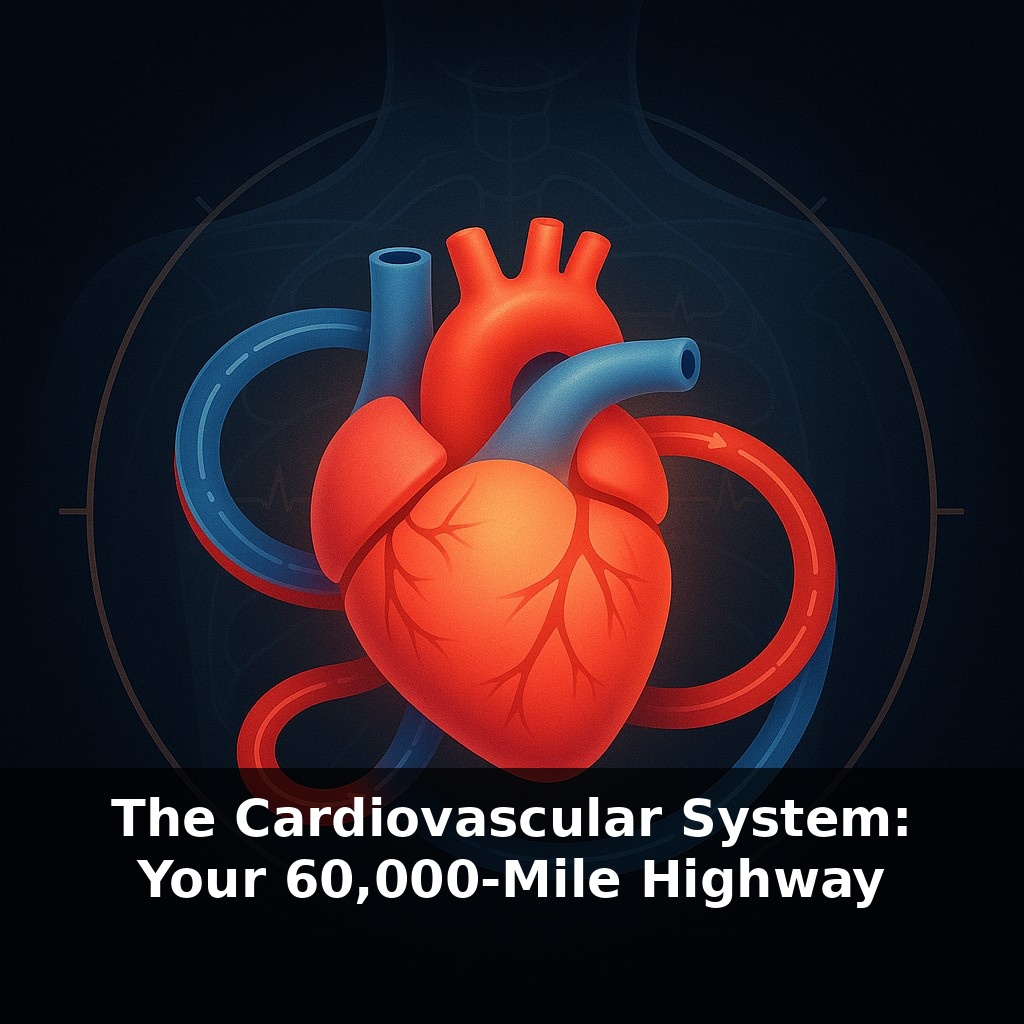
The Cardiovascular System: Your 60,000-Mile Highway
📝 Transcript
Right now, as you sit still, your heart is quietly moving roughly two thousand gallons of blood through tens of thousands of miles of vessels. In the time it takes to tie your shoes, your entire blood supply has already done a full lap through your body.
Your heart and vessels aren’t just moving blood; they’re constantly negotiating priorities. Sprint up the stairs, and blood flow to your leg muscles can increase more than tenfold, while supply to your gut quietly dials down. Eat a big meal, and the opposite happens—your digestive tract becomes the VIP guest. At the same time, your brain refuses to compromise; its flow is held remarkably steady, like a reserved table that’s never given away. All of this happens automatically, driven by tiny sensors in your arteries, chemical signals from tissues, and electrical messages from your nervous system adjusting vessel diameter in milliseconds. Even your emotions leave a signature: stress hormones stiffen arteries and nudge pressure up; deep, slow breathing does the reverse. You don’t just have “blood pressure”—you have a living, constantly updated circulation strategy.
Those shifting priorities show up differently in each branch of the system. Large vessels focus on moving volume; small ones fine‑tune who gets what, when. In your skin, flow can surge to dump heat, which is why your face flushes in a hot room or intense workout. In your kidneys, flow is filtered, minute by minute, to decide how much water and salt you keep—an ongoing edit of your blood’s “recipe.” Meanwhile, microscopic vessels in your bones quietly supply the cells that remodel your skeleton, so even when you feel “at rest,” your circulation is financing continuous construction work everywhere.
Every beat of your heart launches two distinct journeys at once: one to fuel your body, and one to clean it up. On the “fuel” side, blood leaving the left side of the heart heads through major vessels to reach high‑demand organs. Working muscles, for example, can pull so much oxygen and glucose out of passing blood that the saturation of oxygen drops sharply between the artery going in and the vein coming out. That “before and after” difference is actually measurable, and athletes use it—indirectly—to gauge how efficiently their tissues are extracting energy.
The cleanup journey starts on the right side of the heart. Veins returning from your body are loaded with carbon dioxide, lactate, urea, and other waste products. When that blood reaches your lungs, thin, delicate barriers only a single cell thick separate it from the air you breathe. Carbon dioxide slips out, oxygen slips in, and the refreshed blood returns to be launched again toward the rest of the body. If those barriers thicken—say, from long‑term smoking or certain lung diseases—gas exchange slows, and even a perfectly strong heart can’t fully compensate.
Zoom in further, and the contents of blood start to matter as much as its route. Red blood cells carry hemoglobin, the protein that binds oxygen. If you’re anemic—after heavy menstrual periods, poor iron intake, or certain chronic illnesses—you might have normal pumping and open vessels, yet still feel wiped out because each milliliter of blood is delivering less oxygen. At the same time, white blood cells patrol for infection or injury. When you cut your skin, they exit nearby microscopic vessels, follow chemical “breadcrumbs” into the tissue, and coordinate repair.
Blood platelets and clotting proteins add another layer of control. Under normal conditions, they cruise harmlessly. But contact with a damaged vessel wall triggers an instant local response: platelets stick, proteins form fibrin strands, and a plug forms exactly where pressure would otherwise cause a leak. Too little clotting, and minor injuries become risky. Too much, and clots can form inside intact vessels, potentially blocking flow to the heart or brain.
All of this depends on the physical properties of the vessels themselves. Healthy arteries are elastic enough to expand with each pulse, then recoil to keep blood moving between beats. With age, high blood sugar, or long‑standing hypertension, that elasticity can fade. Stiffer vessels mean the same volume of blood generates higher pressures, and the left side of the heart has to work harder to eject each stroke. Over years, the heart muscle can thicken in response—initially helpful, but eventually a setup for fatigue and failure if the underlying strain never eases.
Veins face the opposite challenge: low pressure and uphill travel, especially from your legs. They rely on one‑way valves and the squeeze of surrounding muscles. Each time you walk, calf contractions compress deep veins, pushing blood upward; closed valves prevent it from sliding back down between steps. Sit still for hours on a flight or at a desk, and that muscle‑pump help fades. Blood can pool, ankles swell, and in susceptible people, sluggish flow and local clotting conditions line up—a reason doctors emphasize moving around during long bouts of sitting.
Your blood doesn’t just respond to your behavior; it archives it. Regular endurance training increases plasma volume and stimulates subtle remodeling of the vessel tree. The heart doesn’t just pump more per beat; tissues orchestrate construction of additional tiny side streets, improving access. On the flip side, chronic sedentary time encourages the opposite: fewer signals for growth, more for storage. Over years, fats and inflammatory cells can infiltrate artery walls, forming plaques that narrow the passageway. These plaques don’t simply sit there, either—they can rupture, suddenly exposing their contents to flowing blood and triggering a clot big enough to choke off an entire downstream region.
Yet even with those risks, the system is remarkably resilient and adaptable. Losing a bit of vessel capacity in one area can be partly offset by rerouting flow through alternate paths. Surgeons exploit that property in bypass operations, but your body does a milder version on its own. When a region experiences chronically reduced flow—such as after a small, non‑fatal blockage—local signals promote the enlargement of existing tiny vessels into more substantial detours. It’s not a perfect fix, but it can mean the difference between severe symptoms and barely noticeable ones.
Your challenge this week: pay attention to three specific moments and what they reveal about your cardiovascular system in action. First, notice how quickly your pulse climbs in the first minute of brisk walking and how long it takes to settle afterward—this reflects how rapidly your heart and vessels can re‑prioritize demand and then return to baseline. Second, right after a hot shower, look at the color of your skin in the mirror; that surface flush is your body shunting more flow to the skin to dump heat, a visible clue to underlying vessel adjustments. Third, at the end of a long day mostly sitting, check your lower legs and ankles for any sock‑line indentations or mild puffiness; if you see them, that’s low‑pressure venous return working against gravity with minimal muscle‑pump help. Over seven days, compare these observations on days when you move more versus less. You’re not just “noticing your heart”—you’re watching a 60,000‑mile network dynamically rewriting its own traffic report.
Think of your cardiovascular system as a chef constantly tasting and adjusting a massive pot of soup. Instead of salt and spices, it tweaks temperature, pH, and the balance of gases and nutrients flowing through you. When you hold your breath, for instance, carbon dioxide quietly rises, nudging those “seasonings” just enough that specialized receptors signal for deeper, faster breaths and subtle shifts in vessel tone to steady the mix. Sleep adds a different recipe: during deep stages, your heart rate dips, pressure eases, and blood is steered slightly differently through the brain, helping clear metabolic byproducts like amyloid fragments. Even posture edits the flavor profile—stand up too fast, and gravity suddenly pulls blood downward, briefly reducing delivery to your head; within seconds, automatic reflexes tighten certain vessels and adjust heart rhythm to keep you conscious. Across a day, these tiny, constant recalibrations keep your internal “soup” within a narrow, life‑compatible range.
Your cardiovascular system is becoming a data source as much as a lifeline. Tiny wearables already watch patterns in your pulse the way meteorologists track shifting winds, spotting storms—like atrial fibrillation—before you feel them. Future tools may quietly learn your “normal,” then flag subtle drifts linked to sleep loss, air pollution, or heat waves. That raises new questions: Who owns this stream of body data, and how should we act on warnings long before symptoms appear?
You’ll never feel most of this work directly, but small clues keep leaking through: the warm heaviness after a run, the clear‑headed calm after slow breathing, the odd thud of a stressed pulse at 2 a.m. Treat those as postcards from that 60,000‑mile network. The more often you notice them, the earlier you can spot when the messages start to change.
To go deeper, here are 3 next steps: 1) Pull up the free “ASCVD Risk Estimator Plus” from the American College of Cardiology and plug in your real numbers (blood pressure, cholesterol, etc.) to see your 10-year heart risk, then screenshot the result to discuss with your clinician at your next visit. 2) Open the NIH-backed DASH eating plan guide (search “NHLBI DASH Eating Plan PDF”) and pick one specific swap for today’s meals—like replacing processed lunch meat with a can of low-sodium beans or grilled salmon—to directly support your vessels. 3) Download an evidence-based walking app like “NHS Active 10” or “MapMyWalk,” set a 20-minute brisk walk goal for today, and use the app’s tracking to gradually build up toward the 150 minutes/week of moderate cardio the episode recommended.
From this course
How Your Body Actually Works
7 episodesUnlock all episodes
Full access to 7 episodes and everything on OwlUp.
Subscribe — $1.99/monthLess than a coffee ☕ · Cancel anytime