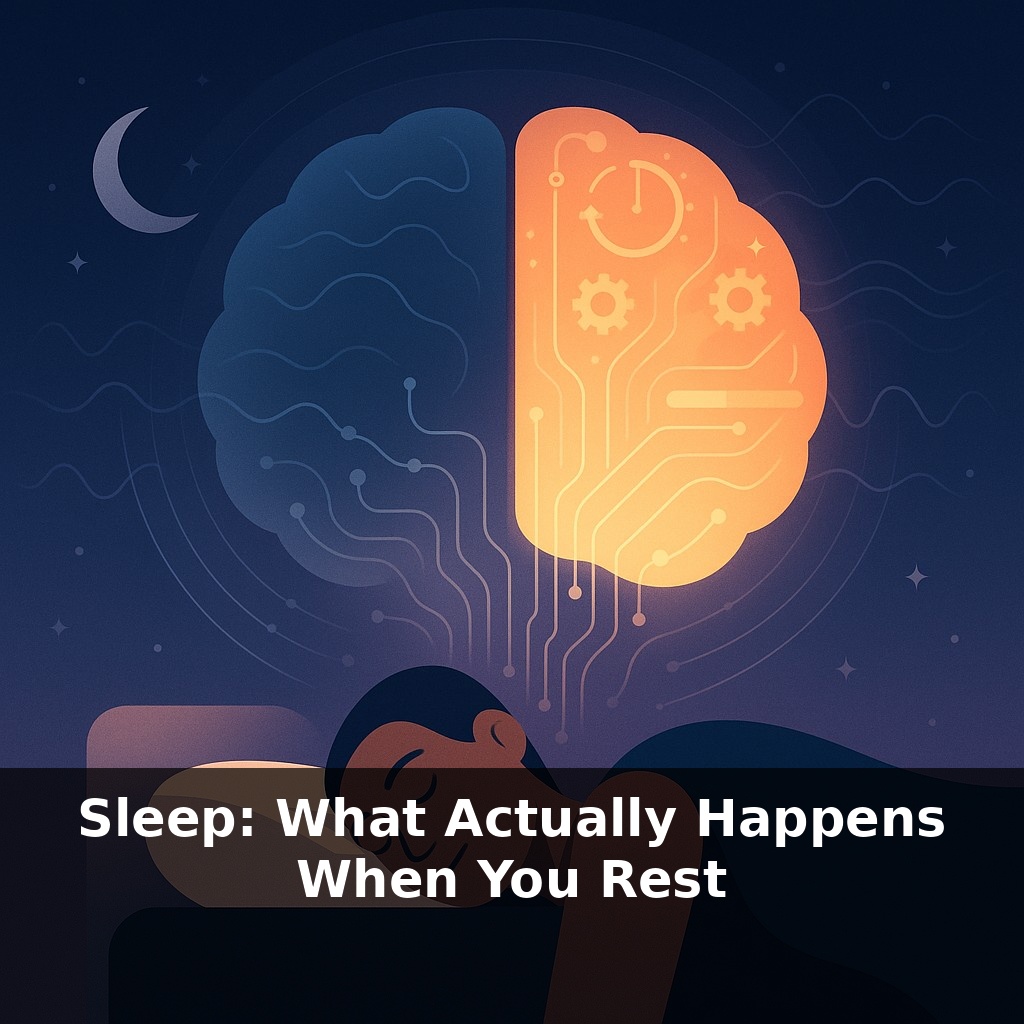
Right now, while you’re asleep, your brain is burning almost as much energy as when you’re awake. In one phase, your muscles go offline while your mind lights up; in another, your body repairs itself while your thoughts quiet down. Sleep isn’t a shutdown—it’s your most intense maintenance shift.
By the time you hit the middle of the night, your brain has already run several full “updates” on your day. It isn’t just sorting what happened; it’s deciding what’s worth keeping and what can be erased. Emotional memories get special treatment: arguments, embarrassments, tiny wins—they’re all reviewed and either softened, reinforced, or quietly filed away. This is why the same problem can feel less overwhelming after a night’s rest, even if nothing in your life has actually changed. Your perception changed first. At the same time, networks that control hunger, stress, and blood pressure are being tuned in the background. Fall short on sleep and those systems drift out of calibration: food looks more tempting, frustration comes faster, and your heart works harder than it needs to. Night after night, that drift adds up to real risk, even if your days still feel “normal.”
As those networks recalibrate, your body quietly renegotiates nearly every contract it has with the outside world. Light levels help set your internal clock, deciding when you’ll feel alert or foggy tomorrow. Temperature drops signal it’s safe to shift resources from keeping you warm to fixing microscopic damage in blood vessels and organs. Immune cells patrol with a different “rulebook” at night, more focused on long-term surveillance than daytime firefighting. Even your appetite tomorrow is influenced by how predictably you sleep, not just by how many hours you log.
Deep in that recalibration, your night breaks into repeating “chapters” that each specialize in different kinds of work. Early in the night, the chapters are dominated by slow, synchronized brain rhythms. Later chapters tilt toward vivid, story-like dreams. Across a typical 7–9 hour stretch, you’ll cycle through this pattern about five times, with each round quietly shifting priorities for your body and mind.
In the earlier cycles, your brain leans hard into physical restoration. This is when growth hormone can spike several-fold, directing resources toward repairing tiny muscle tears from exercise, patching up blood vessel linings, and reinforcing bone. Athletes who miss this window don’t just feel more tired—they literally adapt less to training. In people recovering from illness or surgery, these same chapters are when wounds close faster and immune “battle plans” are rewritten.
As the night wears on, the balance slowly flips. Later cycles are richer in dream-heavy REM, and that’s when complex skills and experiences get reprocessed. Practice a new piano piece or a tricky coding concept, then sleep: the next day, performance usually improves even if you never touched it again. Parts of your brain replay the pattern at high speed, strengthening the most efficient pathways and pruning detours that slow you down.
One striking side effect: your emotional “volume knob” gets adjusted at the same time. Circuitry that links threat detection, reward, and self-control is repeatedly tuned across these cycles. Cut sleep short and you don’t just feel cranky—you’re running a brain that’s been only partially recalibrated, like a clinic opening for the day before the overnight team finishes restocking medication.
Underneath all of this, a newly discovered waste-clearance pathway in the brain becomes more active, flushing out byproducts that build up while you’re awake. If nightly clearance keeps getting interrupted, those leftovers accumulate over years, and that buildup is increasingly linked to higher risk of cognitive decline and dementia. The headline: it isn’t only how long you’re in bed that matters, but how many full, uninterrupted cycles your brain is allowed to complete.
Now zoom in on a single night as if you’re watching a hospital shift board change over. Early in the night, the “orthopedics team” is busiest: tiny cracks in bone from everyday strain are reinforced, which is one reason consistent sleep supports long‑term bone density and why chronic short sleepers see higher fracture risk as they age. A few hours later, the “cardiology staff” takes over, adjusting blood vessel flexibility and nightly blood pressure dips; when those dips vanish because sleep is fragmented, daytime hypertension follows more easily.
Meanwhile, the “endocrine team” fine‑tunes how strongly your tissues respond to insulin the next day. Miss enough of those quiet calibrations and your cells start “ignoring” insulin’s signal, a key step toward type 2 diabetes. On other nights, your immune “oncology service” spends more time marking damaged cells for destruction; shift workers, whose sleep timing constantly changes, show higher rates of several cancers, suggesting that repeatedly rescheduling these invisible rounds has long‑term costs most people never feel in the moment.
Your future nights may be measured as carefully as your steps. Wearable sleep recorders are already shifting from crude “toss‑and‑turn” trackers to clinical‑grade tools that can flag apnea or arrhythmias before you notice symptoms. Expect bedrooms to act more like quiet laboratories: smart lights that dim in sync with your body clock, thermostats that nudge you toward cooler, deeper rest, even mattresses that adapt firmness like a skilled physical therapist adjusting support mid‑session.
Treat your sleep like a lab you run every night: tweak one variable at a time—bedtime, light, temperature, caffeine cut‑off—and notice what actually changes the next day. Your challenge this week: run a 7‑night “sleep experiment,” adjust only one factor, and track mornings like a scientist testing a new weather forecast.