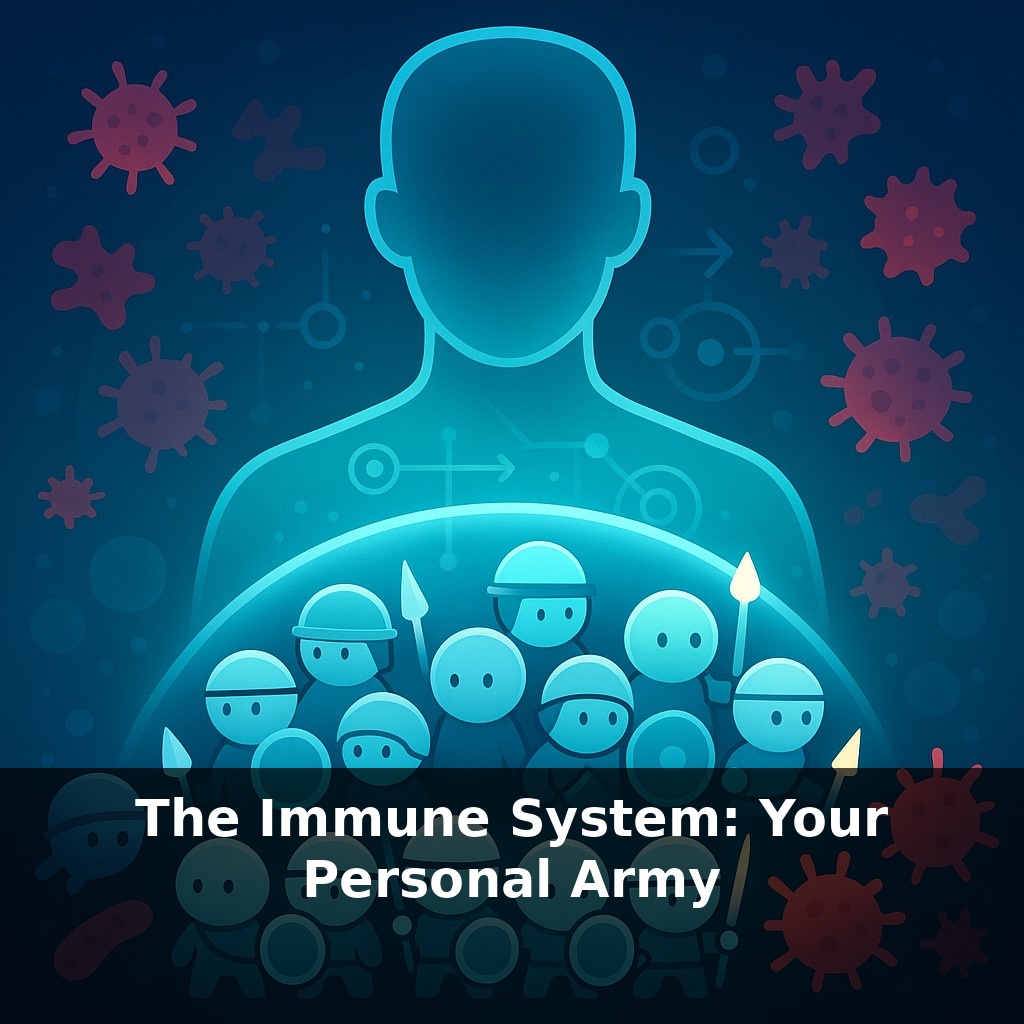
Right now, as you listen, your body is quietly training billions of microscopic soldiers. No sign-up forms, no boot camp, no days off. One cuts your finger, another sneezes nearby—and this hidden army instantly decides: defend, ignore, or, sometimes, dangerously misfire.
That hidden army doesn’t just react to chaos—it follows a surprisingly organized playbook. Before anything dramatic happens, your body sets up quiet barriers and checkpoints: tightly packed skin cells, sticky mucus, acid in your stomach, even the helpful microbes on your skin and in your gut. They’re like “Do Not Enter” signs written in chemistry instead of ink. Most threats are stopped here, long before you feel sick.
But when something slips through, the response isn’t random panic. Chemical messages ripple through your tissues, calling in different specialist cells in a specific order, a bit like a well-rehearsed emergency drill. And while all this unfolds automatically, your daily choices—how you sleep, move, eat, and handle stress—are constantly editing that playbook, making the difference between a minor skirmish and a full-blown health crisis.
Inside that quiet coordination is a crucial split-second decision: “friend” or “foe.” Your cells constantly scan tiny molecular ID badges on everything they meet—pollen, peanuts, bacteria, even your own tissues. Most days, this ID check is smooth, like a well-run airport security line. But the criteria are tunable. Chronic stress, ultra-processed food, too little movement, or ongoing infections can subtly rewrite who gets flagged. That’s when harmless particles trigger misery, or your own joints or gut lining end up on the suspicious list—and the fallout can simmer for years before you notice.
Here’s where the story gets more surprising: your “friend or foe” decisions aren’t made in just one place—they’re negotiated across multiple checkpoints, each with its own rules.
First stop is the front line tissue where a threat shows up. Cells there release small alarm molecules that change blood flow, loosen vessel walls, and let white blood cells exit the bloodstream exactly where they’re needed. That redness and swelling around a cut or pimple? It’s not chaos; it’s controlled traffic management so the right cells can leave the “highway” and enter the “neighborhood.”
Among the earliest arrivals are rapid responders that don’t need detailed intel; they just recognize broad danger patterns. They’re especially good at swallowing invaders and breaking them into molecular “snapshots.” Those snapshots then get displayed on the cell surface and carried to lymph nodes—quiet hubs scattered through your body in your neck, armpits, groin, and deep in your abdomen.
Inside a lymph node, the mood is very different from that first inflamed tissue. It’s calmer, more selective. Cells there act more like careful editors than fighters, comparing those snapshots against a huge library of possible responses. If they find a match, they don’t just flip “on” or “off.” They choose *how* to respond: with targeted antibodies, cell-killing teams, or a combination, and how intense that response should be.
This is also where precision gets sharpened. Some cells start out with relatively clumsy recognition, then mutate and compete so that only those with the best “fit” to the threat are kept. Others are assigned to become long-lived memory, dispersing through your tissues, ready to respond faster and more efficiently next time.
Your internal environment shapes these choices. Nutrients like protein, zinc, and vitamin D influence how quickly cells can divide and specialize. Chronic high cortisol from stress can thin out certain populations, especially in lymph nodes, and blunt their coordination. Sleep loss changes the timing of when key cells circulate and meet in those hubs, which can alter how strongly you respond to a vaccine or a new infection.
Fever adds another layer. When your set-point rises, immune chemistry speeds up: trafficking, signaling, and certain killer functions become more efficient—up to a point. Too high or too long, and protective heat tips toward collateral damage, so your body continuously rebalances intensity versus safety.
Think about what happens when you get a vaccine: you’re *not* given a full-blown infection, but just enough of a target for your system to practice on. In the days after, some cells commit to becoming long-lived memory; others quietly die off once the “drill” is over. Months later, those memory cells can still be measured in your blood, which is why a booster shot years later often triggers a faster, stronger response than the first dose.
Real-world data make this less abstract. Newborns, for example, coast for a while on IgG antibodies borrowed from their mother, then gradually switch to relying on their own. People on chemotherapy see blood counts drop and watch minor colds turn into serious problems. Athletes who suddenly overtrain without rest can move from “stronger immunity” to more frequent respiratory infections.
Your behaviors leave fingerprints here too: a week of night shifts, a crash diet, or a month of heavy drinking won’t show up on a standard checkup, but can quietly reshape how vigorously you respond to the next microbe that comes along.
A century from now, today’s “superfoods” and step counts may look quaint beside immune readouts woven into clothing and contact lenses. Instead of guessing you’re “coming down with something,” a spike in certain cytokines could ping your phone hours before symptoms, like a weather radar for your body. Yet as gene-edited fixes and bespoke vaccines arrive, societies will have to decide: who gets access first, and what risks are acceptable when we edit the very cells that remember our past infections?
So the real experiment isn’t happening in a lab—it’s in your next 24 hours: how you sleep tonight, what you eat, how hard you push your workout, whether you pause when stress spikes. Each choice nudges that inner weather a little sunnier or stormier. Your challenge this week: notice which habits consistently leave you feeling just a bit more resilient.