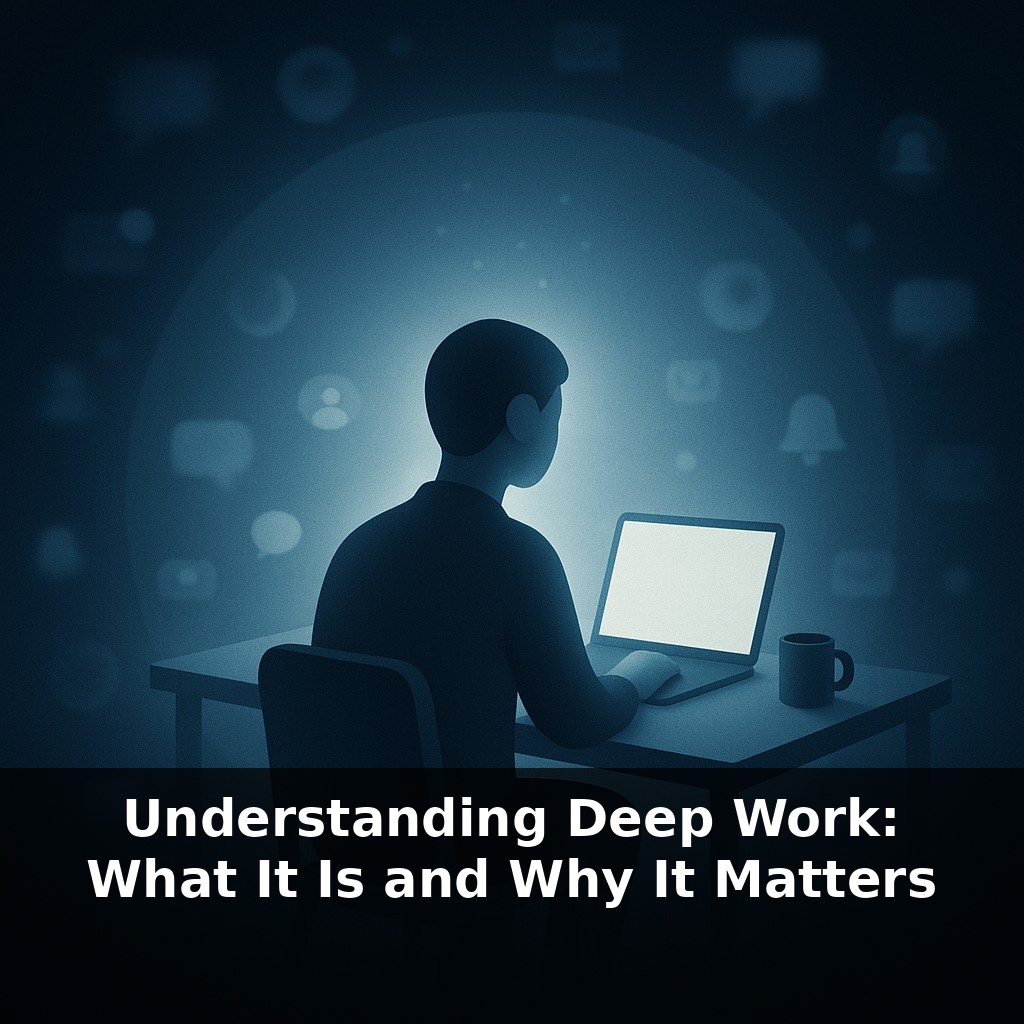
Understanding Deep Work: What It Is and Why It Matters
📝 Transcript
Your best ideas probably aren't born in long workdays—they appear in the rare minutes no one can reach you. A study found it can take over 20 minutes to recover from a single interruption. So here’s the real mystery: in a world wired for distraction, how do you ever reach that depth at all?
You’ve likely felt the difference: the days when work feels scattered and thin, versus the rare stretches when your mind locks onto a problem and time disappears. That second mode is where deep work lives—not as a productivity hack, but as a different *quality* of thinking. Neuroscientists see it in how the brain rewires itself during sustained effort; elite performers see it in how quickly they outpace peers who stay at the surface. In creative fields, it’s often the hidden reason two people with similar talent produce wildly different results over a decade. One keeps skimming; the other regularly sinks below the noise. And here’s the uncomfortable twist: modern work is engineered to keep you skimming. If you don’t deliberately design time and conditions for deep work, you’re quietly training your brain to avoid it—precisely when it matters most for your career.
In practical terms, this means most “work days” are oddly misnamed. The data says knowledge workers burn most hours in inboxes, chats, and quick checks—busy enough to feel spent, yet rarely touching the kind of effort that moves a career or a project meaningfully forward. That gap has real consequences: skills plateau, ambitious ideas stall, and your sense of progress erodes. Meanwhile, the market quietly raises the bar, rewarding people who can do what algorithms and hurried committees can’t: wrestle with complexity long enough to produce something crisp, original, and hard to copy over the long run.
When researchers track how we actually use our minds, a sharp divide appears. One kind of effort chews through email threads, status updates, and low‑stakes decisions. It’s reactive, fast, and endlessly repeatable. The other kind of effort is rare: it’s when you’re holding multiple constraints in your head, testing ideas, discarding most of them, and slowly shaping something that didn’t exist before. That second category is the territory we’re interested in—not because it “feels better,” but because it compounds.
Look at where value is created in modern careers. A developer isn’t judged on hours in an IDE, but on shipping robust systems that don’t collapse under real users. A strategist isn’t paid for attending meetings, but for a small number of clear choices that avoid expensive dead ends. A designer isn’t remembered for dozens of mood boards, but for a few artifacts that define a product or brand. In each case, the leverage sits in a surprisingly small set of decisions and artifacts that required sustained, undivided effort to get right.
Economically, this matters more every year. As automation absorbs repeatable tasks, the premium shifts toward people who can solve novel problems, learn hard tools quickly, and synthesize messy information into something coherent. Those abilities don’t emerge from staying constantly available; they emerge from repeatedly giving your mind enough contiguous runway to do difficult internal work. Over time, that practice changes what feels “normal” when you sit down to tackle something ambitious.
There’s also a competitive asymmetry at play. Many environments reward visible busyness: fast replies, crowded calendars, constantly updated dashboards. But those signals don’t reliably track with meaningful contribution. Someone who quietly protects a few hours most days for high‑stakes thinking can look less “plugged in” moment to moment, yet accumulate far more progress quarter to quarter.
Think of a software team: two engineers log the same eight‑hour day. One slices attention across chat pings, minor tweaks, and quick favors. The other carves out a protected block to untangle a core architectural issue. At review time, the second engineer may have fewer lines of visible activity—but has removed an entire class of bugs and limitations for the whole group. Same job title, radically different impact.
Consider a filmmaker in the editing room. The first pass is easy: trim obvious mistakes, fix crooked shots, add temp music. That’s the “surface” layer. The real film emerges later, when they sit with the timeline long enough to notice hidden rhythms, tighten the emotional arc, and cut entire scenes that don’t serve the story. Same footage, different *depth* of engagement, radically different movie.
Careers work similarly. A writer who spends most days responding to briefs and tweaking copy might ship a lot of words; another, who regularly disappears into focused drafting and structural revision, slowly builds a body of work that defines a niche. On paper, both “wrote all day.” In reality, one mostly rearranged sentences; the other repeatedly wrestled with structure, insight, and voice.
Look at teams, too. The groups that leap ahead aren’t always the ones attending the most meetings. They’re often the ones that reserve protected time to hash through gnarly trade‑offs, modeling scenarios until a clear, bold decision finally appears—and holds.
In a few years, careers may quietly split into two tracks: those who can regularly enter deep states, and those whose attention is permanently leased out to alerts. The first group will be trusted with problems where failure is expensive and credit is lasting, much like architects who stamp the final blueprint. You’ll also see “focus capital” emerge—people known for protecting and directing long stretches of clear thinking becoming the default choice for ambiguous, career‑defining projects.
Deep work isn’t a moral virtue; it’s a practical tool. Treat it less like a promise to “be better” and more like tuning a studio before you record. You’re not chasing perfection, just creating conditions where important problems can actually unfold. The real shift is this: attention becomes something you *allocate*, not something the day casually spends for you.
Your challenge this week: pick just *one* important problem and give it a single 60‑minute, notification‑free block. No multitasking, no “quick checks,” just you and that problem. Notice what feels harder than expected—and what becomes clearer than it ever does in scattered ten‑minute bursts.
From this course
Mastering Focus: The Art of Deep Work
6 episodesUnlock all episodes
Full access to 6 episodes and everything on OwlUp.
Subscribe — $1.99/monthLess than a coffee ☕ · Cancel anytime