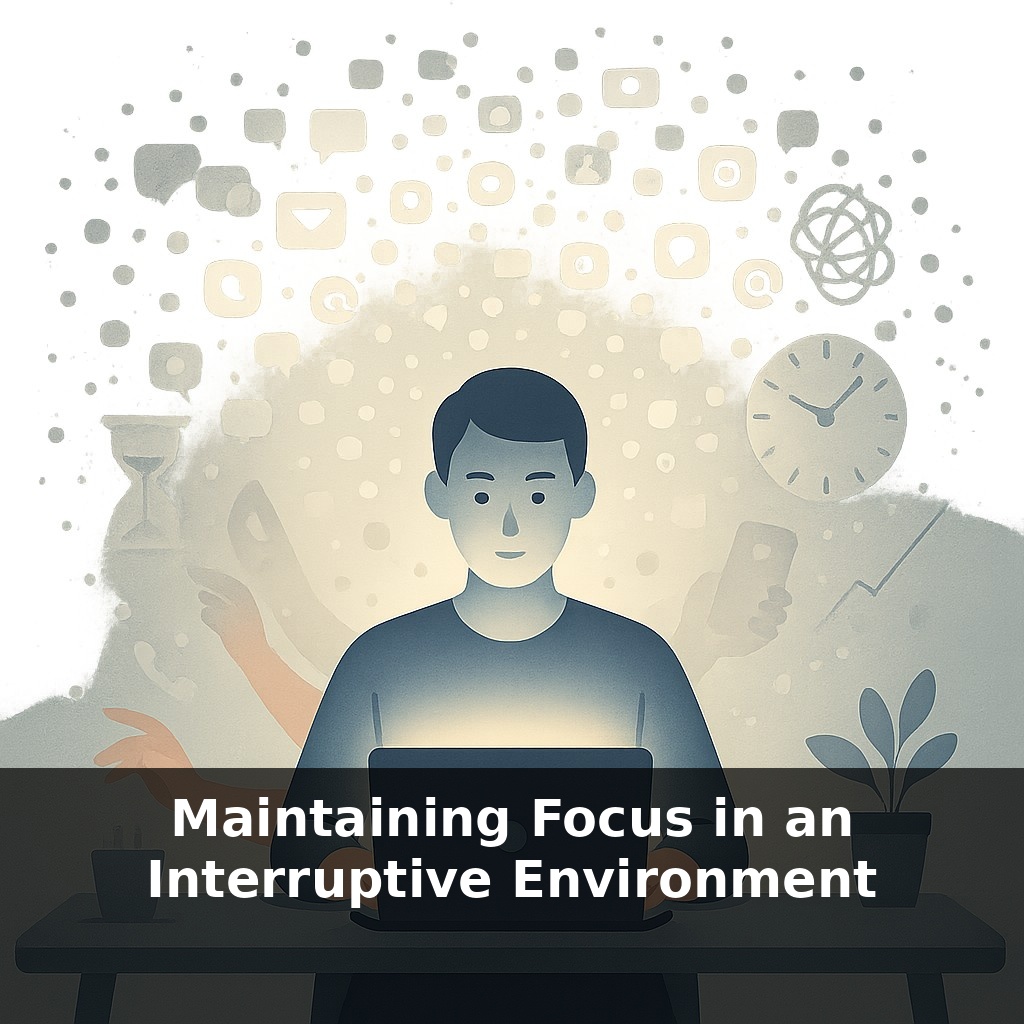
Right now, the average knowledge worker taps email or chat about 70 times a day—often without noticing. You sit down to finish one important thing, and suddenly an hour’s gone. Were you really working… or just recovering from interruptions you didn’t choose?
Seventy‑seven checks a day. That’s the average for email and chat—more than once every 10 minutes in a typical workday. No wonder so many people end the day exhausted but unsure what they actually finished. This isn’t just about “too many apps” or “not enough willpower.” It’s about how your brain rations a limited fuel: attention. Every time you glance at a notification or respond to a stray question, you’re making a tiny withdrawal from that fuel tank. Do it often enough, and even simple tasks start to feel strangely heavy. The good news: focus isn’t an innate talent some people are born with—it’s a skill you can engineer. By redesigning how you move through your day, how your tools behave, and how you recover after getting pulled away, you can reclaim large chunks of that lost time with surprisingly small tweaks.
Most people blame the loudest distraction—the chat ping, the coworker’s question, the kid shouting from the next room. But research shows the more silent culprit is context switching itself: every time you jump between tools, priorities, or roles, your brain has to reload a different “workspace.” In modern jobs, that reload happens dozens of times a day. You start answering a message “for just a second,” then peek at a dashboard, then remember a meeting you need to prep. None of these are wrong on their own; together, they quietly fracture what could have been a solid block of meaningful progress.
Here’s where the research gets uncomfortably concrete: most of what derails you isn’t “big emergencies.” It’s tiny, almost invisible decisions. You see an unread badge. You think, “I’ll just clear this.” You overhear a half‑conversation and your mind fills in the rest. You glance at your calendar mid‑task “to see what’s next.” None of these feel like real choices, but together they create that 23‑minute recovery gap Gloria Mark documented.
To work with this instead of against it, treat your day less like an open highway and more like a train schedule. Trains don’t leave whenever they feel like it; they depart in blocks, on rails that tell them where they’re allowed to go. You can do the same with your attention by pre‑deciding *when* certain categories of work are even allowed to exist.
Start with “modes,” not tasks. For example: - Communication mode: scanning, replying, routing messages - Deep work mode: anything that benefits from sustained thinking - Admin mode: expenses, forms, approvals, simple updates - Collaborative mode: calls, pair work, live docs
Instead of sprinkling all four through every hour, you batch them. Two 25‑ to 50‑minute deep work blocks in the morning. A communication block before lunch. Admin after lunch, when your mental energy naturally dips. Collaborative time later in the day when interaction costs less.
Crucially, each mode gets its own toolset and rules. In deep work mode, only the document, data, or design you’re shaping is allowed on screen. In communication mode, you *only* clear and triage. No “quickly starting” a task that pops up—those get parked in a list for the next deep work block. This separation cuts down on the “I opened chat, then somehow ended up in a spreadsheet and then in analytics” spiral.
Your environment can mirror these modes. Noise‑cancelling on and phone in another room signals deep work. Open door and regular headphones signals “interruptible.” Teams that make these signals explicit—status emojis, desk signs, shared calendars—dramatically reduce unplanned pings because people aren’t guessing about each other’s availability.
The point isn’t rigidity; it’s fewer on‑the‑fly decisions. Every time you don’t have to ask “What should I do next?” or “Should I answer this now?” you save a measurable slice of that 20–40 % lost to switching.
A software team I worked with ran a simple experiment: for two weeks, mornings were reserved for “build time,” afternoons for everything else. No one changed tools or added new apps; the only rule was that before noon, you could *only* touch work that moved a project forward. Support questions, status updates, and brainstorms waited. By the end of week two, the same people, in the same jobs, were finishing key tasks a full day earlier on average—purely because they stopped slicing their momentum into ribbons.
You can try a lighter version solo. Pick one recurring activity that constantly leaks into everything else—Slack, design reviews, code reviews, budgeting—and give it a fixed rail in your day. For instance: reviews from 2:00–3:00 p.m., three days a week. Outside that window, you capture requests but don’t act on them. Notice what happens: some “urgent” items resolve themselves, some turn out to be unclear, and the real priorities stand out because they’re still there when the next rail arrives.
Gloria Mark suggests we’re drifting toward a “permanent partial attention” culture; future tools will quietly push the tide the other way. Think of an AI calendar that behaves like a veteran air‑traffic controller, stacking meetings, routing low‑value pings to holding patterns, and protecting clear runways for serious work. Teams could negotiate “focus budgets” the way they negotiate headcount, and leaders might be judged not by how fast they reply, but by how often they preserve uninterrupted time for others.
You don’t have to fix everything at once. Tiny, consistent tweaks compound, like nudging a telescope a millimeter and ending up with a different galaxy in view. Your challenge this week: pick one recurring disruption, and design a small “rule” around it. Observe, adjust, and treat the experiment as data—not judgment—about how you actually work best.