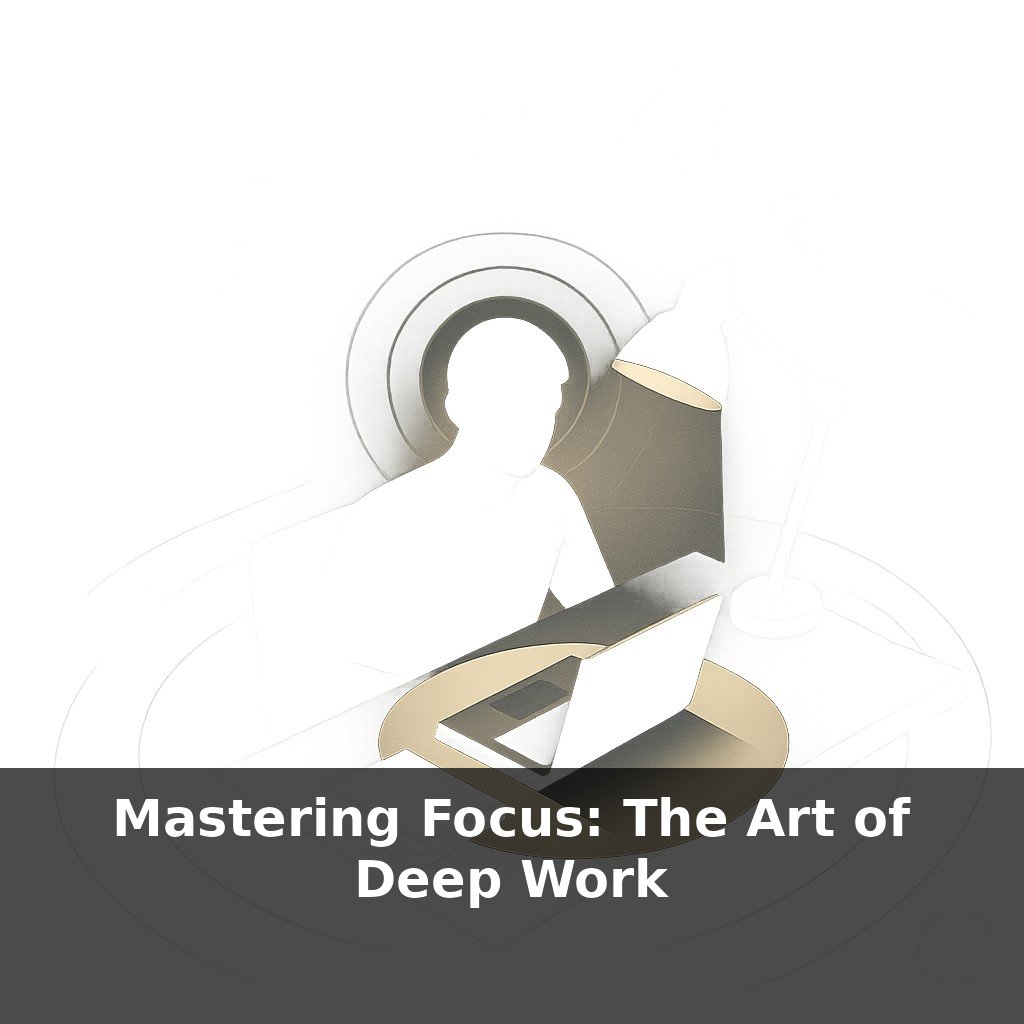
You lose focus at work, and it quietly steals almost half your day—yet it never shows up on your calendar. An email here, a quick message there, a “two‑minute” task. By evening, you’re exhausted. But here’s the twist: your brain was never built to work this way.
You can feel the gap between what your day looks like and what you’re actually capable of. Your calendar is crammed, your apps are glowing, but the work you’re proud of—the kind that moves your career or art forward—keeps getting squeezed to the margins. It’s not laziness, and it’s not a motivation problem. It’s that your attention is constantly being drafted into a dozen low‑impact battles instead of one meaningful campaign. Modern tools are optimized for responsiveness, not depth, so unless you actively push back, your best hours get traded away in tiny pieces. The good news: deep work isn’t a rare talent; it’s a trainable state. With the right cues, spaces, and timing, you can reliably drop into it, on purpose, and stay there long enough to do work that actually feels like you.
Most people try to “fix” their focus by downloading another app or making a prettier to‑do list. But the real leverage sits underneath the surface: the small, repeatable patterns that tell your brain, “Now we’re going in.” Think of the way your body reacts when you lace up the same shoes before a run or sit in the same seat before a performance; over time, those details become a quiet on‑ramp into a different mode of operating. In knowledge work, you almost never design that on‑ramp. You rely on willpower, then blame yourself when it collapses under notifications, meetings, and the constant pull of being reachable.
The first pillar is ritual, but not in the vague “morning routine” sense. Think of it as programming for your nervous system: very specific, repeatable steps that always precede serious work. Over time, your brain starts predicting what comes next and pre‑loads the mental resources you need. The aim is to reduce “attentional residue”—all the half‑open loops from the rest of your life that otherwise bleed into your work session.
Start small. A good ritual has three components: a physical reset, a scope decision, and a start signal.
The physical reset is anything that clearly separates “before” from “now.” Close every unrelated window. Put your phone in another room. Change where you sit, or clear the part of your desk you’ll actually use. You’re stripping away stray stimuli so your mind has fewer doors to wander through.
Next is the scope decision. Instead of “work on the project,” define exactly what today’s session is for: “Draft the first 500 words of the proposal,” “Sketch three alternate compositions,” “Refine bars 16–32 of the track.” Your brain handles concrete, bounded targets far better than vague ambition. This is where implementation intentions shine: “If it’s 9:00–11:00 and I’m at my desk, then I work only on the grant draft.” You’re pre‑negotiating with your future, distractible self.
Finally, the start signal. This is a brief, consistent action that marks the point of no return. A 10‑minute mindfulness session, one page of freewriting, a specific playlist that you use only for deep sessions. Research shows even short mindfulness bouts sharpen working memory and extend time‑on‑task, not because they make you “calmer” in general, but because they train you to notice when your mind slips so you can bring it back without drama.
None of this has to be elaborate. What matters is that it’s the same, in the same order, often enough that your brain recognizes the pattern. At first, the ritual will feel like extra work. After a few weeks, skipping it will feel like trying to start a film halfway through the reel—you’ll sense that something important is missing.
Your challenge this week: design a 5‑minute pre‑work ritual and run it before one important block each day. Keep it fixed: same place, same steps, same time of day if possible. At the end of the week, review only one question: “During which sessions did I forget to check my phone or email for the longest stretch?” That’s your signal the ritual is starting to bite. Keep those elements; discard the rest.
Think about someone training for a marathon who always warms up with the same 400‑meter drill. They’re not just stretching muscles; they’re calibrating pace, breathing, and mindset for the miles ahead. Your 5‑minute pre‑work ritual can work the same way if you tune it to your actual craft, not some generic productivity template.
For a designer, that might mean opening yesterday’s Figma file and, before touching anything, spending three minutes silently labeling which parts feel “heavy,” “flat,” or “off‑brand.” A software engineer could spend five minutes writing one failing test that defines today’s target behavior, then starting the timer only when the test is in place. A writer might retype a single favorite paragraph from another author to sync their internal rhythm before adding a new sentence of their own.
Notice how each example narrows your field: you’re not “getting ready to work,” you’re stepping into a very specific corridor. Over time, that corridor becomes familiar territory, and entering it gets faster, almost frictionless, even on days when motivation is low.
As tools get better at handling logistics, the real leverage shifts to how you design the *texture* of your day. Expect careers to differentiate less by role title and more by how fluently you can move between shallow collaboration and deep creation. Teams might start sharing “focus maps” the way developers share API docs—clear protocols for when you’re reachable and when you’re in protected mode, so coordination stops trampling your best cognitive hours.
Over time, these tiny, consistent “entry scripts” do more than front‑load a session—they reshape what your workday *feels* like. You may notice certain hours become “prime territory,” like a sunlit corner in your home that quietly invites you to sit and create. Follow that pull. Let your schedule bend around those pockets, not the other way around.
Try this experiment: Tomorrow, block a 60-minute “deep work sprint” where you do one clearly defined task (like writing a draft, debugging a specific feature, or outlining a presentation) with a three-step ritual: 2 minutes of box breathing (4–4–4–4), 1 minute of clearing your desk except for what you need, and then setting a visible 60-minute timer. During that hour, keep your phone in another room, close all messaging apps, and keep a scrap paper nearby only for jotting down distractions you’ll handle later. After the timer ends, quickly rate your focus level from 1–10 and note what broke your concentration most often; repeat the same ritual the next day but tweak just one variable (time of day, location, or task type) and compare your focus scores.