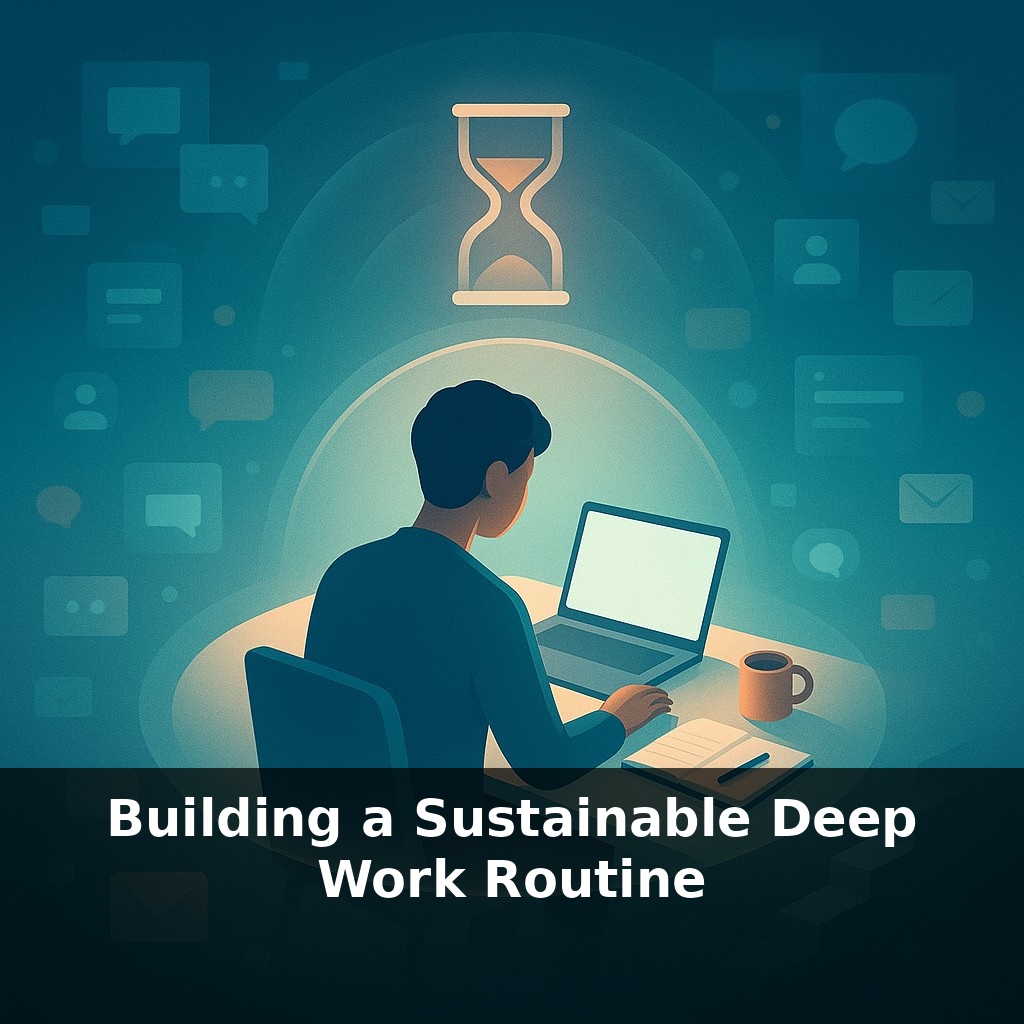
Right now, the average knowledge worker switches windows several hundred times a day. In one moment, you’re shaping an important idea; the next, you’re knee-deep in notifications. This episode is about building a routine that protects your best thinking time.
A 4-hour deep work day sounds extreme—yet many top performers rarely exceed it. The goal isn’t to fill every minute with intensity, but to build a routine that lets you hit 2–4 truly focused hours without grinding yourself down.
To do that, you need two things: timing and protection.
First, timing: your brain naturally moves through 90–120 minute attention cycles. If you align focus blocks to those waves instead of squeezing them into random gaps, concentration becomes easier and feels less draining. Two such blocks—say 9:00–10:30 and 2:00–3:30—already put you in the same range where teams like Atlassian saw faster project completion.
Second, protection: those blocks only work if they’re shielded. That means scheduling them visibly, setting clear “offline” rules, and pairing each block with a short, deliberate recovery ritual so you can come back strong tomorrow, not just today.
To make this sustainable, zoom out from single sessions to your whole week. Most people overestimate how much focused time they can handle and underestimate how much friction they face getting started. Begin by choosing just 2–3 days where you’ll protect one 60–90 minute block, not every day, and not multiple blocks. Then, map that block to your real constraints: meetings, commute, childcare, energy dips. For example, a 7:30–8:45 slot before Slack ramps up, or 3:00–4:15 when the office is quiet. The routine must fit your life as it is, not the fantasy calendar in your head.
Deep work becomes sustainable when you treat it as a behavior system, not a burst of willpower. The most reliable way to do that is to wire it into your environment using cue–routine–reward loops and to grow it gradually.
Start by choosing one consistent cue that already happens every workday. For example: - 9:05, right after your first coffee - The moment you dock your laptop at your desk - After a recurring 9:00 standup ends
Lock that cue to a **specific behavior sequence**, not just a vague intention. For a 75-minute session, your routine might look like this, with concrete steps and numbers:
1) **00:00–00:05 – Start ritual (5 minutes)** - Close all windows except one document or app. - Turn on Do Not Disturb for 90 minutes. - Put phone in another room or in a closed drawer. - Open a single written plan listing 1–3 targets for this block, no more than 150 words.
2) **00:05–01:10 – Work sprint (65 minutes)** - Work on one “needle-moving” task only: e.g., 3 sections of a report, 30 lines of code refactor, 2 key slides. - If a new thought pops up, park it in a small “later” list; do not chase it.
3) **01:10–01:15 – Shutdown + reward (5 minutes)** - Write one sentence: “In the next block, I will start with…” - Log a simple score from 1–5 for focus quality. - Pair with a small reward: a preferred tea, a short walk, a 5-minute chat.
Repeat this same pattern at least 3 times a week for 3 weeks. That gives you a minimum of 9 repetitions to start wiring the loop before you aim for daily deep work. Remember that 66 days is the *median* time for habits to feel automatic; some people in the Lally study needed over 200 days. Expect inconsistency early on and track adherence, not perfection.
To prevent burnout, cap your total deep work at a firm limit: for example, **no more than 120 minutes a day, 4 days a week**, for the first month. If you consistently hit 75–90 minutes with energy left, add a second, shorter block of 30–45 minutes on 1–2 days, never increasing your weekly total by more than 25%.
Finally, create one visible safeguard against overcommitment: - A calendar rule: no meetings before 10:30 on Tuesdays/Thursdays - A team norm: Slack status “Heads down, back at 11:00” - A personal rule: no deep work after 4 p.m. to avoid mental spillover into the night
At Trello, one product manager ran a 6-week trial: 3 days a week with a single 75-minute session anchored to a 9:15 cue—“calendar cleared, headphones on, one card pulled to ‘Today.’” She limited the target to finishing just **one** meaningful card per block. By week 2, she’d shipped 4 backlog items that had sat untouched for over a month, simply because nothing else was allowed into that window.
You can do something similar by assigning each block a clear **theme** instead of a vague goal: - Monday: strategy / architecture decisions - Wednesday: deep writing or design - Friday: learning or experiments
That way, when the cue fires, you’re not choosing from 20 possibilities; you’re picking from 2–3 tasks in a pre-defined lane.
One architect I worked with went further: he color-coded his calendar so no more than **8 hours a week** were marked as “blue work” (high-intensity) and at least **4 hours** as “green work” (administrative or light collaboration). When blue started creeping past 8, he knew to scale back before fatigue did it for him.
119 minutes of true concentration could soon matter more than 8 “busy” hours. As AI handles routine tasks, teams that defend even 2 × 60-minute deep sessions per day may ship features 30–40 % faster while making fewer defects. Expect job offers specifying “4 hours protected focus time” and performance reviews including a “cognitive sustainability score” from wearables that flag when your weekly high-intensity total passes, say, 10–12 hours and recovery is slipping.
Your challenge this week: treat yourself like those future teams. For 7 days, log one number every afternoon: minutes of uninterrupted, high-effort work (no email, no messaging apps, no window-switching for >5 seconds). Don’t try to improve it yet—just get a baseline. Next episode, you’ll use that baseline to design a realistic, sustainable deep-work schedule instead of guessing.
Now, use your baseline to choose a single upgrade: either extend your longest daily focus stretch by 10 minutes, or protect one extra 30-minute block this week. Set a visible “no-switching” timer, and at the end of 5 days, compare output: count features shipped, pages drafted, or designs finalized before and after the change.
Try this experiment: For the next 5 workdays, schedule just one 90-minute deep work block at the same time each day (e.g., 9:00–10:30), dedicated to your single most cognitively demanding task. Before each session, clear your desk except for your laptop/notebook, close email/Slack, and turn your phone completely off and out of sight. Use a simple timer, work with zero multitasking, and put a sticky note by your keyboard where you quickly tally every time you feel the urge to check something or switch tasks. At the end of each day, give the session a quick score from 1–5 for “depth” and note what time of day your focus felt strongest, then decide whether to keep or shift that same-time daily block for next week.