Your First Impression: What Really Matters
📝 Transcript
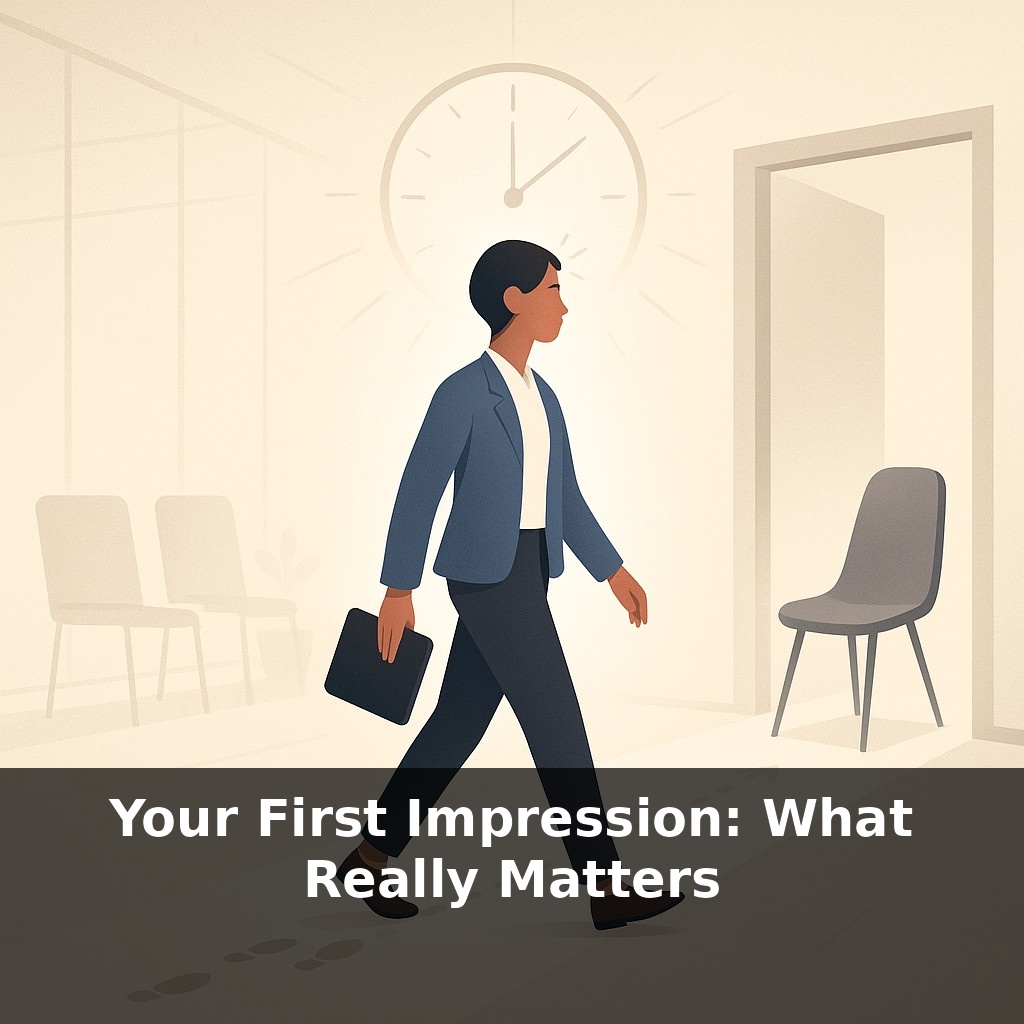
Before you’ve said your name in an interview, your future boss may already feel like they “know” you. In the time it takes to walk from the waiting room to the chair, your posture, your clothes, and your face have started answering questions you haven’t even heard yet.
Here’s the twist: most candidates obsess over perfect answers to “Tell me about yourself,” but research shows the first *seven to thirty seconds* often carry more weight than the next thirty minutes. Before you dive into your career stories, the interviewer has already made an initial call on three things: “Can I trust this person? Do they seem competent? Do I actually want to work with them?” Those snap judgments are crude, but they’re not random—they’re heavily shaped by small, controllable details most people treat as afterthoughts: how your clothes fit, how prepared you seem the moment they say your name, even how you manage the silence while you sit down. Think of this as the “pre-interview interview”: a hidden phase you’re already being evaluated on, whether you prepare for it or not. In this episode, we’ll turn that invisible stage into something you can deliberately design.
Think about everything that happens before you ever touch a whiteboard or answer a single behavioral question: the recruiter scanning your résumé for 7.4 seconds, the hiring manager glancing up as you enter, the first 30 words that come out of your mouth. Those moments are quiet, but they’re not neutral—your interviewer is already sorting you into mental buckets like “pro” or “maybe later.” In this episode, we’re not chasing perfection; we’re tightening the first 1 % of your process that tilts the next 99 %. Tiny upgrades here can silently upgrade every interview that follows.
Here’s where the science gets uncomfortably specific. In one study, people looked at a stranger’s face for just 100 milliseconds and still produced “trust” and “competence” ratings that barely changed with more viewing time. That’s how fast the baseline gets set. In interviews, that baseline isn’t just a feeling—it becomes the quiet background track for everything that follows.
Researchers have found something even trickier: the halo effect. If your early signals say “put-together and confident,” the interviewer is more likely to interpret later, *ambiguous* answers as smart or thoughtful. If those signals say “uncertain” or “sloppy,” the same answer can read as vague or unprepared. That’s the 25–35 % swing you read about: it’s not that interviewers stop listening; it’s that what they hear gets filtered through “probably strong” or “probably weak.”
Now layer on clothing, but not in the one-size-fits-all “dress formally” way. Data shows navy and charcoal quietly nudge people toward “professional” ratings, but they’re not magic colors. The deeper question is: “Does what I’m wearing fit the *story* this company tells about itself?” A candidate in a sharp charcoal suit might look perfect at a bank and oddly stiff at a hoodie-heavy startup. Overdressing there can spark “culture mismatch” doubts before you’ve opened your laptop.
Then there’s your voice—the forgotten half of presence. Even when content is identical, a slightly slower pace, clear articulation, and a steady pitch lead to higher perceived intelligence and reliability. The first 30 words you say are doing double duty: they communicate *information* (“Thanks for having me; I’ve been looking forward to this”) and they communicate *capacity* (“I can stay composed under mild stress”).
Treat this as design, not performance. You’re not faking a new personality; you’re removing static that keeps your real strengths from coming through. Think less “memorize a script,” more “pre-decide the first 5 % so I’m not improvising it under adrenaline.”
One useful mental model: customize your “opening settings” the way you’d configure a new app—default font, notifications, theme. You choose a stable base once, then make small tweaks for each context instead of reinventing yourself for every call, screen, or onsite.
Think about the first 30 words you say as “seed data” for the whole conversation. If you start with scattered small talk and a half-whispered “hey,” you’re training the interviewer’s brain to expect more of the same. Instead, you can deliberately front-load three signals: clarity (“Hi, I’m Alex Chen”), relevance (“I’ve been excited to talk about how my background in X could support your work on Y”), and warmth (“Thanks again for taking the time today”). That’s under ten seconds, but it quietly answers: “Do they get why they’re here?” and “Will this be easy to follow?”
You can also calibrate your presence before you’re called in. Set a “pre-entry routine” that takes 90 seconds: stand up straight, take two slow breaths, review a one-line intention (“Show them how I solve problems with users in mind”), and rehearse your opening sentence once in a normal speaking voice. This isn’t about becoming someone else; it’s about making your “default setting” under stress look a lot more like how you are on your best days.
Seven seconds with a recruiter can outweigh the next 45 minutes of your answers—and soon, those seven seconds may be judged by code as much as by humans.
As AI tools move from résumé screening into video analysis, they’ll start flagging patterns you barely notice: how long you pause before speaking, how often your gaze drifts from the camera, whether your speaking rhythm sounds “confident” compared to a training set. That’s powerful and risky: useful for consistency, dangerous if the data behind it bakes in bias about accents, age, or appearance.
Expect two parallel futures: regulators asking, “On what basis did this system decide Candidate A ‘lacked executive presence’?” and candidates quietly using tech of their own. Think browser extensions that overlay a subtle grid to keep your eyes near the lens, or apps that highlight spikes in your speaking speed like a fitness tracker highlights your heart rate. Instead of guessing how you come across on-screen, you’ll be able to treat your presence like a dashboard: small tweaks, visible impact.
Your challenge this week: record a 60-second “interview hello” on your laptop or phone, exactly as you’d start a real call. Then, play it back twice—first with the sound off, then with eyes closed listening only to audio. Notice what future AI or a rushed recruiter might pick up in each mode, and adjust one visible habit and one vocal habit before your next opportunity.
Those first seconds aren’t a verdict; they’re more like a starting balance in your “credibility account.” Each clear example, thoughtful pause, and honest admission deposits more. Even a shaky opening can recover if your later choices show consistency and judgment. Treat every interview as data: which version of you they met, and which one you want to bring next time.
To go deeper, here are 3 next steps:
1. Watch Vanessa Van Edwards’ TEDx talk “You Are Contagious” and practice her “eye triangle” technique and open‑body stance in front of a mirror for 5 minutes, then test it in your very next interaction today (even if it’s just at a coffee shop). 2. Take the free “Purpose of Presence” or “First Impressions” quiz on the Science of People website, and use your results to choose one behavior to experiment with this week—like leading with a warmth signal (genuine smile + head tilt) or a competence signal (firm, vertical handshake). 3. Grab a friend and record a 60‑second mock “first meeting” on your phone, then replay it while following along with Amy Cuddy’s TED talk “Your Body Language May Shape Who You Are,” pausing to adjust posture, gestures, and vocal tone exactly as she demonstrates.
From this course
Mastering the Interview Process
6 episodesUnlock all episodes
Full access to 6 episodes and everything on OwlUp.
Subscribe — $1.99/monthLess than a coffee ☕ · Cancel anytime