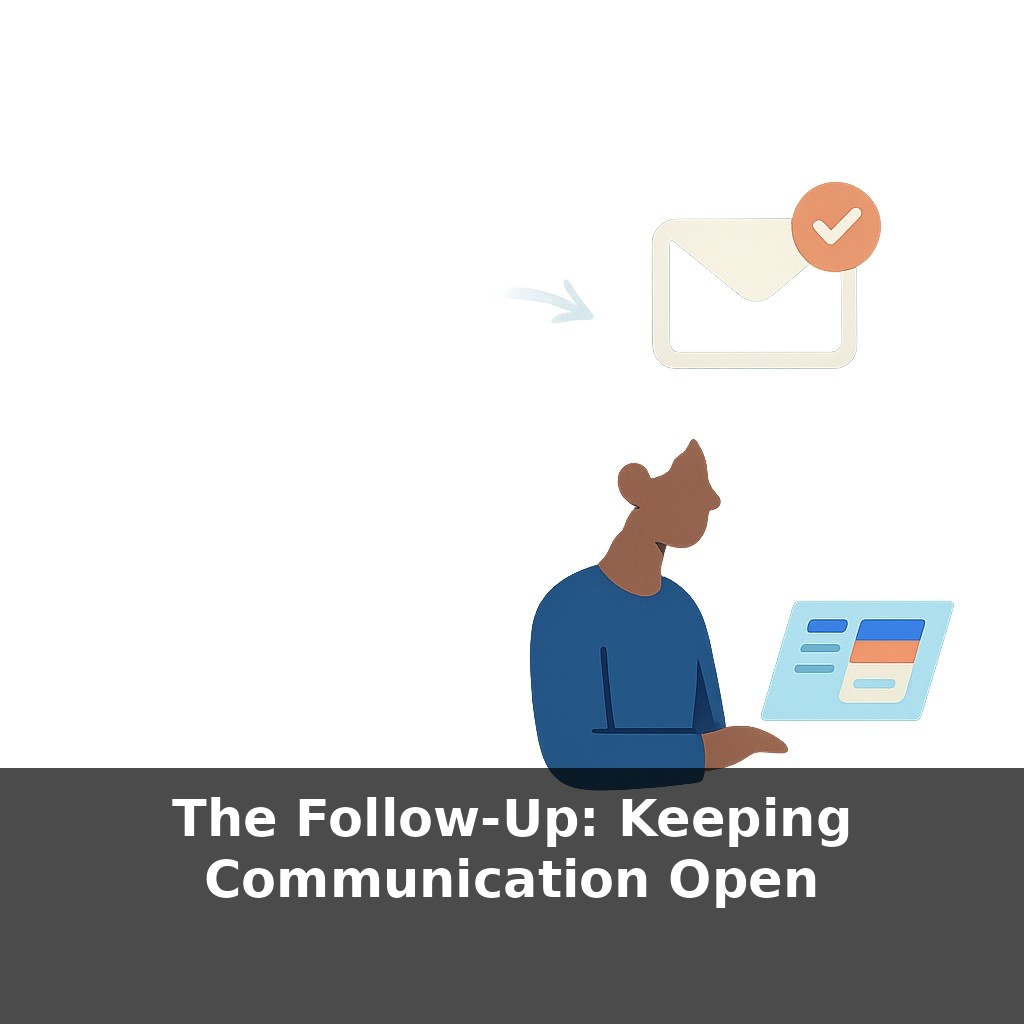
About half of employers quietly downgrade candidates who never send a follow-up. Now, put yourself in two parallel timelines: in one, the interviewer never hears from you again; in the other, a short, sharp note lands in their inbox the next morning. Which version of you gets remembered?
Fifteen minutes after you log off the video call, the interviewer jumps to their next meeting. An hour later, they’re scanning another resume. By tomorrow, details about you are already fading—unless you give their memory something sharp to anchor to. That’s where a thoughtful follow-up shifts from “polite gesture” to strategic move: it extends the conversation without being in the room. Done well, it doesn’t just say “thank you”; it subtly reminds them why you fit, shows how you think, and signals you’re someone who follows through. Think of it like seasoning a dish right before serving: the meal was mostly cooked during the interview, but this final touch can heighten flavor, balance any weak spots, and leave a stronger aftertaste than candidates who simply disappear once the call ends. In this episode, we’ll turn that brief message into a real advantage.
Here’s where the nuance starts to matter. Not every “thank you” note has the same impact; some are like a generic auto-reply, others feel crafted for that one person on that one day. The difference lives in timing, specificity, and the tiny bit of extra thought you’re willing to invest. The data shows employers actually notice these subtleties—but they notice missteps too: sending a group email, rehashing your entire resume, or pushing for a decision too soon can quietly undo goodwill. In this episode, we’ll explore how to use that brief message to extend rapport, clarify fit, and even repair small interview misfires.
Most candidates treat the post-interview message as a formality; hiring managers quietly treat it as more data. This is where you can tilt that data in your favor.
Start with a clear purpose. Before you draft anything, decide what this message should accomplish for you in *this* process: - Shore up one shaky answer? - Highlight a strength that didn’t really surface? - Deepen the “I’d be great to work with” impression?
That goal will shape what you emphasize, what you link, and even your tone.
Then, anchor it in *their* world, not yours. Scan your notes for one or two moments that clearly mattered to them—a problem they vented about, a metric they care about, a product direction they’re excited about. Your follow-up works best when it shows you were listening at that level of detail and are already mentally working on their problems.
Notice what this is *not*: it’s not a transcript of the interview or a second cover letter. Think of it more like a compact software update: - “Here’s the bug I fixed” (clarifying or improving something you said) - “Here’s the small new feature” (a link, idea, or brief example that adds value) - “System is stable” (your continued enthusiasm and fit)
Three practical angles to consider as you write:
1. **Reinforce cultural fit without saying “culture fit.”** Instead of claiming you’re collaborative, connect a specific part of your experience to how their team works: “You mentioned weekly architecture reviews; at X I led a similar forum that cut production incidents by 30%.”
2. **Repair small missteps with precision, not apology tours.** If you fumbled a question, one tight paragraph that reframes your answer is enough. Over-explaining makes the stumble bigger in their memory.
3. **Add value in one move, not a reading list.** If you share an article, framework, or quick sketch of an approach, tie it directly to what they raised: “You noted churn in your SMB segment; this short case study on onboarding experiments might be relevant.”
Finally, consider the channel mix. Email is the default; a concise, well-timed note on LinkedIn to a non-primary interviewer can strengthen the relationship without feeling duplicative. A handwritten note can stand out, but only if it arrives within a few days and complements, not replaces, the digital message.
A useful way to stress‑test your note is to treat it like a tiny product you’re shipping. Ask: what’s the single “feature” the reader walks away with—clarity, confidence, curiosity? If you try to cram in five, none land. Consider three quick variants:
- **The “problem-solver” follow-up.** You briefly extend something you discussed into a concrete next step: a metric you’d track, a hypothesis you’d test, or a stakeholder you’d involve first. One move that says, “I’m already working the problem.”
- **The “bridge-builder” follow-up.** You notice where two interviewers cared about different things—say, speed vs. robustness—and you show how you’ve balanced that tension in past work, in two sentences.
- **The “signal boost” follow-up.** You lightly echo the hiring manager’s own language or priorities (“reduce onboarding friction,” “tight feedback loops”) so their words come back to them tied to your name.
Each version keeps the note short but lets you choose the story you’re amplifying.
As tools evolve, your note becomes a tiny data point in a bigger system: tone, clarity, and relevance can be scored the way click‑through rates or credit risk once were. To stay human in that environment, treat each message like a short voice sample of your working style—how you frame problems, share credit, and disagree thoughtfully. Your challenge this week: draft one “practice follow‑up” to a past conversation and ask a friend, “Does this sound exactly like me, on my best day?”
Treat each message as a low‑stakes prototype, not a verdict. You’re testing tone, pacing, and how much “you” fits into a tight space—more like tuning an instrument than chasing perfection. Over a few iterations, you’ll spot patterns: which subject lines get replies, which details spark dialogue, which questions reopen doors you assumed were closed.
Before next week, ask yourself: 1. “Who is one person I recently talked to (a client, colleague, or friend) that would benefit from a thoughtful follow-up, and what’s one specific detail from our last conversation I can reference so they feel genuinely remembered?” 2. “If I sent a short follow-up message today—by email, text, or voice note—what clear question or next step could I include so the conversation doesn’t just ‘check in,’ but actually moves something forward for both of us?” 3. “When I hesitate to follow up because I ‘don’t want to bother them,’ what outcome am I actually afraid of—and what’s a kinder, more realistic story I can tell myself that would make it easier to hit send anyway?”