Your next interviewer might decide to hire you before you’ve finished your first answer. Now, here’s the twist: the candidates who pause for a few seconds before speaking are often rated as more confident. So why does doing *less* in that stressful moment lead to *more* success?
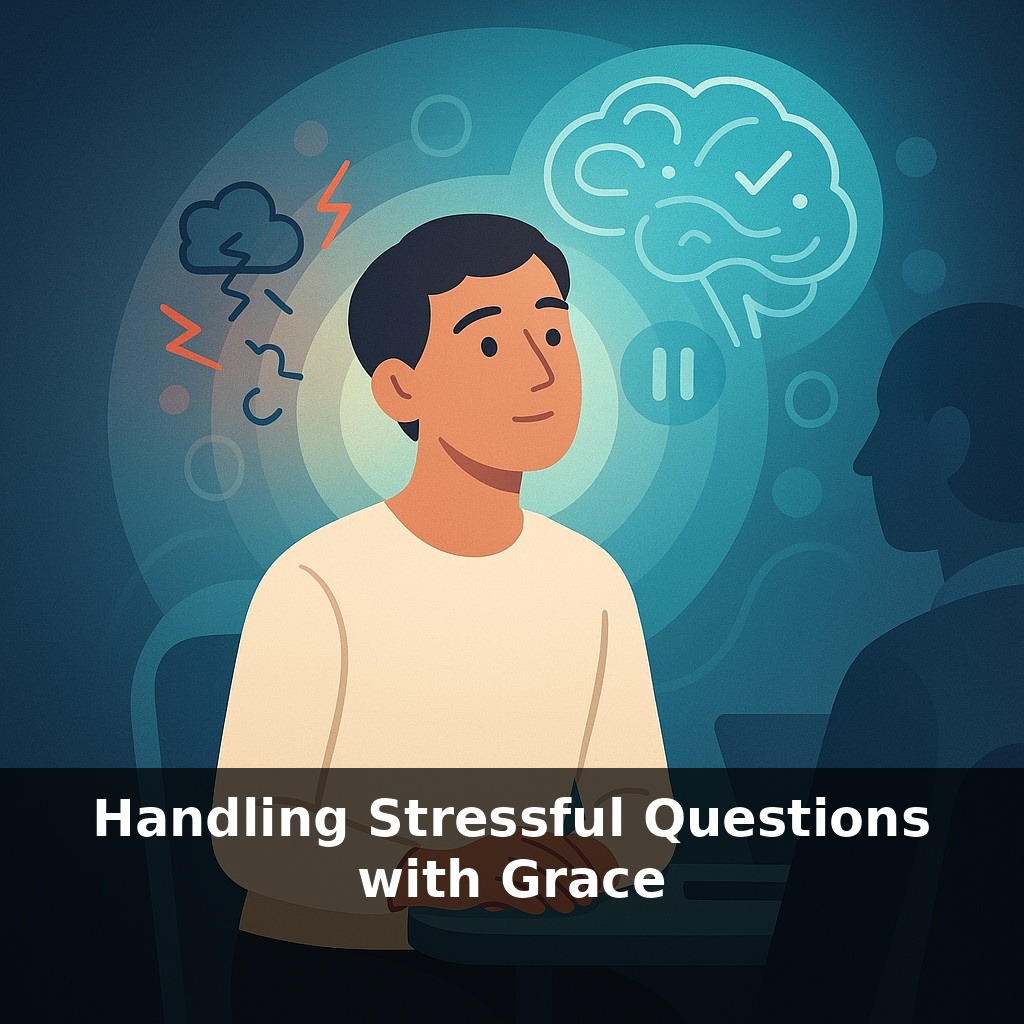
Here’s the catch: under stress, your brain quietly swaps out “think clearly” for “protect me now.” That’s your fight‑or‑flight system kicking in, tightening your chest, speeding your thoughts, and pushing you toward whatever answer gets you out of the hot seat fastest. Great for escaping danger; terrible for a nuanced question about a failed project or a gap on your resume. In those moments, many strong candidates do one of two things: start talking just to fill the silence, or mentally freeze and offer a vague, forgettable response. Both reactions leak subtle signals—rushed tone, scattered structure, defensive wording—that interviewers are trained to notice. The good news: you can retrain that split second between “pressure” and “response” so it becomes a micro‑space for clarity instead of panic. That’s where neuroscience, mindset, and structure quietly work together.
So instead of trying to “be less nervous,” it’s more useful to design what happens in that first pressured moment. Think of it as upgrading the default setting on how you handle a tough question. Most candidates focus only on *content*—perfect stories, ideal phrases, flawless resume explanations. But interviewers are also tracking *process*: Do you buy yourself a second to think? Do you organize your thoughts under pressure? Do you stay steady when the question is challenging or uncomfortable? Those tiny behaviors don’t just soothe you; they quietly signal “I can handle hard things” to the person across the table.
Most people treat that first tough question like a pop quiz. In reality, you can treat it more like open‑book: you’re allowed to consult tools *in the moment*. The skill isn’t “having the perfect answer ready”; it’s knowing what to *do* in those first 5–10 seconds so your brain comes with you instead of running ahead without you.
Start with your body, because it’s the fastest lever. When you feel that internal jolt—heat in your face, tighter breathing—your goal isn’t to “calm down,” it’s to *steady the signal*. One simple pattern: silent inhale through your nose for 4, exhale for 6. You can do a full round while the interviewer is still finishing the question, or while you glance briefly at your notes. The slightly longer exhale cues your system that this is intensity, not danger, giving you a clearer channel to think.
Next, give your mind a small job instead of letting it spin. A good move is to mentally label the type of question: “Past failure,” “priority tradeoff,” “conflict,” “learning curve,” “values/ethics.” That two‑word tag guides what story you reach for, instead of rummaging through your whole career history at once.
Now you can drop your answer into a simple narrative frame. Whether you prefer STAR or CAR, the point is to pick *one* structure and use it consistently so it becomes muscle memory. Under pressure you’re not inventing how to speak; you’re just filling four boxes: What was going on? What was hard? What did I do? What changed? This is also where you can quietly highlight how you operated under pressure—decisions made with incomplete data, tradeoffs, stakeholder management—without sounding like you’re giving a monologue about stress.
When the question is genuinely tricky—ambiguous, technical beyond your knowledge, or slightly confrontational—showing your *thinking path* beats forcing a slick answer. You can: • Clarify scope: “To make sure I’m addressing what matters most, are you more interested in X or Y aspect?” • Think out loud in a organized way: outline assumptions, options, and why you’d choose one. • Name the edge of your knowledge and pivot: briefly state what you *do* know and how you’d find the rest.
These moves don’t remove the pressure; they choreograph it. You’re demonstrating that even when put on the spot, you choose to slow the moment down, organize it, and respond with intention instead of reactivity.
Think of this like learning to debug your own response pattern in real time. In one tech company’s onsite loop, a senior engineer got a hostile‑sounding question: “Your last launch slipped by two months. Why should we trust your timelines here?” Instead of defending, she paused, jotted two words in her notebook—“cause” and “fix”—and then walked through each. That tiny written cue kept her from spiraling into apology mode and turned a trap into a systems‑thinking story.
You can borrow that move with low‑key props: a blank notepad where you write 2–3 keywords from the question, or a short vertical list—A, B, C—to keep multi‑part prompts straight. It looks like simple note‑taking, but it quietly slows the exchange and signals that you’re tracking details.
Over time, patterns emerge: maybe questions about conflict tend to fluster you, or anything involving numbers. That’s not a flaw; it’s a roadmap for what to rehearse more deliberately before high‑stakes conversations.
As hiring gets more automated, composure becomes a visible skill, not just a feeling. AI tools increasingly read facial tension, voice strain, even micro‑pauses the way a seasoned chef reads subtle changes in a sauce: small shifts signal whether things are under control or about to burn. That means your “in‑the‑moment” habits—breath, eye focus, even how you ask for clarification—will quietly shape how both humans and algorithms score your readiness for complex, ambiguous work.
Treat each tough question as a small lab: you’re running experiments on how you respond, not proving perfection. Over time, you’ll collect your own “data”—which stories land, which habits steady you. Like adjusting a recipe, tiny tweaks in how you pause, clarify, and frame answers can quietly shift you from surviving interviews to steering them.
Before next week, ask yourself: 1) “Which specific questions (like ‘Why are you behind on this?’ or ‘When will you finally decide?’) reliably spike my stress, and what story am I secretly telling myself in that moment about what this question ‘means’ about me?” 2) “If I had to answer one of those tough questions today using the podcast’s pause–breathe–bridge approach, what exact words would I use for the pause (silent count), the calm breath, and then a bridging phrase like ‘That’s an important question—here’s how I’m thinking about it…’?” 3) “The next time I’m caught off guard—maybe in a meeting, a family conversation, or a performance review—how could I experiment with buying myself 5–10 seconds (e.g., by asking a clarifying question or repeating their words) so I can respond with clarity instead of reacting on autopilot?”