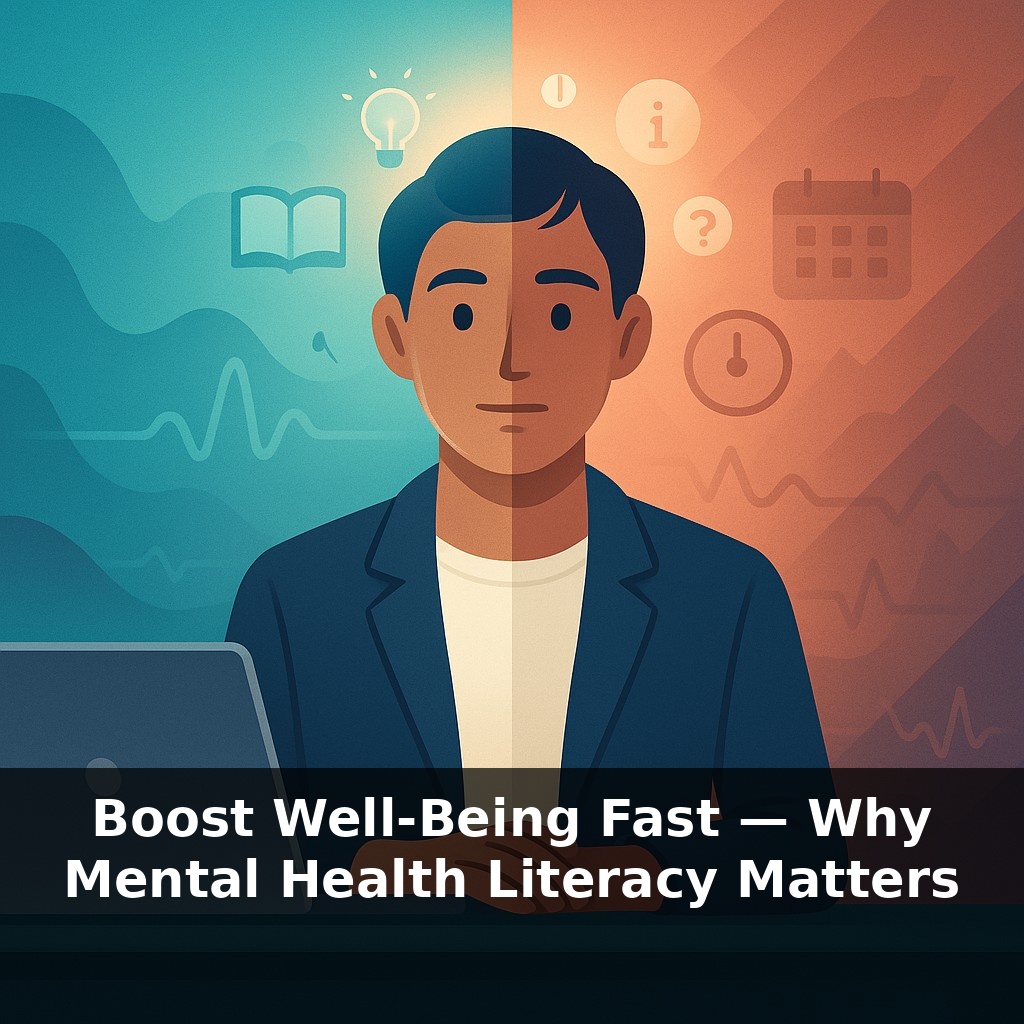
Boost Well-Being Fast — Why Mental Health Literacy Matters
📝 Transcript
A bold statement: At least one person on your team is battling a silent mental health struggle—and it's rarely who you’d suspect. They’re still hitting deadlines, still showing up on calls. The paradox? The very skills that make them look “fine” can also hide the moments they most need help.
Maybe they’ve just been promoted. Maybe they’re the one people go to when projects are on fire. On the surface: composed, competent, “the strong one.” Underneath: poor sleep, quiet panic between meetings, a calendar full of back-to-back “just one more” obligations that never quite ends.
This is where mental health literacy quietly changes the script. Instead of waiting for a dramatic crisis, it trains your eye to spot small, early signals: the teammate who suddenly stops sharing in meetings, the high performer who begins working strange hours, the friend whose messages shrink from paragraphs to single-word replies.
Think of it as learning to read the “weather patterns” of your own mind and your team’s: subtle shifts in mood, energy, and behavior that, when noticed early, let you adjust course before the storm fully forms.
In fast-paced workplaces, we’re trained to decode everything—metrics, client feedback, market shifts—except our own inner data. That’s where mental health literacy becomes a quiet performance edge. It gives you a shared language for what’s actually happening beneath “I’m fine”: knowing the difference between a rough week and burnout brewing, between normal nerves and spiraling anxiety. It also reframes support from something dramatic to something practical: a quick check-in, a small boundary, a nudge toward professional help, all as routine as updating a project plan when new information arrives.
Here’s where the research gets practical.
When psychologists talk about mental health literacy, they’re not asking you to become an amateur therapist. They’re talking about three very specific abilities that busy professionals can realistically build:
First, accurate naming. Not every bad day is “burnout,” and not every moment of pressure is “anxiety.” Being able to distinguish stress from depression, or perfectionism from a clinical disorder, matters because it changes what you do next. Mislabeling can keep people stuck—either overreacting to normal strain or minimizing something serious.
Second, pattern spotting over time. High performers are often great at powering through today; MHL nudges you to also ask, “How long has this been going on?” and “Is it getting better or worse?” That shift from isolated moments to trajectories is what leads to earlier course corrections instead of late-stage emergencies.
Third, knowing the “next right step.” Research shows people with strong MHL don’t just recognize problems; they know which levers are available: a peer conversation, a manager check-in, an EAP, a therapist, a GP, a crisis line. They have a mental menu, not a single, vague idea of “getting help someday.”
That’s why even a 90‑minute module can move the needle. In trials, participants didn’t come out as experts; they came out with sharper mental categories, lower stigma, and a concrete sense of where to turn. That’s enough to double the likelihood of seeking support early and to trim measurable stress within weeks.
For organizations, this is less about “being nice” and more about reducing silent drag on performance. Missed deadlines, presenteeism, avoidable sick leave—these often start as misread or ignored mental health signals. When teams share a basic literacy, conversations shift from personality judgments (“they’re just not committed”) to solvable conditions (“their workload and sleep have tanked; what can we adjust?”).
The result isn’t a therapy culture; it’s a competence culture where psychological health is treated with the same clarity and rigor as budgets and timelines.
A senior consultant starts snapping at minor requests, then staying late to “catch up,” then quietly missing nonessential meetings. No blow‑up, no formal complaint—just a slow drift. With low literacy, the story becomes: “She’s losing her edge.” With higher literacy, the story shifts to curiosity: “Her behavior’s changed across projects and weeks—what’s underneath?” That small narrative change opens doors: a private check‑in, a referral to existing benefits, a workload reset before a resignation letter appears.
On a product team, one manager began asking in 1:1s, “What’s one thing draining your energy that I can help remove?” Over three months, people surfaced meeting overload, unclear priorities, and sleep issues. None of these were labeled as “problems” before; MHL simply gave permission and language. The result: fewer last‑minute crunches, more strategic “no’s,” and a noticeable lift in baseline energy—without adding a single new wellness perk.
Teams that invest in this now will be better positioned for the next wave of change: tighter deadlines, hybrid friction, and AI‑accelerated work. As MHL tools get embedded into calendars, project dashboards, and wearables, check‑ins may feel less like “wellness add‑ons” and more like adjusting settings in a cockpit mid‑flight. Your challenge this week: notice where decisions are made with zero psychological data—and ask, “What signal are we missing here?”
Conclusion: Consider this a long-term performance upgrade, not a one-off wellness fix. As your literacy grows, you’ll start catching “micro‑detours” in your day—like noticing when you’re driving slightly off‑lane before the rumble strip. Over time, shared language and tiny course corrections compound, turning scattered coping tactics into a more stable, sustainable way of working.
Start with this tiny habit: When you unlock your phone for the first time each morning, whisper to yourself: “Name it to tame it,” and label one feeling you notice (e.g., “I feel tense,” “I feel flat,” “I feel hopeful”). Then quickly add one word about its intensity—“low,” “medium,” or “high.” If it feels safe, follow it with one gentle thought you’d offer a friend in the same state (like, “It makes sense you feel tense before that meeting”). This 10-second check-in builds your “mental health vocabulary” and trains your brain to notice shifts in your well-being before they snowball.
From this course
Foundations of Mental Health Literacy
10 episodesUnlock all episodes
Full access to 10 episodes and everything on OwlUp.
Subscribe — $1.99/monthLess than a coffee ☕ · Cancel anytime