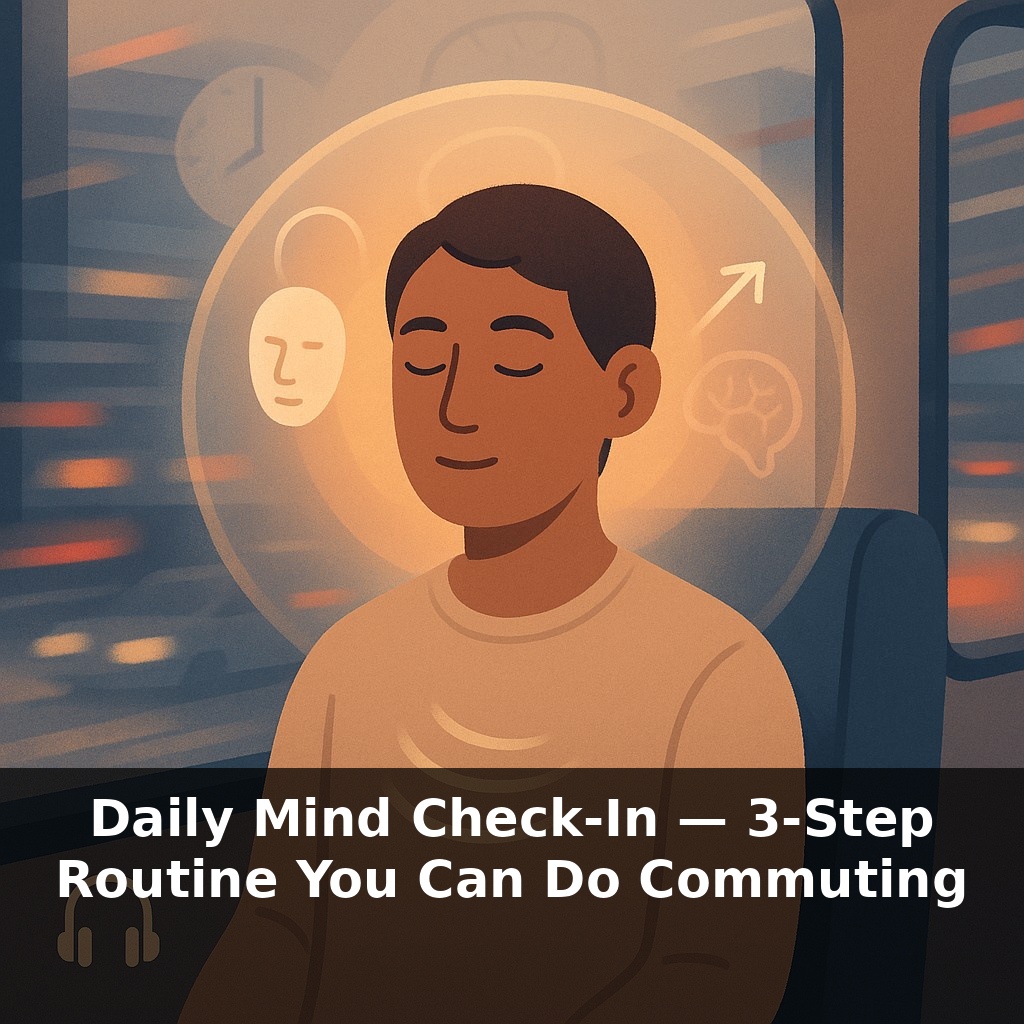
Your commute might be the most powerful mental health tool you’re ignoring. In just a few minutes of breathing, naming what you feel, and setting a simple intention, research shows you can calm stress chemistry before you even clock in or walk through your front door.
Rushing for the train, inching through traffic, scrolling on the bus—those “in‑between” minutes are usually where stress quietly piles up. Yet neuroscience suggests this is prime real estate for mental maintenance: a tiny window where your brain is shifting gears and is unusually open to new habits. Instead of treating the commute as dead time or a doom‑scroll zone, you can turn it into a daily mind check‑in that runs almost on autopilot. You’re not adding another task to your overcrowded day; you’re slightly upgrading something you already do. Over time, this 3–5‑minute ritual can become as natural as checking the weather before you leave home—short, practical, and surprisingly predictive of how the rest of your day will feel, both at work and when you return.
That small upgrade matters because stress rarely arrives as a crisis; it seeps in through tiny leaks—an unfinished email, a tense meeting ahead, a crowded train. This is where a brief, structured ritual helps you notice early “weather changes” in your mood before they become a storm. You’re not trying to force positivity or fix every problem while you travel. Think of it more like checking the day’s forecast: is your inner climate cloudy, windy, or clear enough for bigger decisions? Over days and weeks, this gentle tracking makes subtle shifts visible—like realizing Monday mornings feel different from Fridays, or that certain routes leave you drained.
You can think of this 3‑step check‑in as a compact “operating system” that runs quietly in the background while the rest of your life stays busy in the foreground. The goal isn’t to create a perfect morning or evening; it’s to give your brain a consistent script to follow when it would otherwise drift into worry or autopilot.
Step one: breathing. Keep it practical: four slow breaths is enough. What matters now is consistency and portability. Can you do it at a red light without closing your eyes? On a crowded bus without looking odd? Choose a pattern that fits your actual commute—maybe one breath per stoplight, or per two train stops—so the environment itself nudges you. Over time, those same cues start to signal “this is the moment I reset,” even on unusually stressful days.
Step two: affect labeling. Many people get stuck here because “How do you feel?” sounds vague or overwhelming. Shrink the menu. Pick a simple “emotion palette” of 5–7 words you’ll use most: for example, calm, tense, worried, flat, irritated, hopeful, tired. During your check‑in, you’re just sampling from the palette, not searching your soul. If a word feels 60–70% accurate, that’s good enough. You can even add intensity: “tense – 7/10.” Over days, these quick snapshots become a kind of emotional trendline you’re carrying in your head.
Step three: intention setting. This is not a to‑do list. It’s one sentence that changes how you move through whatever is already on your calendar. Useful intentions are tiny, behavioral, and situational. “For the first meeting, I’ll pause before responding.” “On the way home, I’ll walk slower from the station.” “For the next hour, I’ll speak 10% less and listen 10% more.” Think of it as choosing a camera filter, not rewriting the whole scene.
Viewed together, the three steps form a loop: brief pause (breath), brief scan (label), brief steer (intention). Run the loop once per commute, no more than five minutes. The power is not in depth, but in repetition. Over weeks, your brain starts to expect this small act of checking in, just as reliably as your body expects breakfast—even on days when life feels anything but routine.
A manager I worked with started using this 3‑step routine only on days she had performance reviews. After a month, she noticed something unexpected: she was using the same “emotion palette” words to describe both her mornings and her post‑review debriefs. That pattern helped her spot a recurring trigger—she felt “irritated 6/10” every time feedback was vague. Her next micro‑intention became, “Ask for one concrete example in each review.” The result: clearer conversations and less leftover tension on the ride home.
You can experiment in similar ways. Try pairing specific routes or days with specific intentions. Maybe Monday mornings get a “protect my focus” intention, while Friday rides home highlight “transition out of work mode.” Over time, you’re building a personal map: which situations drain you fastest, which tiny behavioral shifts reliably lift you, and which labels keep repeating even when your calendar changes. That map becomes a quiet decision tool for how you schedule, negotiate boundaries, and recover.
As cars get quieter and trains smoother, those 3–5 minutes may become prime real estate for subtle mental “tuning.” Think of your check‑in like a dimmer switch rather than an on/off button—over time you’ll notice you can nudge your energy up before a tough presentation or down before going home to family. Teams might even sync their own versions, the way runners share training plans, making brief emotional status checks as normal as syncing calendars before a project launch.
Over time, this tiny practice can become less like “self-care” and more like basic hygiene—quietly preventing buildup instead of reacting to crises. Your inner weather report gets clearer: you spot emotional cold fronts earlier, notice rare sunny spells, and learn which conditions help you think, relate, and recover at your best.
Your challenge this week: turn one regular trip into a live experiment. For the next five working days, pick just the **morning** or the **evening** leg and run the 3 steps once, no notes, no app. On day six, ask yourself: *What word showed up most? When did I feel even 5% different?* Let those answers shape one small change to next week’s schedule.