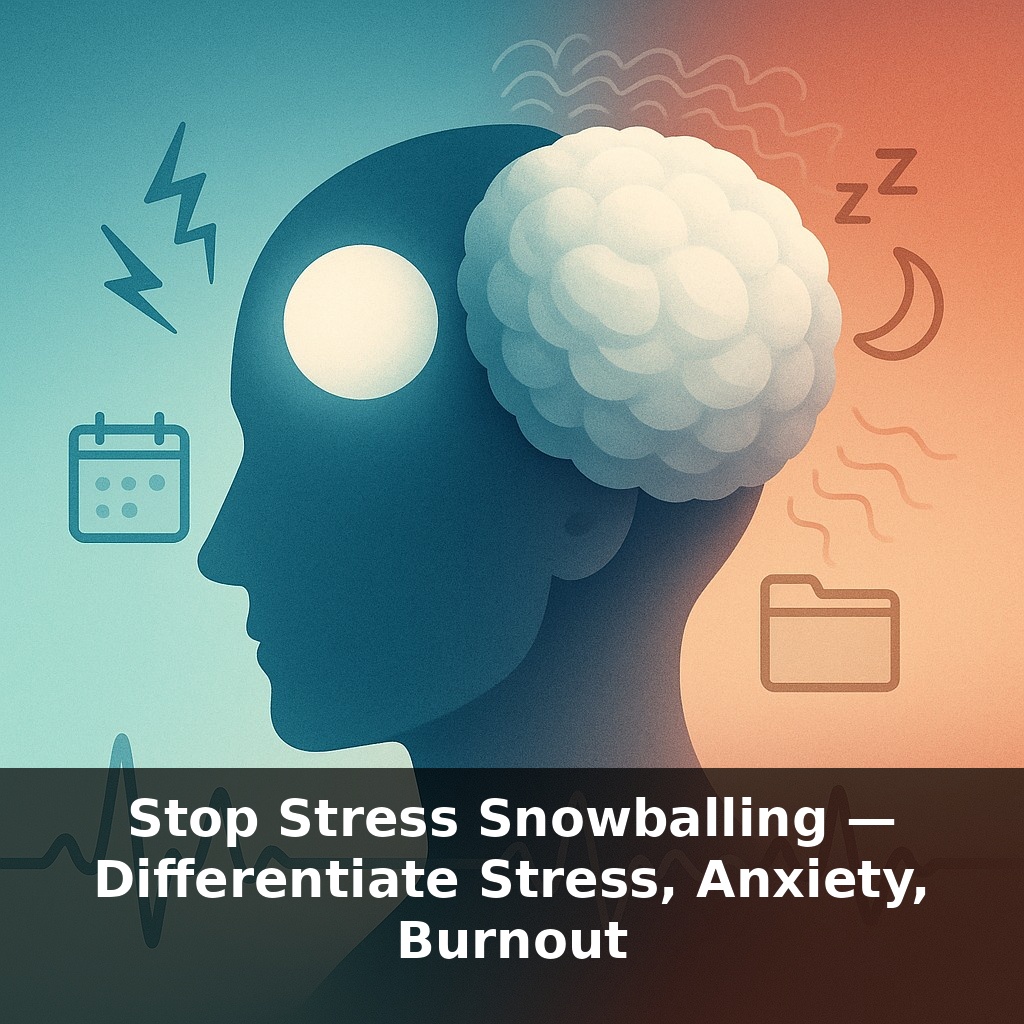
A short burst of stress can actually boost your performance by almost a third—yet the same feeling, stretched out, can quietly wreck your sleep, your focus, and your work. In today’s episode, we’ll step into those moments and untangle: is this stress, anxiety, or burnout?
Some people power through launch week on tight deadlines, sleep badly for a few nights, then bounce back once the pressure lifts. Others notice the tension never really “turns off,” even when the calendar looks lighter. And some reach a point where a normal workday feels like wading through wet cement. Same workplace, same goals—totally different inner experience.
In Episode 1, we explored why being able to name what’s happening in your mind is a performance skill, not just a “wellness” add‑on. Today, we’re going one layer deeper: how to notice *early signals* that your stress is stretching into anxiety, or calcifying into burnout.
We’ll look at concrete patterns—how your sleep shifts, how your calendar feels, how your motivation changes—so you can adjust sooner, not after a crash. Think of this as sharpening your internal dashboard, so your mental “warning lights” are harder to ignore.
Some days, pressure feels sharp and temporary—like stepping into a cold shower, intense but over quickly. Other days, it’s more like a gray sky that never clears, and you’re not sure when the weather even changed. That shift matters. Today we’re zooming out from individual moments and looking at *patterns over time*: how long the tension sticks around, whether there’s a clear trigger, and what starts to slip—focus, patience, creativity. You’ll learn to read those patterns not as personal flaws, but as data about what your mind and workload are actually handling right now.
Think of this section as moving from “noticing something’s off” to running a simple differential diagnosis on yourself.
Start with duration. Stress tends to spike and drop. A product demo, a tough negotiation, a performance review—your body ramps up, then gradually settles once the moment passes. If you notice tension, racing thoughts, or a knotted stomach *most days for weeks*, especially when nothing particularly demanding is happening, you’re drifting toward an anxiety pattern. Anxiety often feels like your mind rehearsing worst‑case scenarios on loop, even on an ordinary Tuesday.
Next, look at specificity. Stress usually has a clear “about”: *this* project, *that* meeting. When you can finish the sentence “I feel on edge because…,” you’re likely in the stress zone. Anxiety is fuzzier. You might say “I just feel off” or “Everything feels like too much,” but struggle to pin it to one situation. Burnout narrows and hardens: work becomes the main source of dread, and even small tasks feel strangely heavy.
Then, check your function. Under stress, performance can actually sharpen—short bursts can push focus and energy up by as much as 30%. You might be more tired, but you’re still getting things done. Anxiety starts to tax capacity: you reread emails, procrastinate simple replies, or avoid decisions because you’re afraid of getting them wrong. Burnout hits execution directly. You sit in front of your laptop and feel blank. Empathy for colleagues shrinks. You’re present, but not really *there*.
Notice spillover. With stress, recovery still works: a weekend offline, a good night’s sleep, a workout meaningfully resets you. Anxiety often follows you off the clock—into the shower, into the night, into days that should be easy. Burnout shows up as a kind of emotional numbness: hobbies don’t refresh you, time off feels too short, and coming back on Monday you feel just as depleted as when you left.
Finally, zoom out to impact. Is this a rough patch you move through, or is your world getting smaller—less social, less creative, more survival‑mode? That shrinking is a sign the snowball is rolling from stress into something that deserves more than “pushing through.”
A quick way to spot which “zone” you’re in is to watch how you react to small, everyday bumps. Say your manager moves a deadline up by two days. In a stress state, you might feel a jolt, reshuffle tasks, ask for help, and push through. Later that night, you’re tired—but you can still enjoy a show or a conversation. If you’re edging into anxiety, that same email might replay in your head all evening. You mentally draft responses, worry you’ve already messed up, and wake at 3 a.m. scanning for more bad news on your phone. With burnout, the reaction can feel flat: you see the new deadline and think, “Of course,” with a kind of resigned numbness. Instead of scrambling, you stare at the screen, half‑heartedly move a few calendar blocks, and feel strangely detached from whether the work goes well or not. Notice which version sounds most like your last tough week—that snapshot can reveal more than any abstract reflection.
Unchecked, these states can quietly reshape careers and cultures. Teams normalize “just one more sprint” until turnover spikes and innovation thins out, like a once-busy café that slowly loses its regulars. On the flip side, organizations that track wellbeing like they track revenue spot trouble earlier: mental health days are built into planning, managers are trained to notice shifts, and recovery is treated as fuel, not a luxury. Over time, that approach becomes a genuine competitive edge.
Think of this week as a pilot test: notice one tiny moment when you *almost* dismiss how you feel—then pause for two breaths and label it. Over time, these micro‑check‑ins work like regularly tuning an instrument; small adjustments prevent big crashes. Your mind won’t become “low‑maintenance,” but it can become more readable—and that’s where choice begins.
Before next week, ask yourself: 1) “Looking back at the past few days, which moments felt like short-term ‘stress’ (a spike tied to something specific), which felt like more free‑floating ‘anxiety’, and where did I notice signs of ‘burnout’ like numbness, cynicism, or exhaustion?” 2) “The next time I feel activated, what’s one concrete ‘stress‑response check’ I can do in the moment—like stepping away for 3 minutes, doing a slow exhale, or saying out loud what I’m actually worried will happen—and what do I notice in my body afterward?” 3) “If my week ahead is already looking crowded, what is one obligation I can downgrade (delegate, delay, or do less perfectly) to prevent today’s stress from snowballing into next week’s burnout, and what makes that choice feel uncomfortable but still right?”