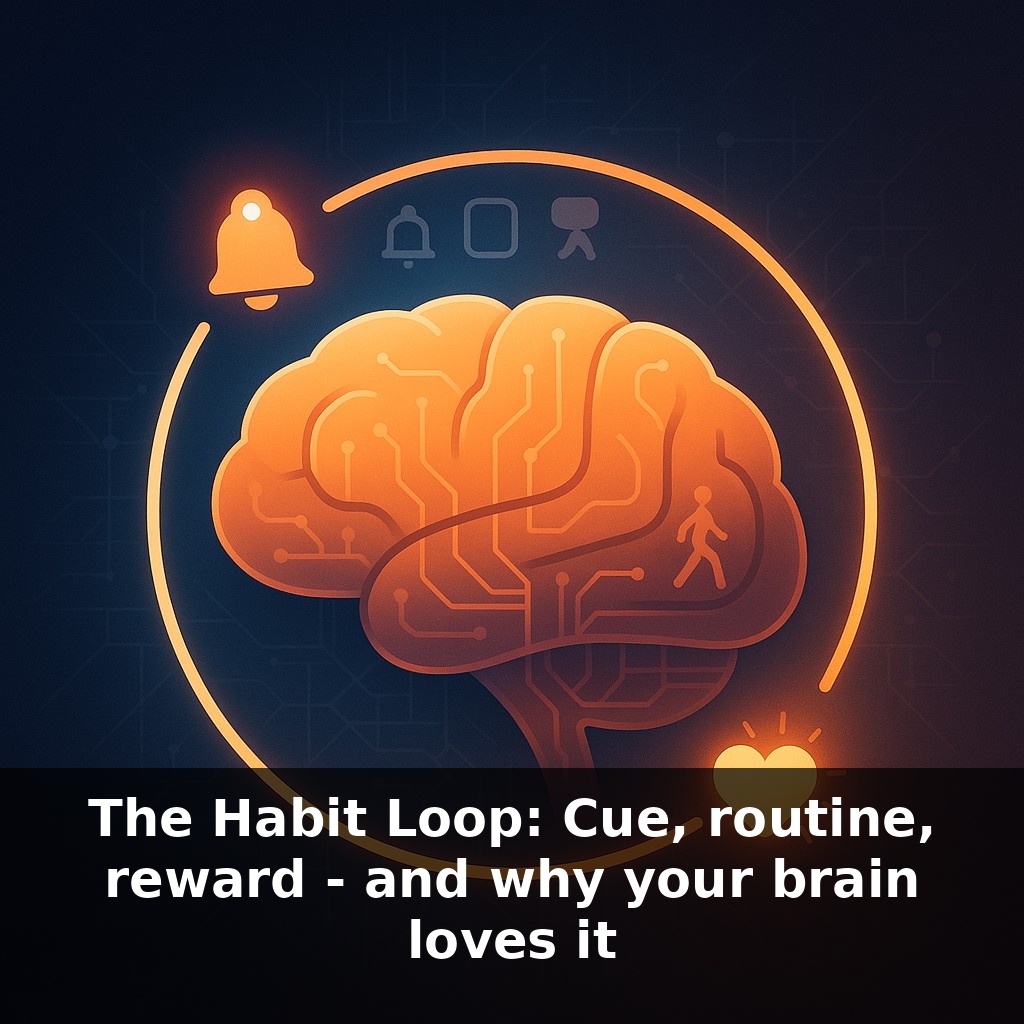
About half of what you did today wasn’t a choice—it was a habit running on autopilot. You reached for your phone, opened that app, grabbed that snack… often without deciding to. In this episode, we’ll explore why your brain loves these loops—and how that can be used for you, or against you.
Your brain isn’t just tolerating those loops running in the background—it’s actively optimizing for them. The more often you repeat a pattern, the more your brain trims away alternative options, like a city gradually closing side streets so traffic flows faster down a single main road. That’s incredibly efficient… and a little dangerous. Because your brain doesn’t label loops as “good” or “bad”; it only tags them as “easy” or “hard.” This is why you can sincerely *want* to do one thing and reliably end up doing another. What wins is usually not willpower, but the path that’s most neurologically streamlined. In a world of endless digital nudges, this matters: every notification, layout choice, and color badge can double as a cue that slips into your existing loops—or quietly installs a new one you never meant to have.
So instead of asking “Why am I like this?”, it’s more useful to ask “What exactly is triggering this loop, and what is it paying me with?” Neuroscientists break that down into three parts: the cue, the routine, and the reward. The cue is often tiny and easy to miss: a red dot on your screen, a vibration in your pocket, a lull in conversation. The routine is whatever you do next—scroll, snack, swipe. The reward isn’t just pleasure; it might be relief from boredom, anxiety, or loneliness. In tech products, whole teams quietly fine‑tune these three pieces to keep you coming back.
Here’s where the neuroscience gets uncomfortably specific.
When that cue appears—say, your phone lights up—the first thing that spikes isn’t pleasure, it’s *anticipation*. Dopamine neurons in areas like the ventral tegmental area fire not because you’ve gotten something rewarding, but because your brain is predicting that something rewarding is *about* to happen. Wolfram Schultz’s work showed that these neurons care less about how big the reward is and more about whether it’s *better or worse than expected*. That “prediction error” is the teaching signal: better‑than‑expected rewards strengthen the loop; worse‑than‑expected ones quietly weaken it.
Tech products exploit this with variable rewards. Sometimes the notification is meaningful, sometimes it’s trivial, and sometimes there’s nothing waiting when you open the app. That unpredictability keeps the prediction‑error system engaged. Your brain keeps thinking, “Maybe *this* time,” and every occasionally great hit over‑trains the loop far more than a steady stream of okay outcomes would.
Over time, control of the behavior shifts. Early on, prefrontal regions—those involved in conscious decision‑making—do more work. As repetition piles up, activity migrates toward the basal ganglia, particularly the dorsolateral striatum. That neural handoff is why the behavior can run while your “thinking brain” is occupied elsewhere. In Parkinson’s disease, where parts of the basal ganglia are damaged, patients can describe what they intend to do but struggle to install or update these automatic patterns.
And the timeline is sneakily long. Lally and colleagues found that for some actions, the curve toward automaticity is shallow; miss a day or two and the system barely notices. For others, especially ones with inconsistent cues or rewards, the curve is jagged—you feel “on track” one week and derailed the next, even though the underlying wiring is still adapting.
This is also where small rewards punch far above their weight. A single green check mark, a streak counter, a tiny celebratory sound in an app—these are all calibrated to be just enough to nudge dopamine prediction without feeling manipulative. The goal isn’t to make you ecstatic; it’s to make the loop slightly more likely to run *again*, and again, until questioning it feels almost unnatural.
Your challenge this week: for 3 specific behaviors you repeat daily with your phone or computer, reverse‑engineer their loops in real time. Choose: 1) One you like (e.g., a learning app) 2) One you feel neutral about (e.g., checking weather) 3) One you’re uneasy about (e.g., late‑night scrolling)
For each, do this *only when you catch yourself in the act*—no journaling marathons, no generic reflection:
- At the *exact* moment you notice you’re in the middle of it, pause the routine for 10 seconds. - Without putting the device down, quickly label: - The last concrete event just before you started (“Slack pinged,” “I hit a slow part in my task,” “The video ended”). - The precise micro‑action you’re taking now (“switching tabs,” “opening search,” “scrolling comments,” not just “using my phone”). - The *first* internal shift that would feel unsatisfying if it didn’t happen (relief, novelty, feeling “caught up,” numbing out).
Then let yourself continue as normal. No need to change anything yet.
End of the week, review your notes and look for: - Cues that repeat across all three behaviors (e.g., boredom between tasks, social anxiety, tiny work frustrations). - Rewards that *aren’t* obvious pleasure—like “I don’t have to think about X for a minute.” - Places where the cue and reward are the same across behaviors, but the routine differs.
If you want, share one loop you mapped and I can help you identify where it’s most “hackable” for redesign in the next step.
Think about how different people “play” their days, the way musicians approach a setlist. A jazz pianist doesn’t decide every note in advance; they rely on well‑worn riffs that fire on their own when a familiar chord hits. Your behaviors work similarly, but in different “genres.”
Take a founder who checks analytics after every meeting. The calendar alert ends, their hand’s already on the trackpad, and minutes later they’re deep in charts. What’s interesting isn’t the behavior—it’s how *portable* that internal pattern is. Swap “analytics” for “Twitter,” and the underlying script barely changes.
Or consider someone recovering from burnout. They might still open their laptop at 9 a.m., but deliberately insert a micro‑pause: headphones on, one song, then work. Over weeks, that track becomes a psychological on‑ramp that marks a cleaner entry into focus.
The point isn’t to moralize those patterns. It’s to notice that once a sequence fits smoothly into your day’s “rhythm,” your brain will reuse that groove wherever it can, unless you consciously remix it.
As interfaces get smarter, those same circuits become programmable terrain. Digital therapeutics already test this: instead of pushing cravings away, they quietly swap in different next steps and outcomes. Cities may follow, using lighting, layout and transit like subtle signposts. The open question is who holds the “sheet music.” When platforms can tune your daily sequences as easily as a playlist, we’ll need norms—and laws—about which grooves are okay to compose for you.
Treat each loop like a trail you’ve been walking without noticing. This week’s mapping shows you where the ground is already worn smooth—and where you might want to reroute. Over time, those tiny detours can turn into new default paths, the way side streets slowly become main roads when enough people keep choosing them.
Before next week, ask yourself: 1) “What’s one habit I do almost on autopilot (like checking my phone in bed or snacking late at night), and what *exact moment* or feeling usually comes right before it—that’s my cue?” 2) “If I kept the same cue but swapped the routine, what’s a different 2‑minute action I could try that might still give me a similar reward—like relaxation, stimulation, or a sense of control?” 3) “After I experiment with this swap just once today, how did I actually feel afterward, and what does that tell me about what reward my brain was really chasing in the first place?”