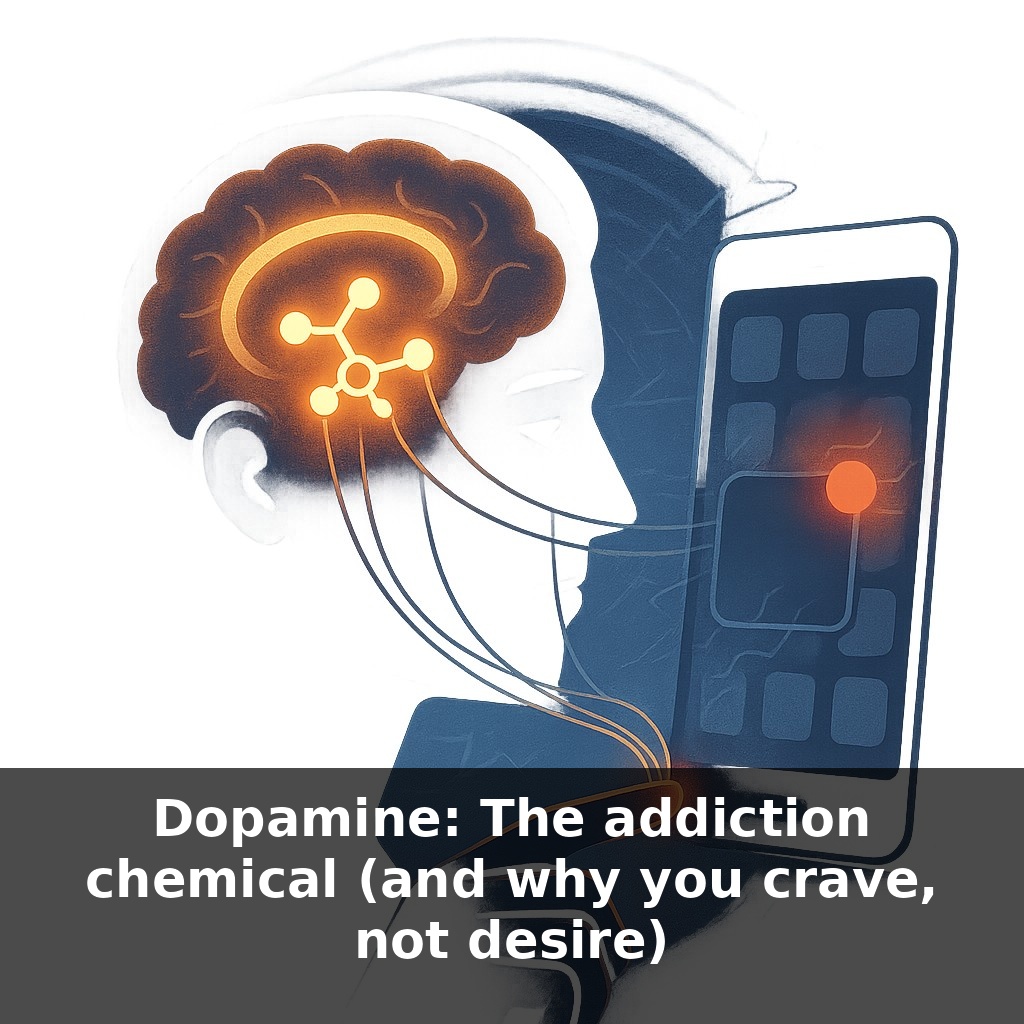
Your brain can learn to crave things you don’t even like anymore. A slot machine, a red notification dot, one more episode at midnight—different scenes, same chemical whisper. Today, we’ll walk into that craving circuit and ask: who’s actually driving your choices?
That whisper in your head doesn’t just show up around drugs or casinos. It’s there when you open your fridge “just to check,” refresh your inbox for no reason, or tap the same three apps in the same order every morning. Those tiny, almost automatic moves are where dopamine quietly shines. Not as a pleasure blast, but as a kind of internal spotlight: “This, right here, might matter.” It doesn’t care whether what follows is good for you, meaningful, or even still enjoyable. It cares that, in the past, something interesting sometimes happened next. A like. A win. A message. A bite. And so it tags the cue—notification chime, app icon, late-night silence—as “worth chasing.” In this episode, we’ll zoom in on that tagging process, and see how it turns ordinary moments into loops you keep repeating, long after the fun has faded.
But the brain isn’t just tagging single moments—it’s quietly mapping patterns over time. It notices how often a “maybe” pays off, how unpredictable the payoff feels, and how close you were to getting it last time. Those details matter. A snack that’s only good sometimes, a message that might be exciting, a feed that occasionally serves gold—these become disproportionately magnetic. The less certain the outcome, the more your attention leans in. This is why variable rewards are so powerful: your brain starts prioritizing “possibility” over actual satisfaction, and repetition over reflection.
Dopamine’s “leaning in” doesn’t happen in a vague, all‑over-the-brain way; it’s surprisingly precise. Tiny bursts in circuits like the nucleus accumbens act almost like timestamps on your experience: this sound, this sight, this context. Over time, your brain starts treating those timestamps as instructions. See this cue? Shift resources. Get ready to move.
At baseline, those signals are faint—on the order of a few nanomolar in that nucleus accumbens soup. Enough to keep you engaged with life, not enough to glue you to any one thing. But when something spikes that signal hard and fast—an amphetamine, a big crypto win, a viral post—your brain doesn’t just register “that was intense.” It quietly updates: “When cues like this show up, drop everything.”
One twist: the biggest blip isn’t when the reward lands, it’s when your brain thinks it *might*. Once the pattern is learned, the cue gets the spike, the payoff often gets a shrug. That’s why a 0.2‑second surge when you glimpse your lock screen can send you into ten minutes of scrolling that feel weirdly flat. You were chasing the *maybe*, not the moment.
Now scale this up. A slot machine, a loot box, an endless feed: each is tuned so the “maybe” hits over and over, on no fixed schedule. Companies A/B test colors, sound effects, timing, and near‑misses to slightly sharpen those transient spikes. The goal isn’t just one big win; it’s to keep your prediction system hovering on the edge of “almost.”
This is also why people can get hooked without any special vulnerability. Give a healthy brain strong, frequent, unpredictable cue–spike pairings and the circuitry adjusts. In Parkinson’s, simply nudging those same pathways with dopamine agonist drugs is enough for 6–8% of patients to slide into compulsive gambling or shopping. The personality didn’t change first; the chemistry did.
Add one more complication: the systems that register “this feels good” can drift out of sync with the systems that say “go get it.” You can end up in a loop where the cue still triggers full pursuit, even though the actual experience now lands as “meh” or even unpleasant. The pursuing part is over-trained; the enjoying part never got a vote.
That split between craving and genuine enjoyment shows up in places that look ordinary on the surface. Think about the moment your food delivery app says “rider is nearby.” You’re suddenly alert, maybe pacing, even if you’re not that hungry and the meal will taste average. Or consider the person who keeps reopening a dating app long after they’ve started dreading actual dates; the swipe still pulls them in, even as each match feels more like admin than romance.
A similar pattern appears in compulsive checking at work. You refresh your analytics dashboard far more often than the numbers really change in meaningful ways. The quick glance rarely satisfies, but the urge to “just check once more” keeps resurfacing, especially when results have been volatile lately.
On a larger scale, this helps explain why certain games, markets, or feeds feel “sticky” even when their content grows stale. The mind isn’t only tracking how good something is; it’s quietly tracking how close you might be to “something big” next time you engage.
Your newsfeed, markets, and notification badges are quietly training you. As systems get better at reading behavior, they can steer that training toward endless micro-pursuits—one more scroll, one more refresh—without ever asking if those pursuits still serve you. Future tools could flip that script: dashboards that show when your wanting has drifted from your values, or apps that throttle triggers once your behavior starts to look more like a twitch than a choice.
So the question shifts from “How do I stop craving?” to “What do I want to *train* to crave?” The same machinery that glued you to feeds can be pointed at practice reps, deep work, or harder conversations—small bets that echo your values. Like rearranging furniture, you don’t change the room itself; you change what you bump into first, and most often.
Before next week, ask yourself: 1) “When do I feel that restless ‘itch’ for a dopamine hit—like scrolling, snacking, or checking notifications—and what very specific feeling or situation is that urge helping me avoid right now?” 2) “If I temporarily removed one of my biggest dopamine loops for just 24 hours (for example, TikTok after 8 pm, gaming, or ultra-processed snacks), what uncomfortable sensations or thoughts would show up—and what might they be trying to tell me about what I actually need?” 3) “Where in my day do I confuse craving with genuine desire—chasing quick hits instead of meaningful goals—and what is one concrete, desire-based activity (like a deep work block, a real conversation, or a creative project) I’m willing to protect in my schedule this week, even when the cravings spike?”