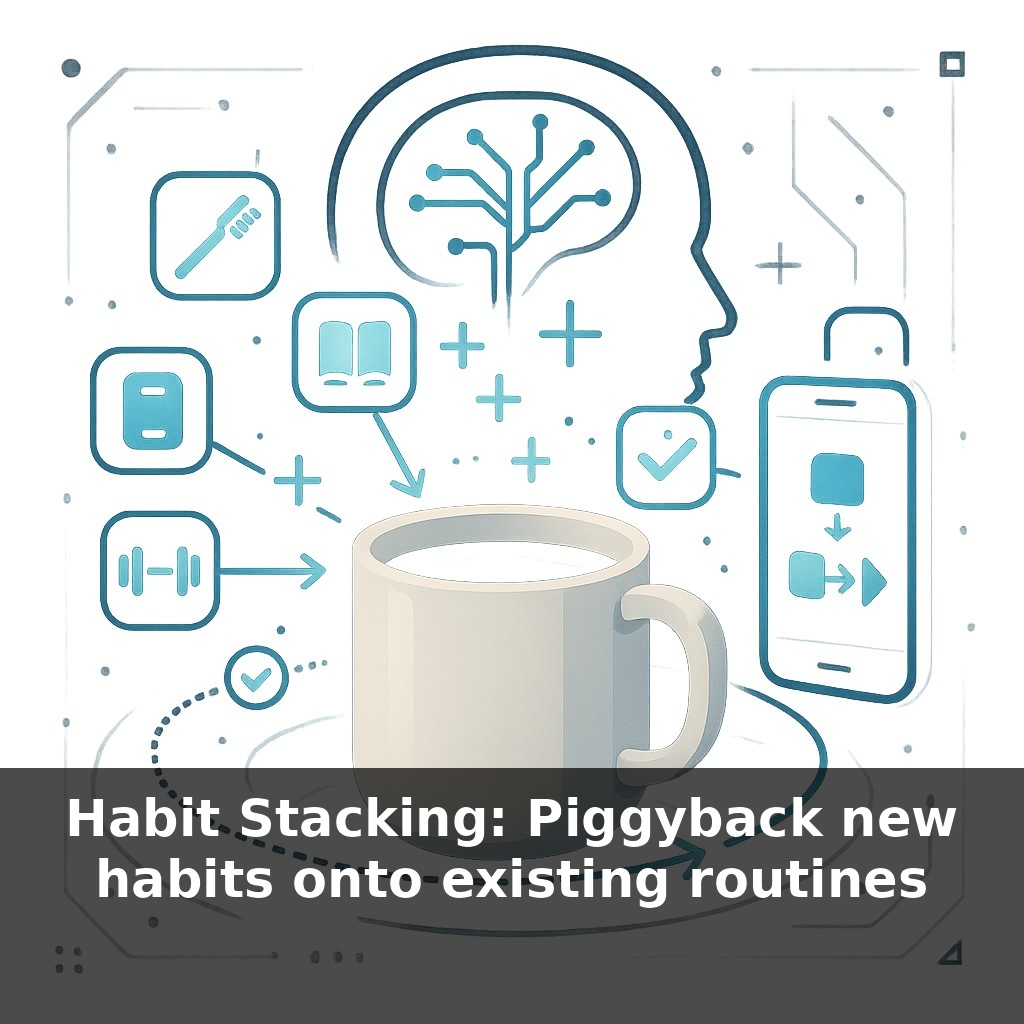
You already perform dozens of tiny rituals each morning—without deciding to. Now here’s the twist: research shows a simple “if this, then that” link can quietly multiply the odds a new habit actually sticks. Today, we’ll slip new behaviors into routines you barely notice.
More than 70% of top habit apps now prompt you to “attach this to an existing routine”—not because it’s trendy UX, but because your brain is quietly optimized for it. Under the surface, your nervous system is constantly scanning for reliable patterns: same sink, same mirror, same commute, same login screen. Those repeating contexts act like backstage crew, setting the scene so behaviors can run on autopilot.
The opportunity isn’t to create more willpower; it’s to exploit these backstage cues with precision. Neuroscience suggests that when the cue stays stable—same time, same place—your brain can “chunk” actions together faster, fusing them into a single script. Instead of forcing a new behavior into your day, you’re editing an existing scene. In this episode, we’ll turn those background moments—coffee brewing, app loading, laptop waking—into deliberate launchpads for change.
But not every daily moment is a good launchpad. Some anchors are too chaotic, infrequent, or emotionally loaded to support anything new. The trick is to spot “quiet” points in your day—short, predictable beats that already happen almost the same way, almost every time. Think of the pause while your computer wakes up, the few seconds after you lock your front door, or the brief wait as your favorite app syncs. These micro-gaps are like soft landing strips in your schedule: stable enough to catch a new behavior, small enough not to trigger resistance.
Here’s where habit stacking becomes less about theory and more about engineering your day. Once you’ve spotted those “quiet” points, the next move is to calibrate *what* you stack and *how precisely* you describe it.
Research on implementation intentions shows that vague add‑ons like “be more active in the morning” barely register in your brain’s control systems. In contrast, a concrete, sensory-rich script—“After I hear the kettle click off, I will do five heel raises at the counter”—creates a tiny, recognizable pattern. The richer the cue description (sound, location, object in your hand), the easier it is for your brain to flag, “This is the moment.”
Start by shrinking the stacked behavior to the smallest unit that still feels meaningful. Instead of “do yoga,” it might be “roll out the mat and hold one stretch.” Large goals still fit here; they’re just expressed as a series of microscopic moves that can be chained later. That’s how people turn “write a book” into “open the doc when my calendar reminder pops up” and gradually expand the session once the opening move is effortless.
The other dimension is compatibility. A good stack respects the physical and emotional texture of the anchor. High-focus anchors (opening your coding IDE, joining a Zoom meeting) pair well with quick clarity tasks like checking a priorities list. Low-focus anchors (waiting for a download, standing in an elevator) are better suited to brief movement or breathing. Mismatch them—like deep reflection during a frantic inbox check—and the stack will constantly feel “off,” even if the timing is perfect.
Finally, treat misfires as data, not failure. If you keep skipping a stack, don’t blame motivation; interrogate the design. Is the anchor unstable? Is the stacked habit still too big? Does it clash with your emotional state in that moment? Tweaking the phrasing, the size, or the anchor itself keeps you in design mode instead of self-criticism mode, which is exactly where long-term automaticity quietly takes shape.
Think of your day like a playlist you already know by heart; stacking is about slipping in short new tracks between songs you never skip. A few concrete builds:
A designer at a health‑tech startup wanted to read more research without blocking calendar time. She chose the instant her project file finished loading: glance at one saved paper and read a single paragraph. Because that loading screen appears dozens of times a week, the “one paragraph” grew into regular deep dives—without a formal reading block.
A customer‑support lead used post‑call notes as an anchor. After each tough ticket, she added one line: “What would have made this 1% easier next time?” Those micro‑reflections later fed process changes and onboarding scripts.
You can also stack on digital “edges.” A cybersecurity team added a rule: after pushing code, run a 15‑second security checklist. The push event was already non‑negotiable; the checklist rode its coattails and quickly felt just as automatic.
As assistants learn your commute, sleep, and meeting rhythms, stacking could move from manual craft to semi-automated co-design. Your calendar, smart lights, and wearables might quietly negotiate *where* a hydration, stretch, or language “layer” fits with minimal friction, like a sound engineer tucking harmonies under a lead vocal. The open question: who controls the mix—your values, or whoever profits from slipping one more behavioral “track” into your daily soundtrack?
As these stacks accumulate, you’re not just tweaking mornings—you’re quietly redesigning identity. Each tiny add‑on is like adjusting a recipe: a pinch more focus here, a dash of recovery there. Over months, the “flavor” of your days shifts. The open frontier is choosing which ingredients you’ll keep adding—and which ones you’ll deliberately leave out.
Here’s your challenge this week: Pick **one existing anchor habit** (like your morning coffee, brushing your teeth, or sitting down at your desk) and attach **one tiny new habit** directly to it—such as doing 5 squats after you start the coffee maker, taking 3 deep breaths right after you buckle your seatbelt, or reading one page of a book as soon as you get into bed. Do this exact pair **every day for the next 7 days** without changing the anchor or the new habit. Keep it so small it feels almost too easy, and track your streak by putting a simple check mark on your calendar each day you complete the stack.