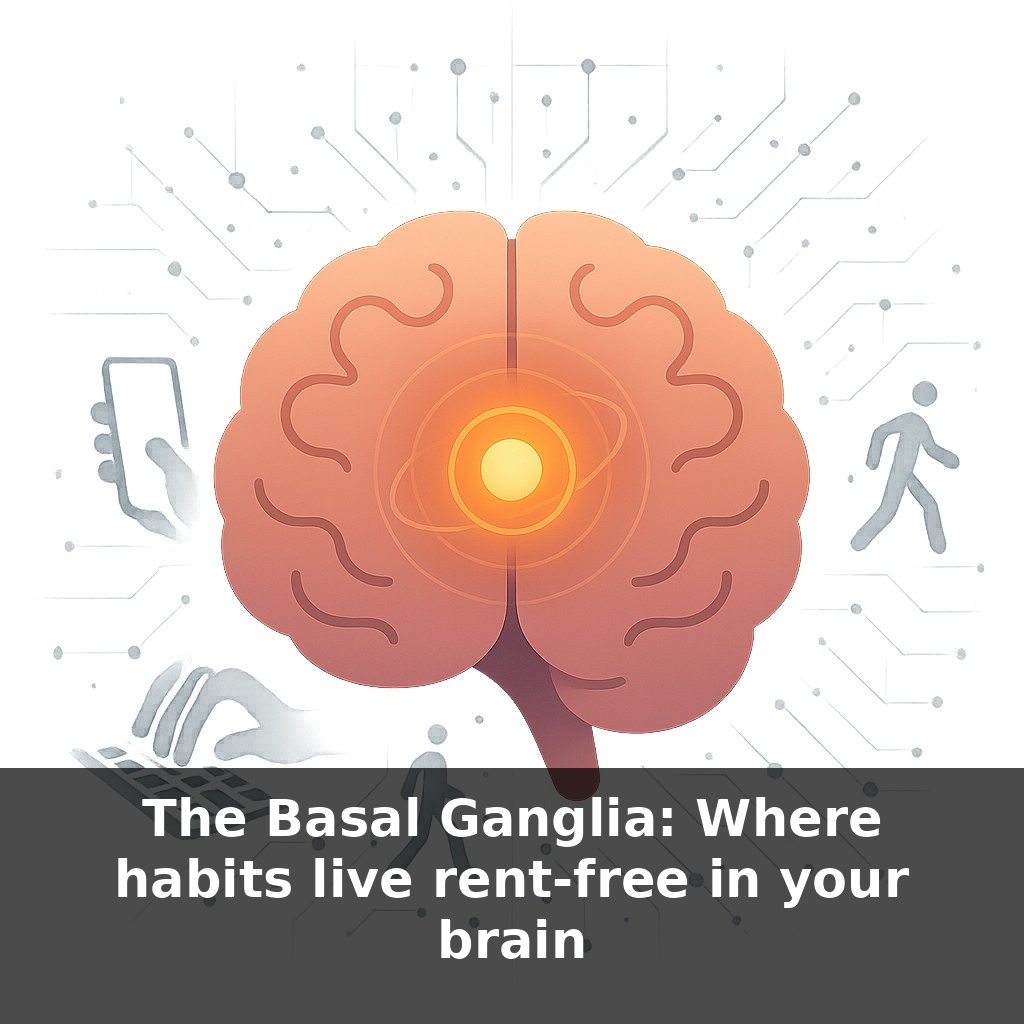
Some of your most complex behaviors are run by brain circuits you barely know exist. Right now, as you walk, scroll, or sip coffee, a tiny cluster buried deep in your brain is quietly taking over… and the more it does, the less you have to think at all.
You’ve met this hidden system every time you “came to” halfway through a commute, or realized you’d typed your password without a single conscious thought. That quiet takeover is the basal ganglia in action—not just storing habits, but reshaping how effort, attention, and motivation are allocated in your day. It doesn’t just repeat what you do; it selectively promotes what’s been rewarded and quietly buries what hasn’t, like a backstage editor cutting awkward scenes from a show. Over time, the basal ganglia start front‑loading work at the start and end of routines, while leaving the middle on autopilot. That’s why starting a new behavior feels heavy, yet once you’re “in it,” time collapses. In this episode, we’ll unpack how this system decides which behaviors become effortless—and how you can tweak its rules instead of fighting them head‑on.
Here’s the twist: your brain’s “habit hub” is extremely picky about what earns a permanent slot. It’s not the longest routines that win, but the ones that are tightly linked to clear cues and fast rewards. Miss those, and even heroic willpower sessions stay stuck in “manual mode.” The surprise from lab studies is how inconsistent habit timelines are—some wire in within a few weeks, others take most of a year—yet they follow the same rule: repetition under stable conditions. In practice, that means your bedroom, phone lock screen, or morning walk may be doing more behavioral programming than any goal-setting session.
Here’s the weird part: the circuits doing your “automatic” life are both power‑hungry and efficiency‑obsessed. Those deep nuclei soak up around a fifth of your brain’s dopamine, yet they’re constantly trying to turn conscious work into cheap background processing. The trade they’re chasing is simple: spend more dopamine now to stamp in a pattern, spend less energy later every time you run it.
In the lab, you can literally watch this transition. Early on, neurons across wide swaths of cortex fire in messy, effortful bursts as someone learns a new sequence. As it becomes familiar, activity shrinks and concentrates; recordings from Graybiel’s group show special “task‑bracketing” cells that fire like bookends only at the start and end of a routine. The middle fades into a quiet groove. That’s the signature of a behavior that’s been accepted into the club.
This is also why automaticity isn’t just about movement. Similar bracketing shows up when people learn mental routines: checking analytics in a fixed order, triaging emails, even the way developers run through a deploy checklist. Once the pattern stabilizes, prefrontal involvement drops and error rates fall—until something breaks the script.
When these circuits are compromised, the cost becomes painfully obvious. People with Parkinson’s can still move, but lose the effortless “stringing together” of actions. What used to be a single glide—stand, turn, walk—becomes a series of consciously negotiated steps. It’s a natural experiment showing how much invisible support you usually get from these subcortical systems.
For knowledge workers, this has a quiet upside: you can deliberately compress multi‑step workflows into single “units” your brain treats as one thing. The more consistent the cue and outcome, the more likely the routine is to be bracketed and offloaded. That’s also why context drift—answering messages from five different apps, at three different times of day—tends to keep you stuck in clunky, half‑learned patterns instead of smooth, chunked runs.
Your challenge this week: pick **one** recurring digital task (like preparing a weekly report, onboarding a client, or cleaning a code branch) and run it the **same way, in the same order, in the same environment** every time. Don’t optimize the steps yet; just lock the sequence and context. You’re not chasing speed—you’re giving those task‑bracketing neurons something stable enough to start carving into the circuitry.
Think about how senior engineers handle deployments at a well‑run tech company. At first, every push feels nerve‑wracking: check logs, run tests, confirm configs, scan Slack—each step conscious and slow. But over months, the team standardizes a runbook, pins the timing, and locks the tooling. Eventually, “shipping on Thursdays at 3 p.m.” becomes a single concept, not fifteen mini‑decisions. One cue on the calendar, one outcome in metrics, and the in‑between stiffens into a routine nobody has to narrate out loud.
Now contrast that with a founder who “kind of” does investor updates: sometimes Sunday night, sometimes Wednesday morning, sometimes skipped. Same number of steps available, but because the when and where smear all over the week, the pattern never gels. The updates stay cognitively expensive long after they’re technically simple, not from lack of willpower, but from lack of stable framing.
If we can read those habit signatures early, your calendar becomes more than logistics—it’s a health signal. Subtle shifts in how rigidly you follow routines might flag burnout, early Parkinsonian changes, or creeping compulsions long before you’d seek help. On the flip side, designing tools that “hand off” work to your automatic systems—like keyboard shortcuts tuned to your own patterns—could make digital workflows feel more like a familiar hiking trail than a daily bushwhack through inboxes and tabs.
The next step is noticing which routines you’ve accidentally trained. Watch for the “I blinked and 20 minutes vanished” feeling—it’s a flare from circuits that have already claimed that slot. Those are leverage points. Like well‑worn paths in fresh snow, they’re easier to follow than erase, but you can still choose where the next trailhead begins.
Here’s your challenge this week: Pick ONE existing habit loop (cue–routine–reward) you notice often—like checking your phone when you sit on the couch—and for the next 7 days, keep the cue and reward exactly the same but deliberately swap in a new routine that better serves you (e.g., 5 bodyweight squats or 60 seconds of deep breathing before you unlock your phone). Each time the cue happens, you must run the new routine at least once before you’re “allowed” to do the old one. At the end of each day, quickly rate from 1–5 how automatic the new routine felt when the cue showed up, and aim to beat your score by at least 1 point by day 7.