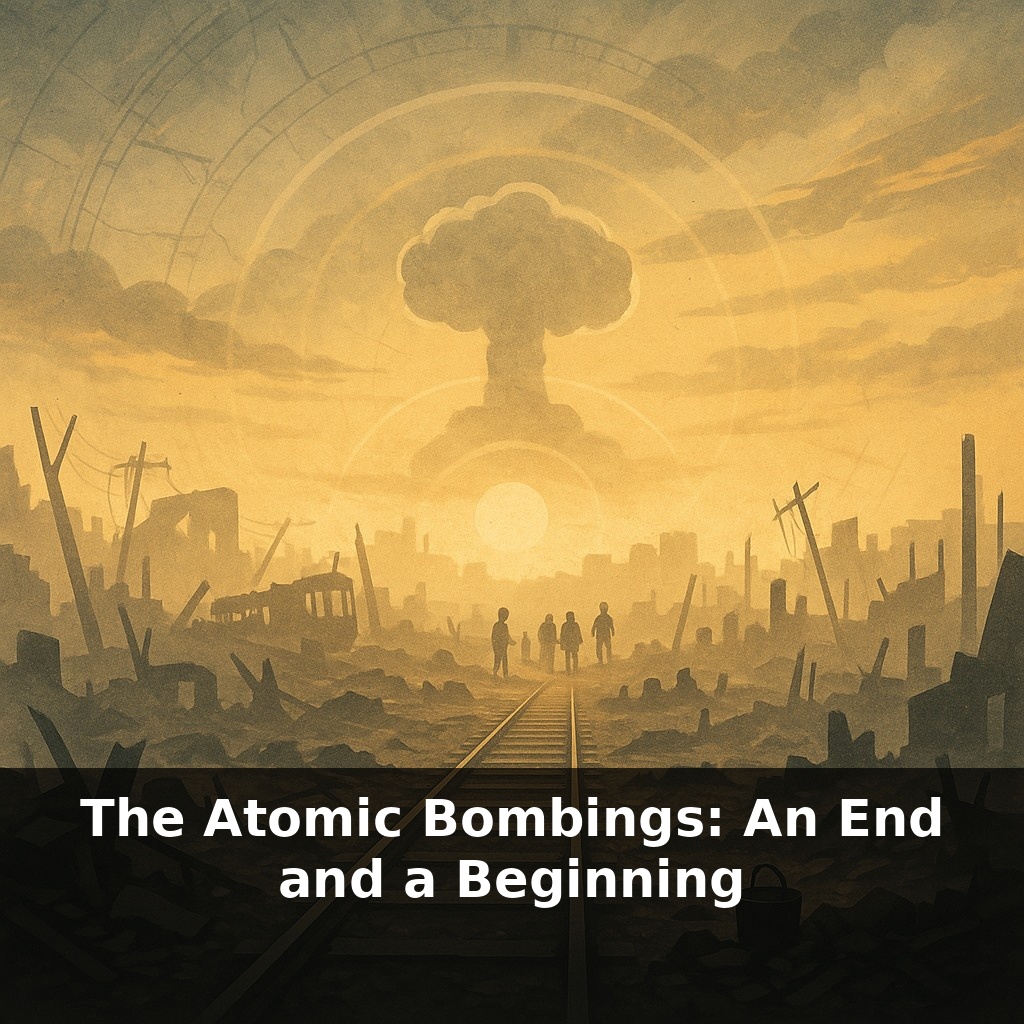
In one morning, almost an entire city was reduced to ash—and the war that had consumed the Pacific lurched to a sudden stop. But here’s the twist: the same blasts that ended one catastrophe quietly launched another, one that still shadows every nuclear decision today.
Seventy percent of Hiroshima’s people were dead, injured, or missing by nightfall, yet trains still tried to run the next day and survivors lined up for water amid ruins that no longer looked like streets. The scale of destruction didn’t just shock Japan; it blindsided Allied planners too. Reports from the bombed cities read less like military dispatches and more like descriptions of a natural disaster no one had words for yet. In Washington and Moscow, leaders realized this wasn’t just a bigger bomb—it was a different kind of power entirely. Within a year, diplomats were arguing over the Baruch Plan, scientists were lobbying for control, and ordinary people were reading headlines about “atomic secrets,” sensing that the rules of war and peace had quietly been rewritten for their lifetime.
In Tokyo, ministers argued under flickering lights, unsure how to describe what had happened; in schoolyards, children practiced air-raid drills that suddenly felt pointless. News of Hiroshima and Nagasaki moved unevenly—tight censorship in Japan, stunned headlines abroad. Some survivors walked for days before realizing their whole neighborhoods no longer existed on any map. In laboratories, physicists who’d rushed to finish the bomb now drafted petitions urging it never be used again, while editors scrambled to explain “radiation sickness” to readers who still thought of bombs as things that simply exploded and were over.
By the time Japan’s emperor recorded his surrender message on August 14, the bombing of Hiroshima was less than ten days old, Nagasaki only five. Yet inside Japan’s Supreme War Council, those dates collided with another shock: the Soviet Union’s sudden declaration of war and invasion of Japanese-held Manchuria. For some generals, the Soviet offensive felt like the greater strategic disaster; for others, the “single-bomb cities” signaled that continued resistance was no longer just costly but meaningless. The surrender that followed was not a simple reaction to one weapon, but the product of overlapping fears—of domestic collapse, foreign invasion, and further atomic strikes.
On the ground, the scale of loss forced new language into existence. Japanese doctors, overwhelmed by burns and injuries, began recording strange delayed symptoms—hair falling out in clumps, bleeding that would not stop. American occupation officials compiled damage surveys noting that a modern city center had become, in a few seconds, an almost featureless plain. Hiroshima and Nagasaki were quickly turned into living laboratories: teams measured blast patterns, mapped casualty zones, and interviewed survivors, not just out of humanitarian concern but to understand how such weapons might be “used better” or “defended against” in some future conflict.
Meanwhile, the technology did not stand still. Engineers who had barely finished the 1945 designs were already sketching more efficient cores, new delivery systems, and—soon—thermonuclear devices of far greater yield. It was as if a door had been kicked open and no major power was willing to close it first. Within four years, the United States lost its monopoly; the Soviet test of 1949 confirmed what many had feared in 1945: atomic war would not remain a one-sided threat.
Policy debates raced to catch up. The Baruch Plan proposed international control, but mistrust on both sides of the emerging Cold War doomed it. Instead, each test, each new warhead, each delivery system—from long-range bombers to ballistic missiles—layered fresh urgency onto the question first posed in the rubble of two Japanese cities: could states learn to live with weapons that their own planners quietly admitted should never be used?
Your challenge this week: trace one thread from 1945 to now. Maybe it’s a country’s arsenal, a treaty like the Non-Proliferation Treaty or a disarmament campaign started by citizens. Follow how it began, how it changed after crises like the Cuban Missile standoff or new tests, and where it stands today. By the end, ask yourself not just how the story has unfolded, but what it suggests about how much control we truly have over technologies once we build them.
In the years after 1945, choices about nuclear weapons often hinged on small, very human moments. In 1983, Soviet officer Stanislav Petrov sat in a bunker outside Moscow when alarms signaled incoming U.S. missiles. Protocol said report; his instinct said something was off. He marked it as a false alarm—correctly—quietly short‑circuiting a path toward possible escalation. In Washington and Moscow, negotiators in the 1960s walked out of sessions furious, then returned the next day to edge draft language a few words closer to workable. Over time, those word‑by‑word compromises produced frameworks like the Limited Test Ban Treaty and, later, START reductions. Their impact was less dramatic than mushroom clouds and not always linear: while France and China built arsenals, countries such as South Africa and later post‑Soviet Ukraine moved in the opposite direction, dismantling weapons or capabilities. The story since 1945 is less a straight line than a tangled map of near‑misses, half‑measures, and quiet course corrections.
Sirens and smartphone alerts now carry echoes of air‑raid warnings, but the choices behind them are quieter. Instead of waiting for leaders, city councils debate “nuclear‑free zones,” engineers redesign power grids to survive electromagnetic pulses, and students simulate treaty talks in classrooms. Like weather fronts that merge unpredictably, cyber tools, AI targeting, and space systems are beginning to overlap with nuclear planning, forcing us to rethink what “deterrence” and “safety” can mean in daily life.
Today’s launch codes sit in silos and briefcases, but they also live in textbooks, protest songs, and city memorials. Like fault lines beneath a crowded city, nuclear choices stay mostly unseen until pressure shifts. Our task is less to erase that fault than to map it clearly, so each generation can decide how much risk it is willing to build its future on.
To go deeper, here are 3 next steps: 1) Watch the 2015 NHK documentary “Hiroshima: BBC History of World War II” (available on YouTube/streaming) and take note of how survivor testimonies compare to the personal stories mentioned in the episode. 2) Read John Hersey’s *Hiroshima* (Vintage edition) and, in parallel, browse the Hiroshima Peace Memorial Museum’s online archive to connect the book’s six real individuals with photos, maps, and artifacts from the actual sites discussed in the podcast. 3) Open the Wilson Center’s “Digital Archive: Nuclear History” and pull up the declassified memos on the 1945 targeting decisions, then contrast them with the moral and strategic arguments raised in the episode by jotting down 3 points where policymakers’ language clashes with the human consequences you just encountered.