Understanding Task Prioritization: A Framework
📝 Transcript
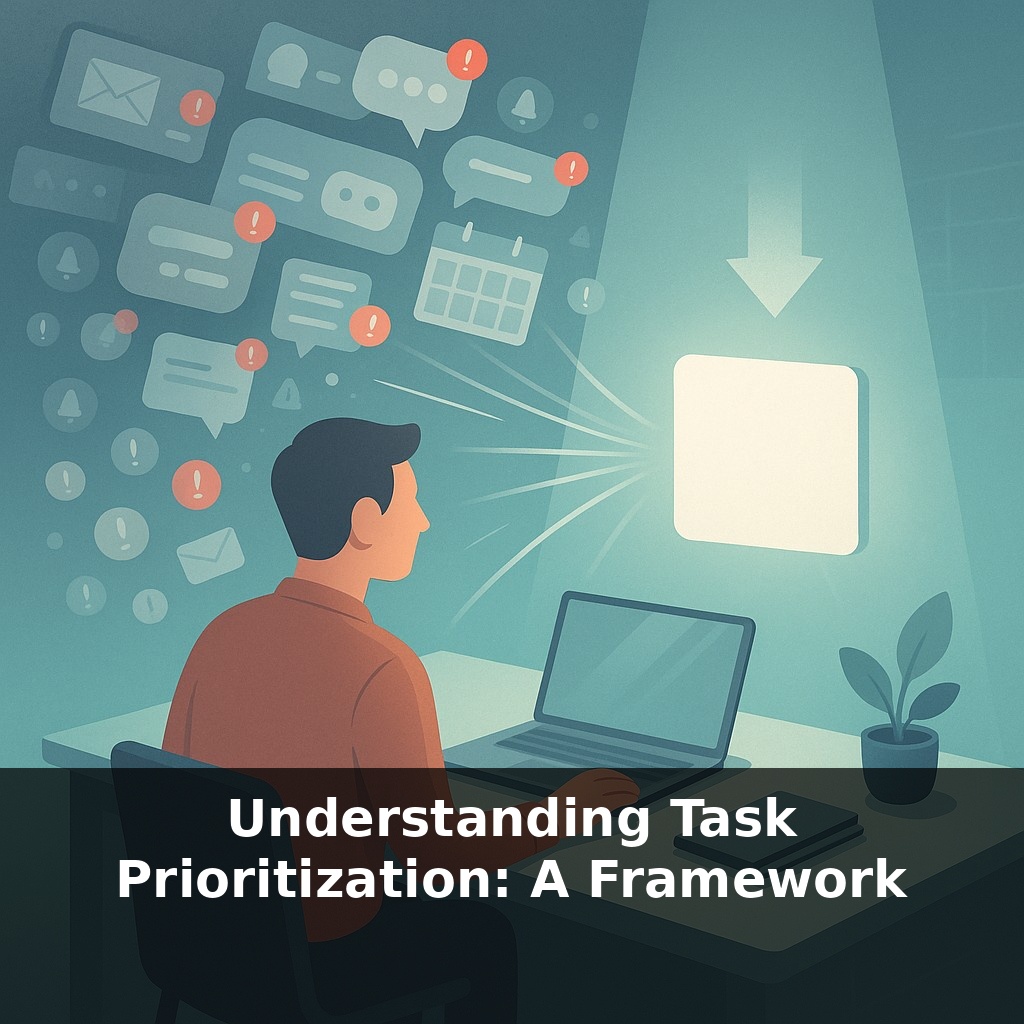
Right now, a typical office worker changes tasks more often in a day than they check their phone. You start answering an urgent email, then a chat pops up, then a meeting invite lands—soon, the work that actually matters most is the only thing not demanding your attention.
The real problem isn’t that you have too much to do—it’s that every task is shouting at the same volume. Calendar pings, “quick questions,” and “need this ASAP” messages all look identical on the surface, so your brain defaults to whatever feels hottest, not what’s actually highest impact. That’s why seasoned leaders quietly rely on prioritization frameworks: they turn a noisy to‑do list into a ranked playlist. Neuroscience and operations research both point to the same pattern: when you decide *up front* what wins your attention, your brain spends less effort re-deciding all day long and more effort doing the work. In this episode, we’ll unpack a practical way to separate urgent from important, give your tasks a clear score, and adjust your plan as things change—without needing a perfectly calm day to start.
The twist most people miss: prioritization isn’t just about ranking tasks once—it’s about running a tiny decision lab every day. Studies on high-performing teams show they treat their to‑do list like a living prototype, testing what should move up or down as real constraints surface: limited energy, shifting deadlines, new opportunities. Think of your week as a finite suitcase before a long trip: every item you add forces a tradeoff. Your role isn’t to cram more in, but to choose what travels with you now, what gets checked, and what simply doesn’t make this journey.
Most people start prioritizing from the wrong place: the list. A better entry point is the *constraints* around the list—your energy, the team’s capacity, and the real cost of delay. Researchers looking at high‑performing product and ops teams noticed a shared habit: before they rank anything, they ask, “What bottlenecks are non‑negotiable this week?” That might be a single stakeholder’s availability, a key dependency, or a narrow window where a decision meaningfully changes outcomes.
So instead of lining up tasks and trying to sort them, flip it: map the *few* levers where timing actually matters. A feature launch tied to a marketing campaign has a different kind of urgency than a generic “Q1 improvement.” A tough conversation scheduled before performance reviews has different weight than one that could happen any time. You’re not just asking, “How soon?” but “How different does the world look if this happens earlier versus later?”
This is where hybrid approaches like RICE, ICE, or MoSCoW quietly help knowledge workers. They force you to translate fuzzy priorities into clearer tradeoffs: impact versus effort, reach versus risk, must‑have versus “nice someday.” Even a light version—giving each significant task a quick 1–3 score for impact and a 1–3 for time‑sensitivity—begins to expose mismatches between what feels loud and what actually moves the needle.
Another overlooked layer is *WIP limits*. Operations research and Kanban data converge on a simple truth: once you’re pushing more than a small handful of active items, everything slows down. The counterintuitive move is to cap how many “in progress” tasks you’ll allow at once—say, three at work, one personal deep task—then ruthlessly queue or drop the rest. The mental friction of starting something new becomes a signal: “What am I willing to pause or cancel to make room for this?”
Like a landscape painter choosing just a few colors for a series, you get sharper, more coherent results by constraining your palette. You’re not under‑committing; you’re committing fully to less, so that the truly critical pieces actually reach done instead of living forever at 80%.
Try zooming in on one ordinary workday and treating it like a small‑scale experiment. Start with a messy, real list: everything from “prep Q2 deck” to “reply to Alex,” plus that vague “work on strategy” item you keep postponing. Now, instead of asking what to *do* first, ask where a tiny shift in timing would meaningfully change the outcome. If you push “prep Q2 deck” by three days, who’s blocked? If “reply to Alex” slides, what truly happens? Often, you’ll notice that a few quiet items create leverage far beyond their size—nudging a decision, unblocking a teammate, or preventing rework.
This is where a lightweight score helps. Give each meaningful task a quick rating for how many people it affects and how irreversible the consequences feel if you delay. A 20‑minute draft that shapes a whole project might quietly outrank a 2‑hour report no one’s using for weeks. That small act of quantifying turns “I should probably…” into “this clearly wins right now.”
Future implications of smarter prioritization reach beyond work speed. As AI tools learn your patterns, they’ll quietly nudge you toward sequences humans rarely notice—pairing tasks that use similar mental “muscles,” or spacing tough decisions after restorative blocks. Expect calendars that negotiate with each other, shifting meetings to protect shared deep‑focus windows. Careers may feel less like climbing a ladder and more like charting sea routes: choosing which long voyages deserve clear weather, crew, and fuel.
As you test this, notice side effects beyond getting “more done”: quieter evenings, fewer half‑finished thoughts tugging at you, a bit more confidence when you say no. Your days start to feel less like a jumbled playlist and more like a setlist you chose on purpose, with room for encores when something truly unexpected deserves the spotlight.
Start with this tiny habit: When you open your laptop in the morning, slide a sticky note (or digital note) in front of you and type just *one* “must-do” task in the format: “If I only finish ______ today, the day is a win.” Then label that task with a single letter: “U” if it’s urgent, “I” if it’s important but not urgent, or “L” if it’s low-value busywork. Before you let yourself check email or Slack, glance at that note for three seconds and say out loud which letter it is and why.
Unlock all episodes
Full access to 7 episodes and everything on OwlUp.
Subscribe — $1.99/monthLess than a coffee ☕ · Cancel anytime