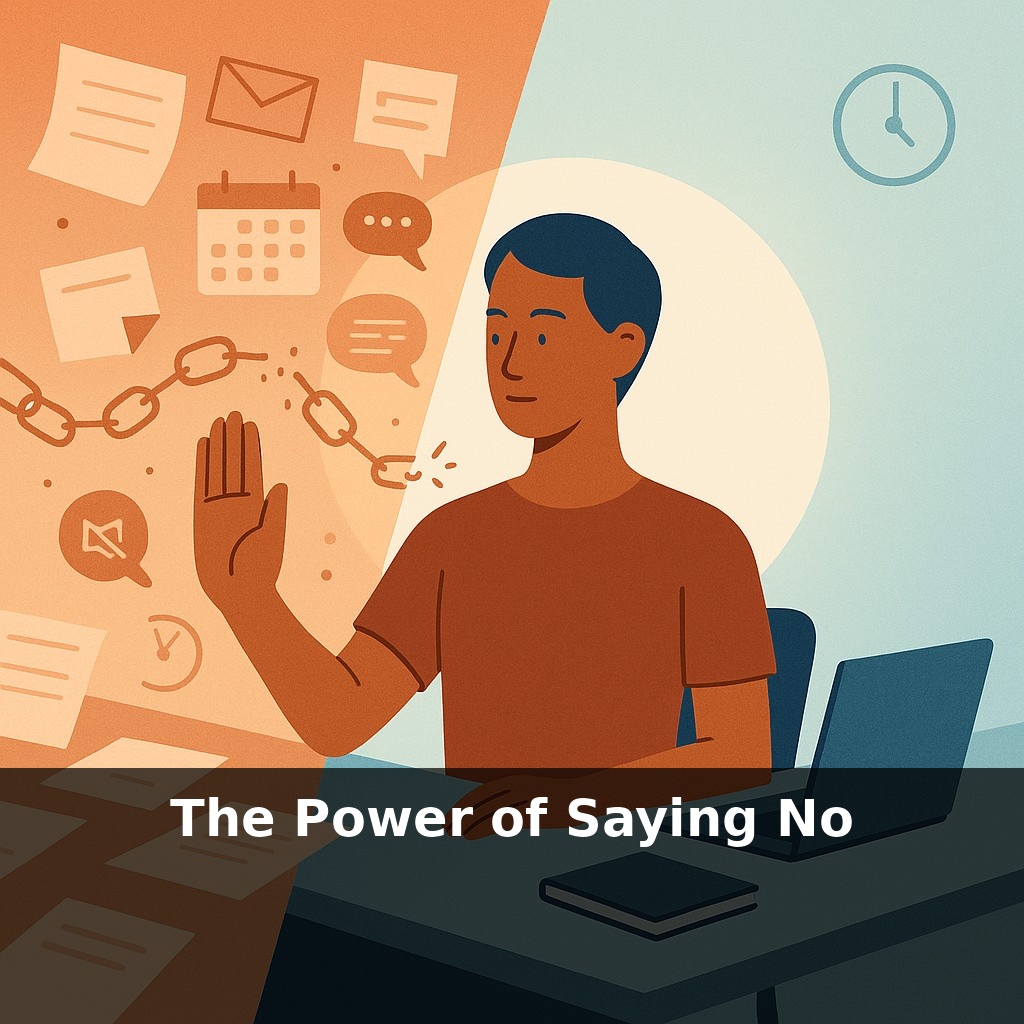
Your brain probably says “yes” faster than you can read this sentence. At work, that reflex quietly steals hours from your best ideas. A quick favor here, a “short” meeting there—and suddenly your day belongs to everyone but you. Why is “no” so hard, and so powerful?
Most careers don’t collapse from one huge “yes.” They erode through dozens of tiny ones that seemed harmless in the moment: “Can you just jump on this call?” “Can you quickly look this over?” Each agreement feels polite, even smart—someone needs help, you’re capable, why not? But zoom out over a quarter, and those choices quietly rewrite your job description. You become the default problem-solver for everyone else’s priorities, while your own highest-impact work stays parked on the runway.
There’s another cost you rarely notice: every time you overcommit, you teach people what to expect from you. Colleagues learn that your boundaries are flexible, that urgency on their side automatically becomes urgency on yours. Over time, your calendar stops reflecting your goals and starts mirroring other people’s agendas. The skill to reverse this isn’t working harder—it’s learning exactly when, where and how to say no.
Behind that quick “yes” are deeper forces: social pressure, fear of missing out, worry about seeming difficult, even habits wired by years of school and early jobs where compliance was rewarded. Those forces don’t just shape single choices—they quietly script your whole workday. This is where research gets interesting: psychologists find that every decision draws from a limited pool of mental energy, like a battery powering your focus, patience and creativity. Spend it on constant approvals and micro-decisions, and you arrive at your real work already running on low power.
You’re not imagining it: in many workplaces, the system is tilted toward “yes.” Calendars are public, chat pings are instant, and “quick sync?” has become a socially acceptable way to claim 30 minutes of someone else’s day. UC Irvine researchers found the average knowledge worker is interrupted every three minutes—and each interruption doesn’t just cost time, it fractures attention. In that environment, refusal isn’t just a personality trait; it’s a strategic tool.
Here’s the twist: people who use that tool thoughtfully often end up *more* respected, not less. Organizational behavior studies show that colleagues rate someone as more competent when they say no selectively and offer clear rationale: “This doesn’t align with the priorities we agreed on,” or “If I take this, X and Y will slip.” You’re signaling that your time is not a free public resource; it’s an asset you manage on behalf of the team’s real goals.
Neuroscience adds another layer. The Baumeister cookie study revealed how constant self-control drains the very circuitry you need for good judgment. Every time you override your better instincts and agree “just to be nice,” you’re spending that limited resource. Over a day of small concessions, your ability to think strategically and push back gracefully actually weakens. That’s how people end up in pointless meetings nodding along to plans they don’t believe in: they’re not unwise, they’re depleted.
Paradoxically, many professionals try to compensate by multitasking—Slack open during calls, inbox during 1:1s. Yet the University of London found heavy multitaskers show temporary IQ drops of up to 15 points, similar to operating after a sleepless night. When you never decline inputs, your brain starts juggling instead of prioritizing. The work feels frantic but shallow.
This is why saying no is not reserved for executives. Studies on assertiveness training with early-career employees show that when people are taught specific, respectful refusal scripts, their performance reviews improve. Managers notice clearer communication, stronger ownership and less rework. In other words: boundary-setting reads as maturity.
Think of it as editing your workday like an artist edits a sketch—removing lines that don’t serve the final image so that what remains comes into sharp focus.
A staff engineer at a fintech company started tracking every internal meeting request for a month. For each invite, she wrote a one-line “cost”: what wouldn’t get done if she attended. Seeing “no time for architecture review” next to yet another status call made declining feel less like being difficult and more like protecting something concrete. Her manager noticed that the projects she did accept moved faster—and quietly began routing only decision-critical meetings her way.
A product marketer used a simple test: “Will this still matter 90 days from now?” If the answer was no, she’d push back or suggest an async update instead. That question turned into a team norm; soon, recurring meetings had to justify their existence or disappear.
Even early-career professionals can do this on a smaller scale. One analyst agreed with her lead that her top priority was improving a key dashboard. She then used that shared target as a filter: “Happy to help—does this replace time on the dashboard work, or should we find someone else?” People started approaching her with clearer, more focused requests.
Selective refusal will matter even more as careers become less linear. You’re no longer optimizing for a single ladder, but for a portfolio of skills, relationships and options. Each yes shapes that portfolio. Treat invitations like choosing connecting flights: a convenient layover that sends you miles off route can quietly rewrite your destination. Teams that normalize “no for now” will adapt faster, because people can pivot focus when strategy changes, instead of dragging old commitments forward.
Your challenge this week: treat “no” as a prototype, not a verdict. Once a day, decline one request *creatively*—offer a later date, a shorter slot, an async update, or a swap with lower-priority work. Notice which options people accept. You’re not just defending time; you’re designing smarter ways for others to work with you.