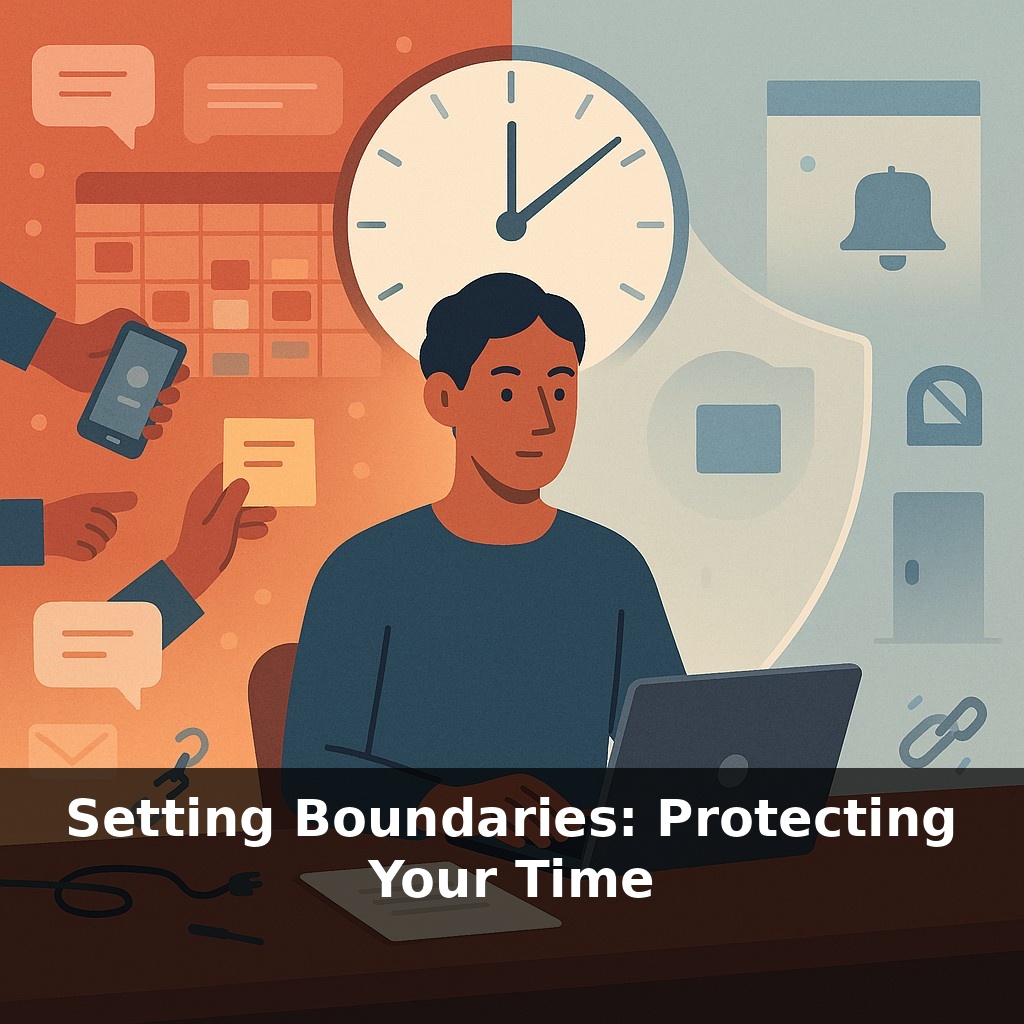
About half your workday disappears not to meetings, but to tiny, unplanned favors. A “quick question.” A “two‑minute” review. An invite you “really should” accept. You say yes once… and suddenly your calendar belongs to everyone but you. How did that happen so quietly?
Twenty to forty percent of your productive time vanishes the moment you start hopping between tasks. Not because the work is hard, but because every switch forces your brain to reboot. Add in constant pings, drop‑ins, and “one small thing” requests, and your day quietly fragments into confetti. The real problem isn’t just other people’s demands—it’s the invisible contracts you sign when you don’t set boundaries at all.
In organizational psychology, people who protect their focus windows and limit reactive work consistently show higher output and lower burnout. It’s less about working longer, more about defending the time you already have. Like a traveler constantly changing flights, you lose hours not in the air, but in layovers between. Boundaries are how you reduce those layovers: clear rules for when you’re available, what you’ll take on, and how others can work with you without owning your schedule.
Most people think of boundaries as walls: rigid, awkward, likely to upset someone. In practice, the most effective ones are more like signposts—simple, visible rules that help others navigate your time without colliding with it. Research on “boundary management” styles shows that high performers don’t just work harder; they deliberately separate deep work, collaboration, and admin into distinct modes. They script how colleagues can reach them in each mode, and when exceptions are worth it. This isn’t about being difficult; it’s about making your limits so clear that others can respect them without guessing.
Think about where your time actually leaks: not in big blocks, but in tiny cracks—an @here ping, a “can you just look at this,” a late‑night email you feel guilty ignoring. Each one seems harmless, but together they create a default rule: “I’m always available.” If you don’t write the rules of engagement, your environment will happily do it for you.
Boundary research shows three patterns that quietly drain you:
First, “open door by default.” You’re reachable on every channel, at all times. People learn that if they want something fast, they go to you. Productivity drops long before resentment shows up.
Second, “polite over‑commitment.” You say yes because you can technically fit it in—by working late, skipping breaks, or fragmenting your attention. On paper you’re a team player; in practice you’re subsidizing other people’s priorities with your energy.
Third, “silent contracts.” You respond instantly once, and others treat that as the norm. No malice—just conditioning. Your behavior teaches them what to expect.
Protecting your time starts with flipping those defaults. Instead of “available unless I say no,” move toward “unavailable unless it truly matters.” That doesn’t mean ignoring people; it means designing explicit pathways for access.
At work, this looks like:
- Channel rules: “If it’s urgent for today, call or chat. Otherwise, email and I’ll reply within 24 hours.” - Time rules: “Mornings are for heads‑down work; I’m best for meetings after 1 pm.” - Scope rules: “I can advise on X; Y needs Z’s sign‑off.”
Notice these aren’t apologies; they’re operating instructions. You’re teaching others how to get your best work, not your constant presence.
Personally, boundaries might be: “No work notifications after 7 pm,” or “I don’t commit to weekend events on the spot; I confirm the next day.” That brief pause protects you from reflexive yeses that quietly multiply into whole lost evenings.
Your time isn’t a communal resource; it’s an asset you allocate. The clearer you are about when and how it can be used, the more valuable your contributions become.
A senior engineer I coached kept losing her mornings to “can you jump on this thread?” Slack pings. We experimented with a simple script: between 9–11, she set her status to “Design work block – available after 11 for questions” and replied to non‑urgent messages with “Happy to help after 11 – add details here.” Within two weeks, people batched requests; her calendar didn’t change, but her output did.
Notice how small, visible rules ripple outward. A manager who always asks, “What should this replace on my plate?” before accepting a new project quietly trains their boss to think in trade‑offs, not add‑ons. A colleague who says, “I can do A by Friday or B by Wednesday—what’s more important?” shifts the conversation from obedience to prioritization.
Think of it like adjusting a camera lens on a hike: a tiny twist changes what comes into focus. Micro‑boundaries—phrases, statuses, default responses—subtly reframe how others see and use your time, without a big announcement.
As AI quietly absorbs more of the routine noise around you, what’s scarce isn’t answers—it’s uninterrupted attention. Protected time becomes like a reserved train compartment: others can ride along only with a ticket that matches your destination. Teams that normalize this—clear “do not disturb” norms, sane response expectations, shared calendars that show real work, not just meetings—signal a culture shift. Over time, careers may be judged less by speed of reply and more by depth of contribution.
Protected time also changes how others see you: not as endlessly available, but as someone who treats commitments like reserved seats at a concert—limited, and chosen with care. Over weeks, this reshapes your reputation: fewer last‑minute rescues, more trusted ownership of work that actually moves the needle. Start small, and let the pattern quietly spread.
Start with this tiny habit: When you open your calendar in the morning, first block off just one 15-minute “protected focus” window and label it exactly: “No meetings / no Slack.” During that 15-minute window, simply close your email tab and silence notifications on one device (phone or laptop, not both). If someone pings you during that time, practice one boundary line from the episode—like typing, “I’m in a focus block right now, I’ll reply after [time]”—and then return to your task.