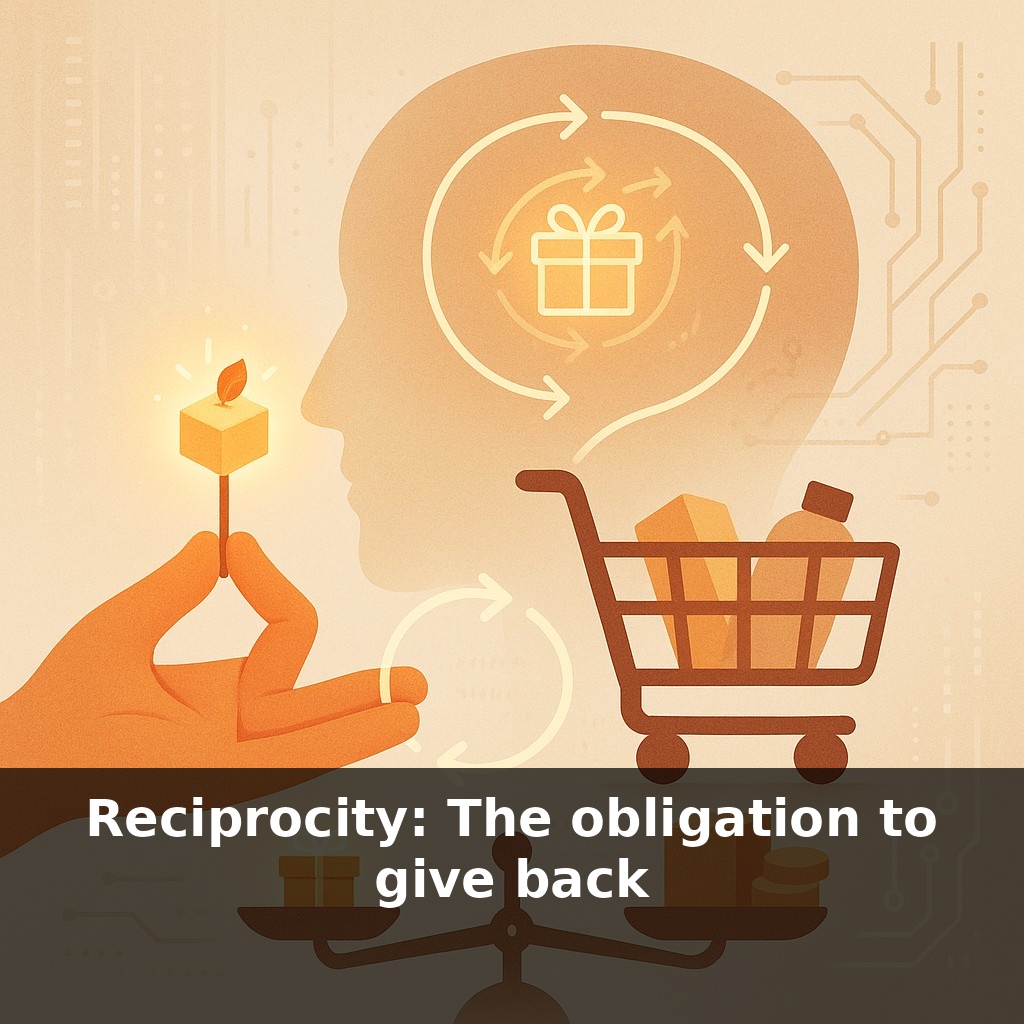
A tiny free sample at the grocery store can quietly triple a product’s sales for that day. You take one bite, feel oddly grateful… and suddenly it’s in your cart. Today we dive into that strange, invisible rule in your brain that makes “getting something” feel like “owing something.”
Marketers, negotiators, even your most persuasive friend all quietly exploit the same reflex: whoever “goes first” often wins. Not by force, but by making you feel that subtle pull to match their move. A salesperson throws in “free shipping,” a colleague shares insider data before a meeting, a creator gives away a genuinely useful template—suddenly, your resistance softens. You’re not just deciding; you’re responding.
But here’s where it gets more interesting: not all “gifts” are equal. A generic discount code feels cheap; a tailored insight that solves your exact problem can feel almost un-ignorable. Like a musician hitting a chord that perfectly resolves the tension in a melody, the right first move makes your “yes” feel natural, even satisfying. In this episode, we’ll unpack how to design those first moves intentionally—ethically—so you invite cooperation without crossing into manipulation.
So where do we actually *see* this rule shaping behavior in the wild? Look past sales floors and boardrooms, and it’s everywhere: open-source developers trading bug fixes, newsletter writers sharing “insider” breakdowns before pitching products, even co-workers who bring coffee to the team right before proposing a risky idea. Each move plants a quiet social bookmark in people’s minds: *you did something for me; we’re now in a kind of informal tab*. Like a playlist that feels unfinished until the final track plays, these unfinished “tabs” nudge us toward following through, often without realizing how the set-up was staged.
Here’s where it gets practical: not all “going first” is created equal. The same rule that boosts free-sample sales can completely flop if the timing, fit, or framing is off. Researchers consistently find three levers that matter: *who* it comes from, *how* it’s framed, and *what* it costs the giver.
First, *who*. A favor from someone we see as competent or selective lands differently than a mass blast. In email tests, “I made this checklist specifically for SaaS founders under $1M ARR—thought of you” outperforms a generic “here’s a helpful guide.” Specificity signals you weren’t just spraying favors everywhere. That perceived effort cranks up the urge to respond.
Second, *how* it’s framed. Gifts that feel like clean, no-strings help trigger gratitude; gifts that feel like bait trigger suspicion. That’s why charities don’t write, “We sent you stickers, so you owe us.” They simply include them, then make a separate, clear ask. The *separation* between favor and request makes the return feel voluntary rather than extorted.
Third, *what* it costs you. Interestingly, it’s less about the dollar value and more about *visible sacrifice*. A short personalized Loom video, a quick teardown of someone’s landing page, an introduction to a relevant contact—these look expensive in time and social capital, even if they were easy for you. People reflexively match not just the gift’s size, but its *felt cost*.
Digital spaces amplify this. A sincere quote-retweet with commentary, a thoughtful code review on GitHub, a detailed answer in a niche forum—each one plants a seed. Often the return doesn’t come from the same person. A founder answers questions generously in public, then months later finds investors, hires, and customers arriving already primed to say yes because “you’ve given so much.”
Think of it like traveling with a well-stamped passport: previous generous “entries” into other people’s worlds smooth your passage through future checkpoints. You’re not keeping an exact ledger—but the accumulated sense of having shown up for others quietly tilts gates open when it’s your turn to ask.
A startup founder quietly audits three prospects’ onboarding flows and sends each a short video walking through one concrete fix. No pitch, just, “Thought this might help.” One replies the same day: “This is gold. Can we hop on a call?” Another forwards it to their CTO. The “ask” emerges downstream, from *them*.
A researcher live-tweets sharp, free breakdowns of recent studies. Months later, when she launches a niche newsletter, signups spike from people who’ve never met her but feel they’ve “been learning from her for ages.”
A manager brings a junior engineer into a high-visibility meeting and lets them present a key slide. When budget season hits, that engineer becomes her loudest internal advocate.
In music terms, it’s like slipping a subtle motif into an early track on an album—by the finale, listeners *want* to hear it return. The early, unforced contribution turns later alignment into something that feels less like persuasion and more like a satisfying resolution.
Courts and regulators are starting to notice when “gifts” feel more like traps—think influencer “PR packages” that quietly expect posts, or apps that offer streak bonuses nudging endless engagement. As AI begins timing micro-favors to our moods—like a playlist that appears on a rough Monday—society may treat some offers like prescribed medicine: still helpful, but monitored, labeled, and sometimes refused to protect long‑term autonomy.
Your challenge this week: run a “giving-first sprint.” In one context that matters to you—work, side project, or community—offer three specific, unasked-for helps: a fix, an intro, or a resource tailored to one person each time. Then, rather than asking for anything, just watch. Which “seeds” sprout into unexpected replies, invites, or support later?