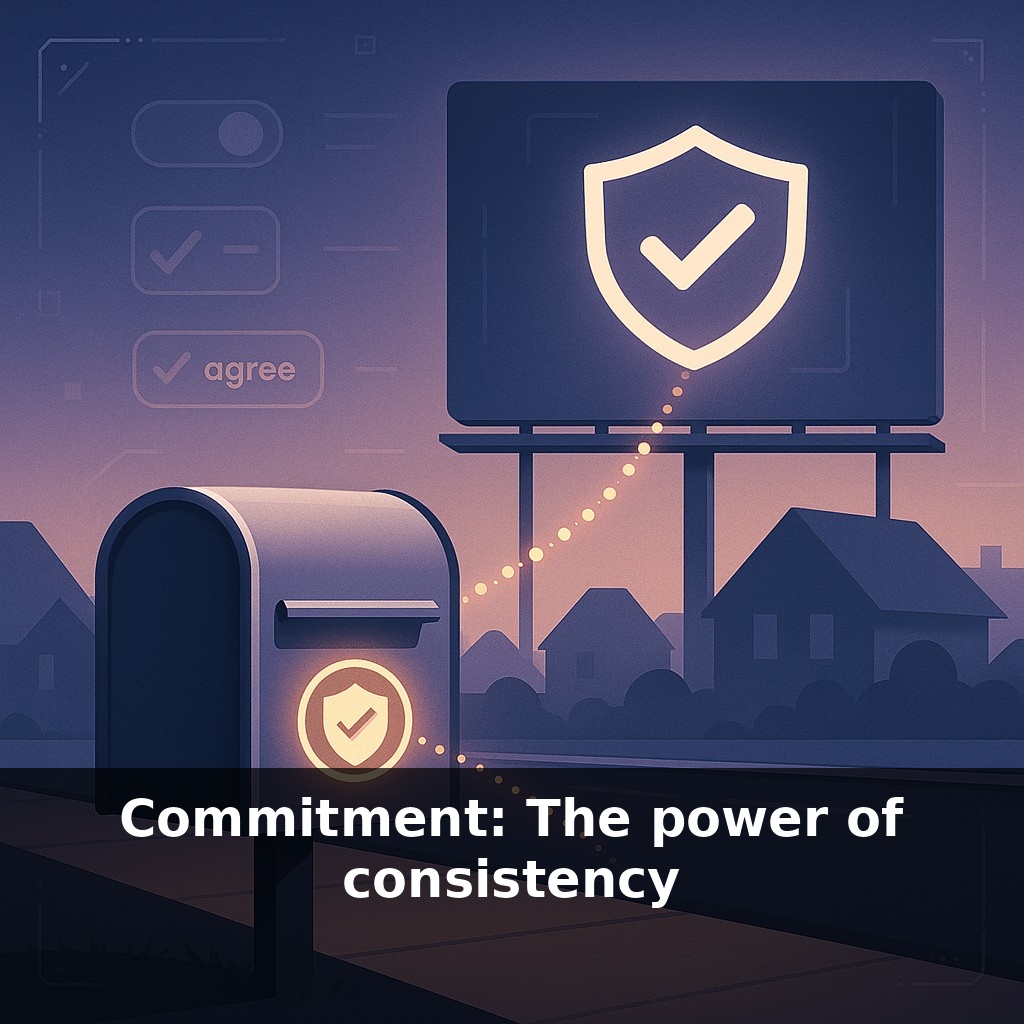
A small sticker on a mailbox once turned ordinary homeowners into people who agreed to a giant, ugly road-safety billboard on their lawn. Same street, same message—totally different behavior. The only thing that changed was a tiny promise they’d already said “yes” to.
Marketers, app designers, and political campaigns quietly bet on one thing: you’ll keep being “the kind of person who…” once you’ve said it out loud or clicked “I agree.” You see it when a fitness app nudges you to “just commit to two workouts this week,” then decorates your profile with a badge. Or when a newsletter signup form adds a tiny checkbox: “I want to become more intentional with my time.” That line isn’t there for poetry; it’s there to shape who you’ll feel you are next time you think about unsubscribing.
The most effective commitments aren’t huge vows. They’re small, specific, and linked to identity: “I’m learning Spanish,” “I support local businesses,” “I care about privacy.” Once claimed, they quietly steer future choices—especially when someone else can see whether you follow through.
Tech products quietly collect these tiny “I’m the kind of person who…” statements and pin them to you like labels. A budgeting app might start by asking you to “name one thing you’re saving for this month.” A climate campaign asks you to tap “I care about cleaner air” before showing you policy options. A creator platform nudges you to pick “I’m here to level up my craft” on signup. None of these asks change your life on day one—but they do something more strategic: they establish a written record of who you say you are, then surface that record right before key decisions.
Open a new app and notice how quickly it asks you to “choose your preferences,” “set a goal,” or “join a challenge.” That’s not just onboarding; it’s data collection for your future self. Once you click “daily learner” or “here to grow my career,” the product has something powerful: a written, time-stamped version of you it can quote back later.
The crucial twist: the most effective commitments in tech rarely *feel* like commitments. They’re disguised as harmless clicks, slider choices, or taps that happen when your guard is down.
Three patterns show up again and again:
First, **micro-asks before money**. A subscription app might start with: “How many books do you want to read this month?” You slide to “3.” Days later, when your free trial ends, the paywall headline isn’t “Give us $9.99”—it’s “Stay on track for 3 books this month.” Your earlier choice becomes the argument.
Second, **“participation” that becomes permission**. A social platform invites you to “support creators” by liking three posts in a category. Later, when it auto-follows similar accounts or pushes more aggressive prompts (“Boost this post to reach more fans”), it can say, implicitly, “You’re someone who supports creators; this is what that looks like.”
Third, **public trackers that escalate**. Duolingo’s streak counter, gym leaderboards, GitHub contribution graphs, Strava segments—these all start as neutral logs. Over time, they become public scoreboards. Features like streak freezes, “don’t break the chain” reminders, and end-of-year summaries turn yesterday’s activity into today’s expectation.
Music platforms show this clearly. You might casually click “Follow” on an artist. Later, the app builds “Your Weekly Mix,” auto-downloads albums, and emails you when tickets drop—each framed as “because you’re a fan.” One soft click seeds a whole ecosystem of “of course you’ll want this.”
Your intentions haven’t necessarily deepened; the system has just become better at staging decisions right next to past clicks that make saying “no” feel off-key.
This is where things tilt from helpful to risky: when interfaces front-load easy taps and bury the long-term implications in settings, terms, or defaults you’ll never read.
A creator platform might first invite you to “pledge support” for an up‑and‑coming artist for just one month. Later, when it switches your pledge to auto‑renew, the prompt isn’t “Do you still want this charge?” but “Keep backing the artists you believe in?” Declining now feels less like clicking a button and more like backing away from a stance you took.
Campaign tools do something similar. A local initiative asks you to tap “Count me in for cleaner streets” and add your name to a volunteer list. A week later, you get a text: “We’re counting on people like you to cover a two‑hour shift this Saturday—can we mark you down?” Your earlier tap becomes a lever on your schedule.
In productivity software, a team dashboard might ask members to commit to a single quarterly goal with their face next to it. Weeks later, any attempt to pivot is framed against that original line in the sand—screens show progress bars, overdue flags, and quotes of your own wording at the exact moment you’re considering a different priority.
Apps will soon stack multiple small promises together, then treat the bundle like a “shadow contract” with your future self. An AI coach might quietly align your fitness, sleep, and food pledges, then time notifications for moments when saying no would fracture that tidy picture. Platforms could even A/B‑test which wording makes you feel most “off‑brand” if you opt out—like a playlist that keeps queuing songs you’d feel guilty skipping, because it knows what you *said* you’re into.
Noticing this pattern is the first real safeguard. When a product asks you to “lock in” something about yourself, pause like you would before signing a long phone contract and ask: “What future decisions is this quietly preloading for me?” That small question keeps your options open—and reminds you that consistency should serve you, not the other way around.
Before next week, ask yourself: 1) “If I fully committed to the ‘never miss twice’ rule from the episode, what’s the one daily habit I’d protect no matter how busy or tired I am—and what exact backup version of it will I do on my worst days (e.g., 5 pushups instead of a full workout, 5 minutes of focused reading instead of a whole chapter)?” 2) “Looking at my week ahead, where am I most likely to break my consistency (late nights, social plans, work crunch), and what specific ‘if-then’ plan can I set now so I stay aligned with my commitment when that moment hits?” 3) “If someone filmed my evenings this week, would my actions clearly show the long-term commitment I say I care about (health, learning, creative work), and what’s one concrete tweak I’ll make tonight—like changing my 9–10 pm slot—to make that alignment obvious?”