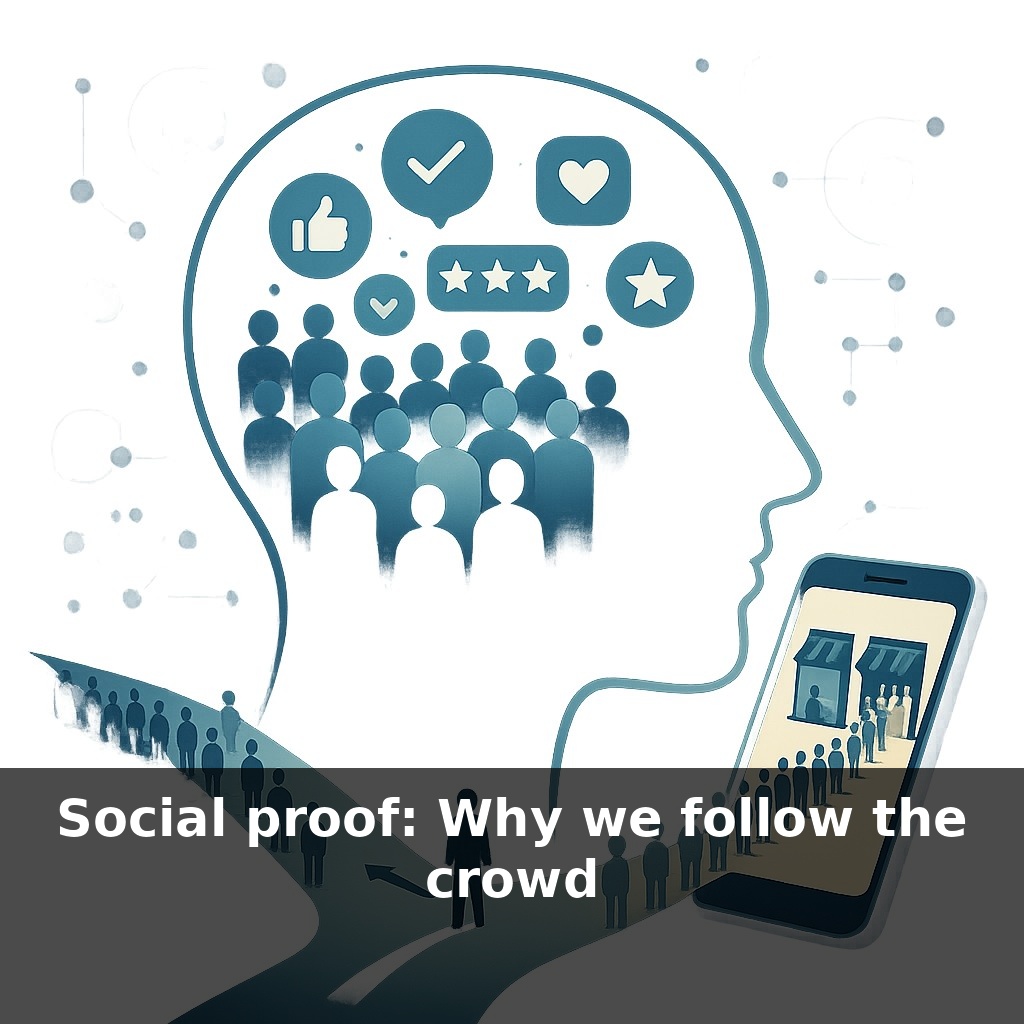
Right now, as you’re listening, there’s a crowd in your head quietly voting on what you’ll do next. Buy or skip. Speak up or stay silent. One strong review, one busy restaurant, one trending post—suddenly your “choice” might not be nearly as personal as it feels.
That quiet inner crowd doesn’t just nudge you on big, obvious decisions; it sneaks into tiny moments you rarely notice. You scroll past a restaurant with three people inside and another with a line out the door. Same menu, same prices, but your feet drift toward the line. You’re not doing a full cost–benefit analysis—you’re scanning for subtle “everyone else thinks this is good” signals and moving on.
Online, it’s even more extreme. Star ratings, “most popular” tags, “500 people bought this today”—these aren’t just decorations; they’re engineered shortcuts for your attention and trust. And here’s the twist: sometimes the crowd is genuinely wise, surfacing hidden gems or warning you away from bad options. Other times, it’s like a catchy song stuck in your head—repeated so often it starts to sound true, even when it’s off-key.
Marketers and tech platforms know this and quietly tune the “background noise” around your decisions. A product page doesn’t just show what’s for sale; it stages a scene: “132 people are viewing this,” “last room at this price,” “bestseller in your area.” Reviews get highlighted, reordered, or buried. Badges like “#1 choice” or “trending now” create a sense that you’re arriving late to something everyone else already discovered. Even silence is engineered—when comments are off, likes are hidden, or view counts vanish, your usual social cues disappear and you’re flying with fewer instruments.
Behind all those ratings, badges, and “bestseller” tags sit two powerful forces: our need to be right and our need to belong. Psychologists call them informational and normative influence. One pulls you toward what seems objectively correct (“They probably know something I don’t”), the other toward what’s socially safe (“I don’t want to be the odd one out”). In real life—and especially online—they blur together so tightly you rarely feel the difference.
In ambiguous situations, informational influence quietly takes the wheel. You’re in a new city, hungry, no idea what’s good. You’re not just lazy; your brain is optimizing. It treats other people’s behavior as extra data points, an informal “meta-analysis” run in real time. That’s why just a handful of reviews can shift purchase rates dramatically: you’re outsourcing your early testing to the crowd.
Normative influence shows up when the “right” answer is already obvious, but the social cost of violating the group is high. In Asch-style setups, people sometimes give wrong answers they clearly see are wrong, simply to avoid friction. Online, this translates into going along with a dominant narrative in a comment section, or hesitating to leave an unpopular but honest rating when you see a wall of five stars.
Neuroscience adds another twist. In Berns’ study, when people’s opinions clashed with the group, it wasn’t just self-control regions lighting up; perception-related areas shifted too. Under strong social pressure, your brain doesn’t just mute your disagreement—it can literally change what you think you’re seeing.
Designers and growth teams lean heavily on this. “9 out of 10 people chose Plan B,” “Most people in your area booked this option,” “Top rated by people like you”—each tiny phrase is calibrated to tug both levers at once: “This is what’s correct” and “this is what people like you do.” That “like you” piece is crucial. Social proof from a distant, vague crowd is weaker than proof from your tribe: coworkers, fellow parents, gamers, founders, people in your city.
And context matters. The same number—“31% of users do X”—can either reassure you (“I’m not alone”) or make something feel fringe (“most people don’t do this”) depending on how it’s framed. That’s where social proof quietly flips from helpful shortcut to subtle form of pressure, or even a brake on the very behavior it was meant to encourage.
Think of a small coffee shop trying to survive next to a well-known chain. On day one, the room is half-empty, nobody’s laptop is open, the tip jar is bare. People peek in, sense “no one’s chosen this yet,” and keep walking. A month later, a local blogger posts a rave; a handful of regulars start camping there; the owner puts up a chalkboard: “Loved by 327 neighbors this year.” Same beans, same barista—but foot traffic changes because the “story” around the place is different.
Platforms quietly script these stories at scale. Spotify’s “Popular” tracks nudge you toward songs others already stream. Kickstarter shows how many backers crossed the line before you. Even workplace tools do it: “Most teams in your org use this workflow” can steer internal decisions as strongly as any memo. And when numbers are hidden—no like counts, no view stats—you’re forced to navigate on taste, not tally marks. That’s when you really notice how often you lean on everyone else’s footsteps.
Five strangers you’ll never meet might soon decide which doctor you see, which fund you invest in, even which city policy passes—just through scores and stars. As AI starts ghostwriting opinions at scale, we may lean harder on “verified humans,” reputation graphs, and smaller circles of trust. Your future feed could look less like a billboard and more like a group chat: fewer loud averages, more quiet indicators from people whose judgment has actually cost them something.
The next step isn’t to mute the crowd; it’s to learn its rhythm. Notice who’s clapping first, who’s just following the beat, and when you’re joining in out of habit. Your challenge this week: catch one moment a day when numbers or badges sway you, then pause and ask, “If those vanished, what would *I* actually pick here?”