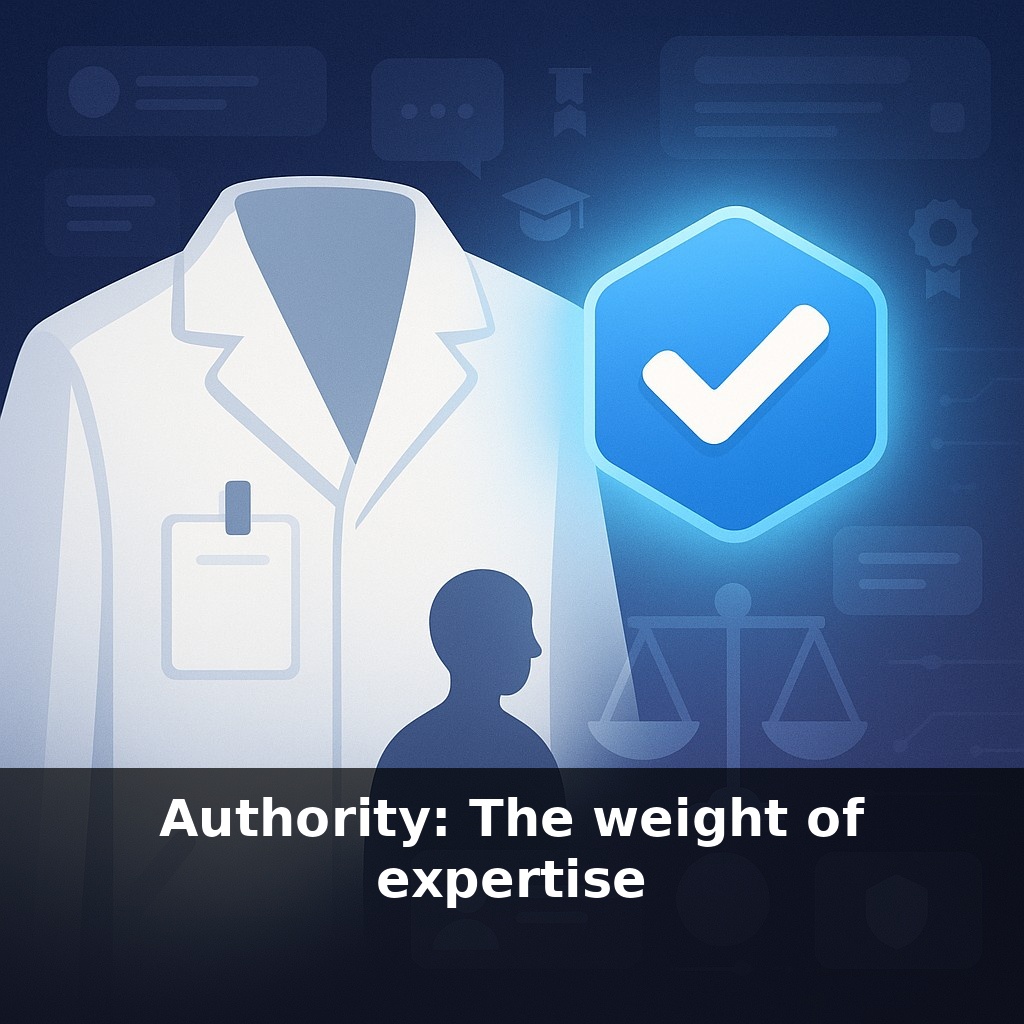
A stranger in a white coat tells you to do something painful and clearly wrong… and most people obey. In a classic study, nearly two-thirds kept going, just because the person looked like an expert. Why does a title, a lab coat, or a job badge feel heavier than our own judgment?
A blue checkmark, a PhD after a name, a “featured in Forbes” badge on a landing page—these tiny symbols quietly tilt the entire decision in front of you. They don’t just say “trust me”; they compress a mountain of uncertainty into a single, fast shortcut: this person probably knows what they’re talking about, and probably isn’t trying to harm me. In digital products, that shortcut gets engineered on purpose. App stores highlight “editor’s choice,” fintech tools spotlight “CFA, CPA,” health apps showcase “backed by Stanford researchers.” Sometimes those signals are rigorously earned; sometimes they’re cosmetic stage props. The persuasive power is the same. In this episode, we’ll unpack how modern tech products manufacture, borrow, or fake authority—and how you can design these cues ethically, while staying sharp enough not to be fooled by them.
Online, authority doesn’t just show up; it’s staged, edited, and A/B tested. Platforms decide whose voice floats to the top of your feed, which reviews look “most helpful,” and which “expert picks” sit one tap away from “Buy now.” Behind the scenes, teams experiment with badges, labels, and endorsements the way sound engineers tweak levels on a mixing board—raising some voices, fading others. This isn’t only about selling more; it shapes whose knowledge is treated as real, whose is sidelined, and how confidently we override our own uncertainty in favor of a sanctioned viewpoint.
Open tabs for a new therapist, a crypto app, and a fitness coach, and you’ll see the same pattern: logos of famous institutions, “as seen in” strips, follower counts, “board-certified,” “top-rated,” “Stanford-trained.” Modern interfaces stack these like bricks into a facade of competence. But there’s a deeper structure underneath that facade: who granted this status, how closely it maps to the actual claim, and whether anyone is double-checking the match.
In research, “expert” isn’t a vibe; it’s usually tied to domain-specific, tested knowledge plus some record of being right over time. Courts bring in medical experts for toxicology, not for economics. When interfaces flatten all credentials into generic badges, domain boundaries blur: a cardiologist’s opinion on nutrition, a software engineer’s take on vaccines, a “Wall Street veteran” commenting on climate science. The authority looks solid, but it’s misaligned with the question at hand.
This is where tech products quietly make high-stakes design choices. A health app can require that its medical library is written or reviewed by people with relevant board certifications; a trading platform can flag when a “guru” has no audited performance data. Even small microcopy shifts matter: “Doctor recommended” can mean “a clinician advisory board wrote these guidelines,” or simply “one GP we hired said this seems fine.”
The strongest implementations don’t just display status—they show the evidence trail. Think: “Reviewed by Dr. Maya Chen, MD (Endocrinology), last updated March 2025, based on guidelines from X and Y,” plus links. That extra specificity tells you both the scope and the limits of someone’s expertise. It also makes faking harder: inventing a vague title is easy; faking a checkable affiliation and recent work is not.
For designers and product teams, the uncomfortable tension is: the more you lean on sleek badges, the more conversions go up—and the more you’re tempted to stretch what those badges really guarantee. Authority becomes a kind of UX performance. The ethical line is crossed the moment the performance hides uncertainty rather than contextualizing it.
A music app quietly rearranges your homepage: at the top, a “Critics’ Picks” playlist; below it, songs “Loved by audio engineers”; further down, “Trending near you.” All three sections guide you, but each borrows a different kind of authority—professional judgment, technical craft, and local crowd wisdom. None explain why those tracks deserve the spotlight; they just inherit weight from whoever’s named. Now swap music for nutrition, investing, or mental health and the stakes change fast. A calorie tracker might highlight “Dietitian-curated meal plans” while burying user-created ones three swipes down, or a brokerage app might spotlight “Institutional-grade strategies” and tuck experimental meme stocks behind extra taps. In both cases, the interface choreographs which sources you touch first, not by censoring others, but by arranging the stage so certain voices always feel like the headliners, and others are forever stuck as opening acts waiting in the wings.
When every profile can flaunt badges, expertise starts to feel like background noise. The next layer isn’t louder signals, but traceable ones: audit trails for claims, like liner notes on an album that credit who actually played what. Products could expose “source trees” for advice—showing which study, dataset, or track record it grew from. That shift nudges us from asking “Who looks legit?” toward “Which path of evidence am I willing to stand on?”
Treat every impressive title or glossy badge like a movie trailer: intriguing, but not the whole story. Before you “buy a ticket,” peek behind the scenes—who funded this, who benefits, who can be held accountable if it’s wrong? As tools lean harder on expert branding, our job is to match that polish with sharper questions, not just quicker acceptance.
Before next week, ask yourself: 1) “Where in my life am I deferring to ‘experts’ (doctors, financial advisors, managers, influencers) without asking how they know what they know—and what specific questions could I ask them next time to test whether their expertise really fits my situation?” 2) “Think of one strong opinion I hold because ‘someone credible said it’—if I had to argue the opposite side for five minutes, what evidence would I need, and do I actually know whether that evidence exists?” 3) “In the next conversation where someone confidently states a ‘fact,’ how can I gently ask for their source or reasoning (for example, ‘What led you to that conclusion?’ or ‘How do you know that?’) and notice whether their answer increases or decreases my trust?”