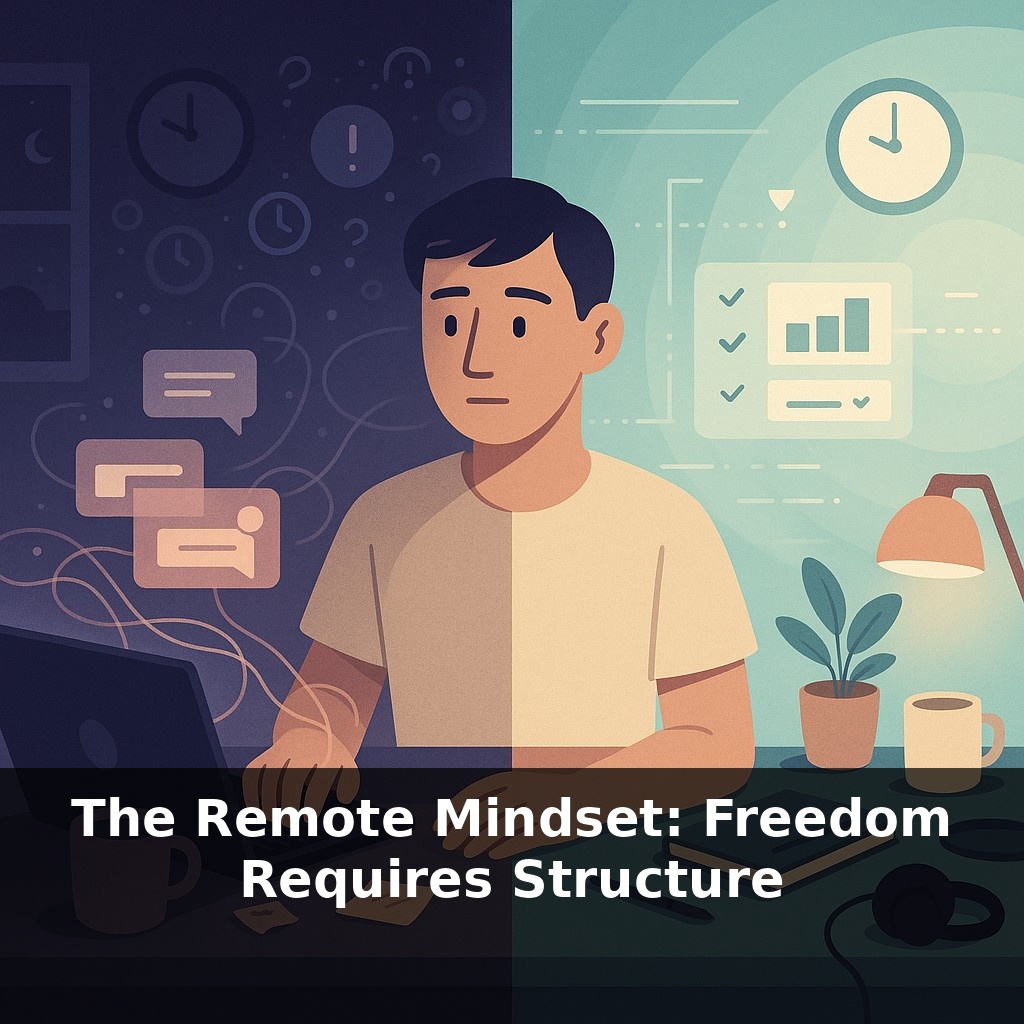
The Remote Mindset: Freedom Requires Structure
📝 Transcript
You get more freedom working remotely—but most people use that freedom to work more, not less. One minute you’re checking a quick message; an hour later, it’s midnight and your brain’s still in the office. So why does “no schedule” so often feel like “no off switch”?
Stanford data says remote and hybrid workers are about 9% more productive on average—but only when their freedom is paired with clear rules of the game: expectations, metrics, and meeting norms. Without those guardrails, the same freedom that can energize you starts to blur your days, stretch your hours, and quietly drain your focus. This is why teams like GitLab don’t just “allow” flexibility; they surround it with detailed handbooks, communication cadences, and documented workflows so people aren’t guessing how to succeed from their couches.
The real shift is mental: instead of letting your calendar be something that happens to you, you treat structure as a tool you design. Think of it like assembling a custom toolkit: daily rituals that anchor you, boundaries that protect your attention, and feedback loops that show you whether what you’re doing is actually working.
The tricky part is that nobody hands you this toolkit when you go remote—you inherit your company’s meetings and metrics, but not a personal operating system. That’s why two people in the same role, same team, same tools can have wildly different outcomes: one feels calmly in control, the other constantly behind. Studies on self-regulation show it’s less about “willpower” and more about pre-deciding: when you start, when you stop, how you recover, and how you’ll know you’re on track—before the chaos of the day starts negotiating with you.
Most people try to “fix” remote chaos at the wrong layer. They start with tools—new apps, prettier to‑do lists, a different calendar layout—when the research keeps pointing back to mindset: how you think about your time, attention, and availability before you touch any tool.
Psychologists call this self-regulation, but in practice it’s three simple questions you answer for yourself every day:
1) What *mode* am I in? 2) What *matters most* in this mode? 3) What will *end* this mode?
Modes matter because your brain is terrible at being “always on.” GitLab’s handbook, for instance, bakes this into process: there are explicit modes for deep work, async collaboration, and synchronous discussion, each with different expectations. When you work remotely, you need your own version of that clarity, or your day dissolves into reacting.
Try thinking in three core modes: - Focus mode: hard, cognitively heavy work - Support mode: responding, helping, unblocking others - Maintenance mode: admin, docs, planning
Stanford’s findings on productivity line up with this: people get more done when it’s obvious which game they’re playing and how to keep score. If you don’t choose your mode, Slack or email will choose “support mode” for you—on repeat.
The second piece is deciding what matters inside each mode. That means naming one or two visible outcomes in advance: a drafted proposal, three customer tickets resolved, a project plan updated. Vague intentions like “work on project X” invite drift; specific outcomes create natural guardrails. This is where autonomy becomes an asset: you pick *how* to hit those outcomes, but you’ve removed the question of *what* you’re doing.
The third—and most neglected—piece is designing your stopping points. Microsoft’s data on “quiet hours” shows this clearly: people who define hard edges around when they won’t respond reclaim attention and energy. Stopping points can be time-based (“at 5:30 I shut the laptop”), event-based (“when this draft is done, I pause”), or state-based (“when I feel my concentration drop twice in 10 minutes, I switch modes”).
Treat these decisions as experiments, not life sentences. The goal isn’t to build a perfect schedule; it’s to take back authorship of your day, one clear mode and one clear stopping point at a time.
A practical way to see this mindset is to watch how different people “script” their day. One engineer I coached starts by labeling three calendar blocks simply: “Build,” “Unblock,” “Reset.” During Build, Slack is closed, phone is in another room, and her only job is moving one key project forward. In Unblock, she races through PR reviews and messages. Reset is for clearing her task list, planning tomorrow, and actually shutting down. Same job, same tools—but her script keeps her from blending everything into one blurry slog.
Teams can do this too. A product trio I worked with agreed on shared language: green time for deep work, yellow for quick async replies, red for meetings only. They don’t need elaborate policies; a simple color on their calendars tells everyone what mode they’re in. That tiny social contract makes it easier to respect quiet hours and reduces the “are you free for a quick call?” pings that fragment days. When your environment understands your modes, it reinforces your choices instead of constantly testing them.
Treat this mindset as career infrastructure. As work unbundles from offices and time zones, employers will scout for people who can *self-govern*—those who can set expectations, negotiate availability, and surface progress without hand-holding. That skill compounds: it makes you easier to trust, easier to promote, and easier to plug into global projects. Your week isn’t just tasks; it’s a living prototype of how you’ll handle bigger scope, looser oversight, and messier problems.
Your challenge this week: run a “structure sprint.” For five workdays, pick one stability move in each layer—time, space, and signals:
- Time: lock one 90-minute focus block at the same hour daily - Space: designate a single spot as “work-only,” even if it’s one chair - Signals: choose one shutdown ritual that clearly ends the day
At week’s end, review: which layer gave you the biggest lift—and where did your freedom actually increase when you tightened the rules slightly?
Treat this like tuning an instrument: tiny adjustments change the whole sound of your week. As you refine your own cadence, notice where you still drift—those are clues, not failures. Over time, your “default day” becomes less like juggling and more like a well-practiced recipe you can tweak, scale, or share when new roles, teams, or time zones enter the mix.
Here’s your challenge this week: For the next 5 workdays, run a “freedom-with-structure sprint” where you plan your day in 3 specific blocks: 90 minutes of deep work on your single most important task, a 60-minute “admin + communication” block (Slack/email/Meetings), and a 30-minute reflection block at the end of the day. Before you start each day, timebox these three blocks on your calendar and protect them by turning off notifications during the deep work block. At the end of each day, quickly rate yourself from 1–5 on how well you followed your structure, and adjust the timing (not the number) of your three blocks for the next day based on what actually happened.
From this course
Remote Work Mastery: Thrive Outside the Office
7 episodesUnlock all episodes
Full access to 7 episodes and everything on OwlUp.
Subscribe — $1.99/monthLess than a coffee ☕ · Cancel anytime