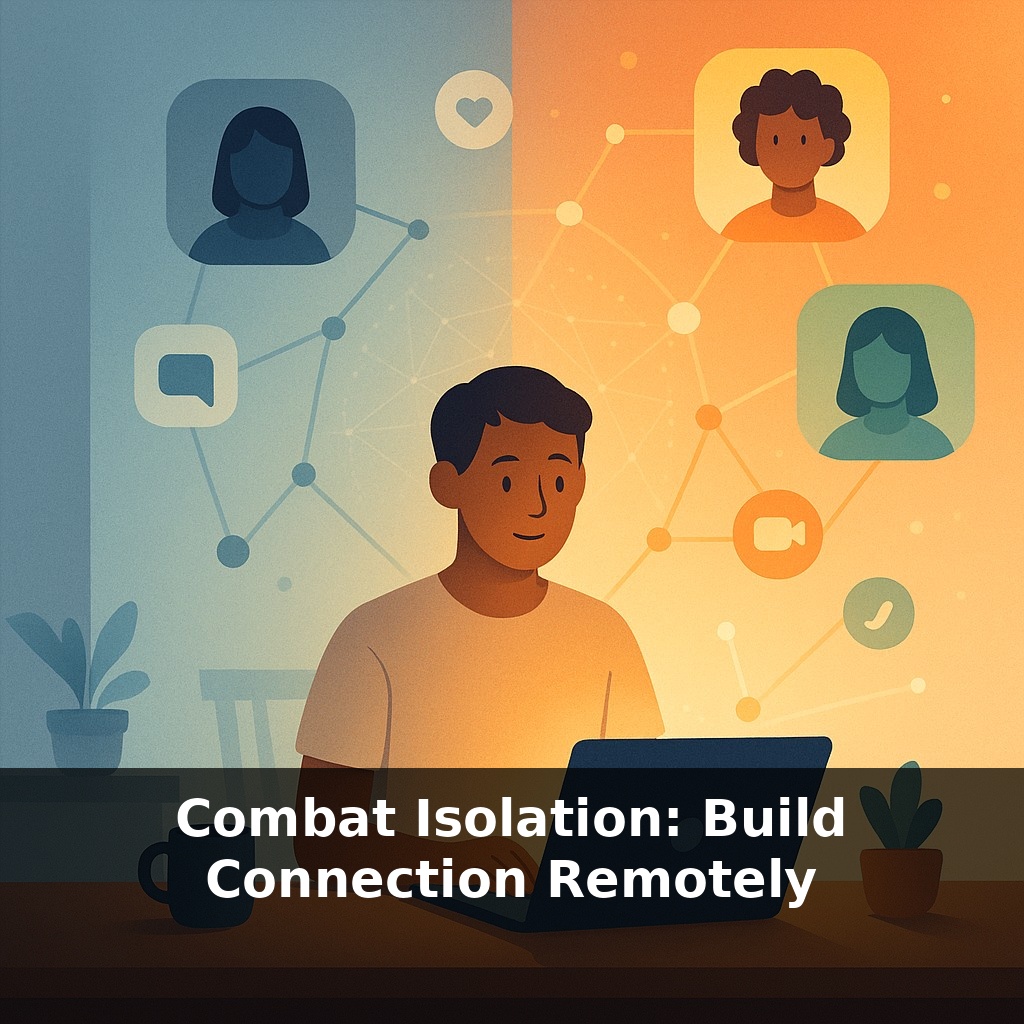
Loneliness can be as deadly as heavy smoking, yet remote workers face it alone at their kitchen tables every day. You log into another video meeting, but no one really sees you. In this episode, we’ll turn that silent drift into deliberate, real connection—without commuting a single mile.
Research on distributed teams is clear: connection isn’t a personality trait, it’s a system you can design. GitLab doesn’t wait for chance friendships in Slack; they use a bot that has already paired thousands of colleagues for short “coffee chats,” and more than 8 in 10 say they feel a stronger sense of belonging as a result. That’s not an accident—that’s infrastructure.
In this episode, we’ll treat your relationships at work the same way you treat your projects: with structure, metrics, and repeatable habits. You’ll learn how to build a tiny “connection stack” that fits into a crowded calendar: one 10‑minute ritual, one 15‑minute relationship anchor, and one monthly group touchpoint. We’ll walk through specific scripts, tools, and calendar setups so you can stop relying on random hallway moments that no longer exist—and still build a network strong enough to support your career.
Those 3 layers you’re building aren’t just “nice to have” socially—they’re performance tools. In Microsoft’s 2022 data, employees with strong coworker ties were 50% more likely to say they thrive at work, and teams with rich internal networks solved problems 2–3x faster. Yet most remote calendars are 90–95% “task” meetings and less than 5% time for relationships. To change that, you’ll need to treat connection like a recurring deliverable: clear owners, set cadences, and light structure so even a 10‑minute call or a 3‑message Slack thread reliably moves you closer to your people.
Start with the smallest unit: a single workday. If your calendar is back‑to‑back, adding “connection time” sounds impossible—until you shrink the scope and hard‑code constraints.
First, cap your total “connection stack” to 40 minutes per week: two 10‑minute 1:1 touchpoints plus one 20‑minute group moment. That’s under 1% of a 40‑hour week, yet over 2,000 minutes a year of deliberate relationship‑building.
Design your 10‑minute ritual like a micro‑meeting with guardrails: - Fixed start and end times (e.g., 9:40–9:50 a.m.). - One purpose per slot (check‑in, feedback, or quick help—not all three). - A simple template: 2 minutes warm‑up, 6 minutes on one specific topic, 2 minutes close with a clear “next tiny step.”
Concrete example: every Tuesday and Thursday, you book 9:40–9:50 with different peers. You rotate through a list of 8–10 people over 5 weeks, then repeat. In a quarter, that’s ~24 short conversations without a single “Can we find time?” thread.
Next, operationalize your 15‑minute anchor so it survives busy weeks. Choose one colleague whose success is tightly coupled with yours—a manager, key partner, or direct report. Lock a recurring 15‑minute slot at the same time and day for at least 8 weeks. To keep it from drifting into status updates, use a standing agenda with fixed proportions: - 5 minutes: personal/professional highs and lows since last time. - 5 minutes: one challenge each, framed as “Where I’m stuck.” - 5 minutes: mutual commitments for the next week (“I’ll introduce you to X by Thursday”).
This cadence lets you surface issues early, trade context, and build trust in small, regular doses.
For the group touchpoint, resist the temptation to invite everyone. Ideal size is 4–7 people; beyond that, airtime per person drops under 3 minutes in a 20‑minute slot. Pick a clear theme: “New joiners in the last 90 days,” “People who work on customer‑facing bugs,” or “Parents in time zones between UTC‑5 and UTC+3.” Rotate themes monthly so different micro‑communities form naturally.
Think of these elements like a medication schedule: small, precisely timed doses are more effective—and more sustainable—than occasional overdoses of all‑hands socials. Your goal isn’t more calls; it’s predictable, repeatable contact that compounds over quarters.
GitLab’s coffee chats show what happens when you scale this on purpose. You don’t need a fancy bot to copy the logic. Take a 10‑person department: if each person books just two 10‑minute micro‑conversations per week with someone outside their immediate project, that’s 20 cross‑team links every week—over 1,000 in a year. The math matters because belonging grows non‑linearly: one extra connection barely moves you, but 5–7 dependable contacts create a safety net you actually feel.
To track that, count people, not meetings. Aim for 8–12 colleagues you’ve spoken with in the last 60 days for more than “status.” If your number is under 5, your work is structurally fragile; a reorg or manager change can erase half your support overnight.
Your challenge this week: identify 3 names you’d want on your “emergency list” for tough days. Invite each to a specific, time‑boxed chat within the next 10 days. Next week, add 2 more. Repeat until you hit 10.
Digital connection will soon be measured as rigorously as uptime. Expect tools that score your “relationship health” across projects and nudge you when your 60‑day contact list shrinks below, say, 8 people. Teams that treat your connection stack like capacity planning—mapping who talks across time zones, roles, and seniority—will move work faster with fewer crises. Your edge: start now. Run a quarterly 30‑minute “network review” and adjust your rituals before HR or compliance mandates it.
Treat this as career insurance: set a quarterly target of 12–15 active ties, spread across at least 3 teams and 2 seniority levels. Add one new cross‑team contact every 2 weeks, and protect 30 minutes a month to refresh dormant links. Over a year, that’s 24 new touchpoints—enough to change how quickly you get help, visibility, and opportunities.
To go deeper, here are 3 next steps: 1) Block 20 minutes today to set up a “connection dashboard” in Notion or Google Sheets, and populate it with 10 people you’d like to stay close to; use a free CRM-for-friends tool like Clay or Monica to remind you to ping them regularly, just like the guest described systematizing their check-ins. 2) Try one structured remote hangout this week using an online game or prompt deck—grab something like Skribbl.io, Gartic Phone, or the free “We’re Not Really Strangers” digital questions, and host a 30‑minute session on Zoom following the podcast’s idea of replacing small talk with intentional prompts. 3) Join one existing remote community that matches your interests—check out Virtual Coffee (for devs), Ness Labs (for mindful productivity folks), or Lakera’s AI Safety Discord—and commit to attending a single live meetup or coworking session in the next 7 days to recreate the “third place” the episode talked about.