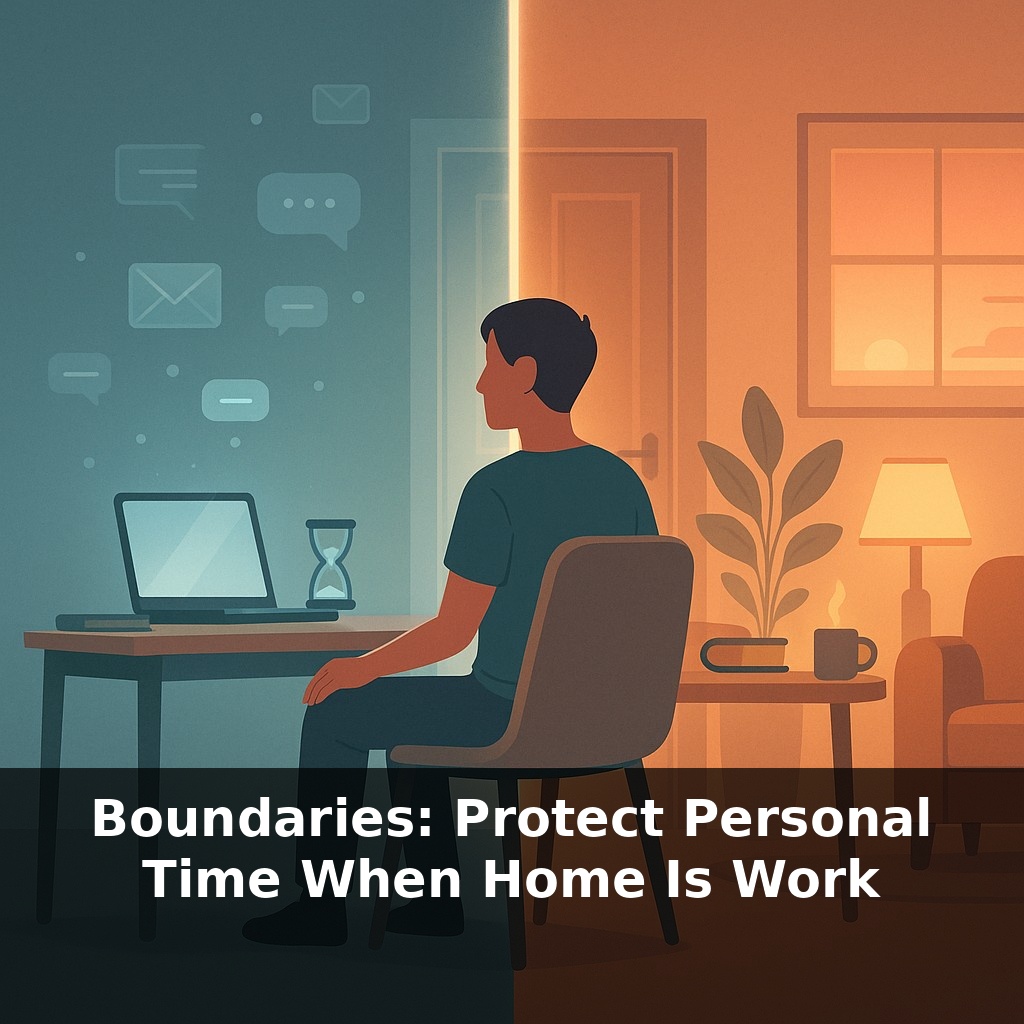
About 7 in 10 remote workers say they can’t tell where work ends and life begins. You close your last meeting, stand up from your chair… and your brain is still in “reply all” mode. If home is the office now, how do you protect time that actually feels like your own?
71% of remote workers say they struggle to separate work and personal life—yet most try to fix it only with more willpower. That’s like blaming yourself for overbaking cookies while refusing to use a timer. The problem isn’t just discipline; it’s design.
When your kitchen table is also your conference room and your phone is both family chat and urgent-Slack central, your brain gets conflicting signals all day. Neurological research shows that constant task-switching without clear breaks ramps up cortisol and quietly drains your focus. Historically, we had physical walls and factory whistles to mark “on” and “off.” Now, the office lives in your pocket—and it never sleeps unless you tell it to.
This episode explores how to build boundaries that actually stick: through tiny rituals, smart tech limits, and social agreements that protect your time even when your home is your HQ.
So instead of forcing yourself to “just log off earlier,” we’ll zoom out and redesign the conditions around you. Think of this less as self-control and more as setting up lanes on a highway: clear lines, gentle guardrails, and signs that tell you when to merge or exit. We’ll look at how your brain responds to visual cues in your space, how tiny changes in lighting, sound, and posture can flip you between roles, and how teams that openly share their “off-grid” times actually perform better. From there, we’ll turn these insights into experiments you can run in your own home this week.
23% higher job satisfaction—from something as simple as a “stop work” ritual. That’s not a motivational poster stat; it’s a signal that your brain loves clear transitions. When home and work share walls, you have to create those transitions on purpose.
Start with **boundary‑crossing activities** you can stack onto moments that already happen. Your first coffee might always belong to work mode; your last mug of tea could always mark “shutdown.” A particular playlist, a lamp you only switch on for deep work, or a short walk after you close your laptop—all of these teach your brain, “We’re in a different chapter now.”
Next, make your **space** do more of the heavy lifting. If you have a dedicated room, great—close the door and leave work objects inside. If you don’t, aim for reversible setups: a folding screen that hides your monitor, a rolling cart for work gear, even a specific chair that never gets used outside work hours. Research on separate home offices isn’t just about ergonomics; it hints at how strongly physical layout shapes stress.
On the **time** side, treat your calendar like real estate, not a public park. Block explicit “no meeting” windows to protect deep focus and genuine off‑time. Then match those blocks with visible **digital signals**: status indicators that actually mean something, delayed‑send on emails, app blockers that turn work tools into read‑only after a certain hour. You’re not just limiting access; you’re reducing the constant invitation to break your own rules.
Culture matters just as much as furniture and apps. Many people quietly fear that setting limits will be judged—but studies keep finding the opposite: teams that respect “right to disconnect” norms tend to sustain higher performance and lower burnout. The key is making your rules **predictable**: share your typical offline windows in your Slack profile, meeting notes, or email footer, and stick to them most of the time.
Over time, your goal is to build a system where you don’t have to keep deciding whether you’re “on” or “off.” The environment, the clock, and your shared norms answer for you.
A simple way to test this is to treat your day like running “shifts” in the same building. One client, a senior engineer with two kids, created a 10‑minute “shift change” between roles. At 5:20 p.m. every weekday, he shut his laptop, wrote tomorrow’s top three tasks, changed into a different hoodie, and moved his laptop into a drawer. The hoodie wasn’t about fashion; it became a cue his family recognized as “off duty.” His Slack status changed automatically at 5:25, and if he re‑opened anything after that, it had to be on his phone, standing up, for no more than five minutes. Within a month, he noticed fewer “phantom” check‑ins and felt less guilty about ignoring late pings. Another team experimented with color‑coding their days: green blocks for focus, yellow for reactive work, red for true emergencies. Leaders agreed that red should stay rare; anything else would wait. Their weekly metrics didn’t drop—but weekend messages did.
Teams that normalize “hard stops” may become magnets for talent as remote work matures. Expect tools that quietly defend your off-hours—AI that holds non-urgent messages like a gate agent rebooking you on a better flight instead of sending you into a storm. You might negotiate boundary clauses the way people now negotiate salary bands. The paradox: the more visibly you limit your availability, the more sustainable—and attractive—your contribution becomes.
Treat these experiments as drafts, not laws. You might notice that a “no laptop in bed” rule quietly improves sleep, or that silencing work apps during dinner makes conversations less rushed. Your challenge this week: redesign one small boundary each day, then note how your mood shifts—like tuning a recipe until the flavor finally fits you.